Digestion prepares molecules for absorption
By UK A Level Biology · independent study · myAudience
Original myAudience scientific illustration; not a documentary photograph or measured specimen. · Original generated project artwork; no source textbook figures reused. Sources support scientific review, not copied-art licensing.
Digestion prepares molecules for absorption
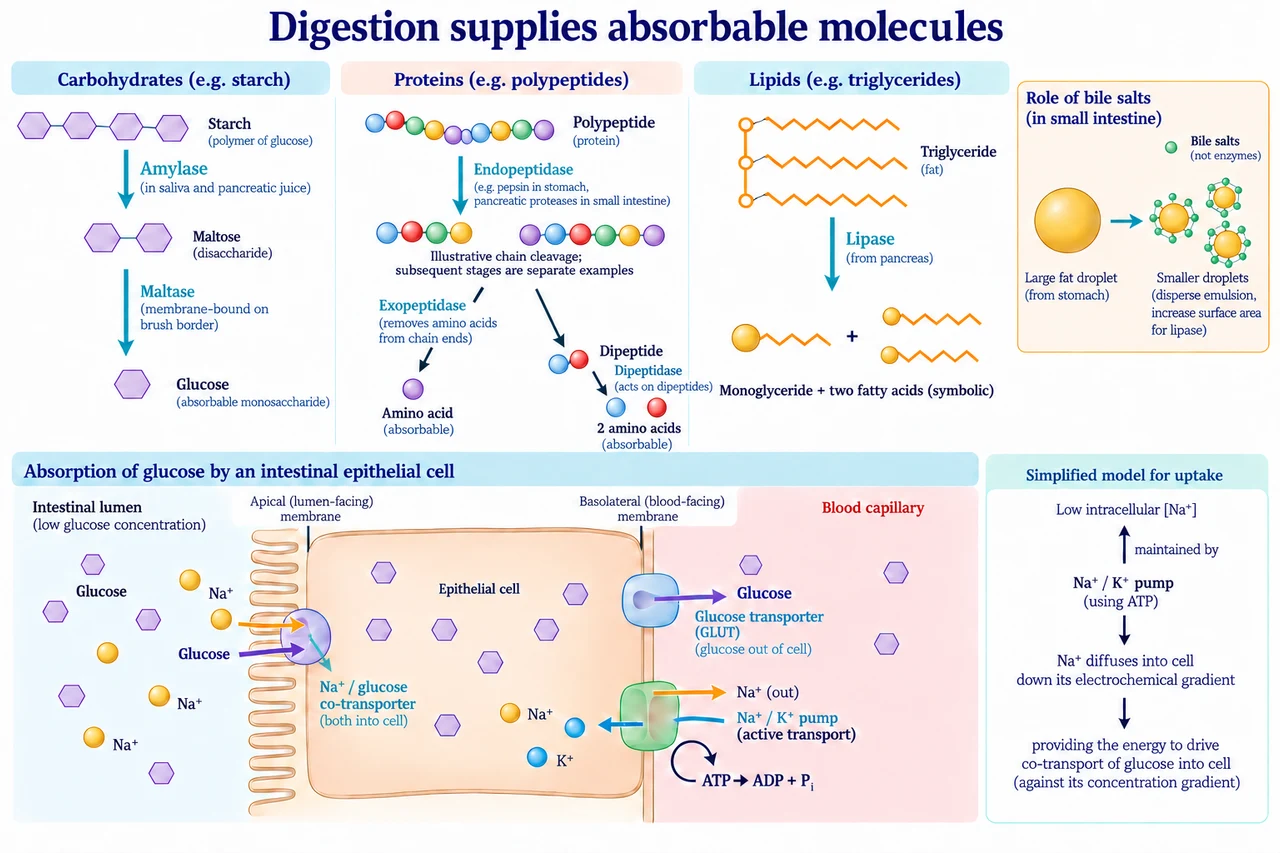
Digestive enzymes break larger molecules into smaller products. Amylase acts on starch; proteases act on peptide bonds; lipase acts on lipids. Bile salts help disperse lipid droplets and assist the handling of digestion products, but bile is not itself a digestive enzyme.
The ileum offers a large absorptive area. Sodium-linked co-transport helps move glucose or amino acids into epithelial cells, using a sodium gradient maintained by energy-dependent pumping. Distinguish the immediate co-transport mechanism from the pump supplying the gradient.
Endopeptidases split internal peptide bonds, exopeptidases act at chain ends, and membrane-bound dipeptidases split dipeptides. Bile salts help form micelles associated with lipid digestion products, bringing them near the epithelial surface; the micelle is not the same structure as a phospholipid membrane. Sodium–glucose cotransport at the lumen-facing membrane depends on a sodium gradient maintained by pumping at another boundary. Glucose then exits toward blood through an appropriate carrier, so uptake into an epithelial cell is only part of absorption.
Worked example: A sodium gradient is removed from an ileum-cell model. Predict the effect on sodium-linked glucose uptake.
Glucose uptake is coupled to sodium moving down its gradient.
Removing that driving gradient reduces the coupled transport.
Answer: Uptake by that mechanism decreases.
Check your understanding: Does bile hydrolyse triglycerides?
Answer: No; lipase does.
Why: Bile assists dispersion and handling of lipid products rather than catalysing triglyceride hydrolysis.