Blood transport links distant tissues
By UK A Level Biology · independent study · myAudience
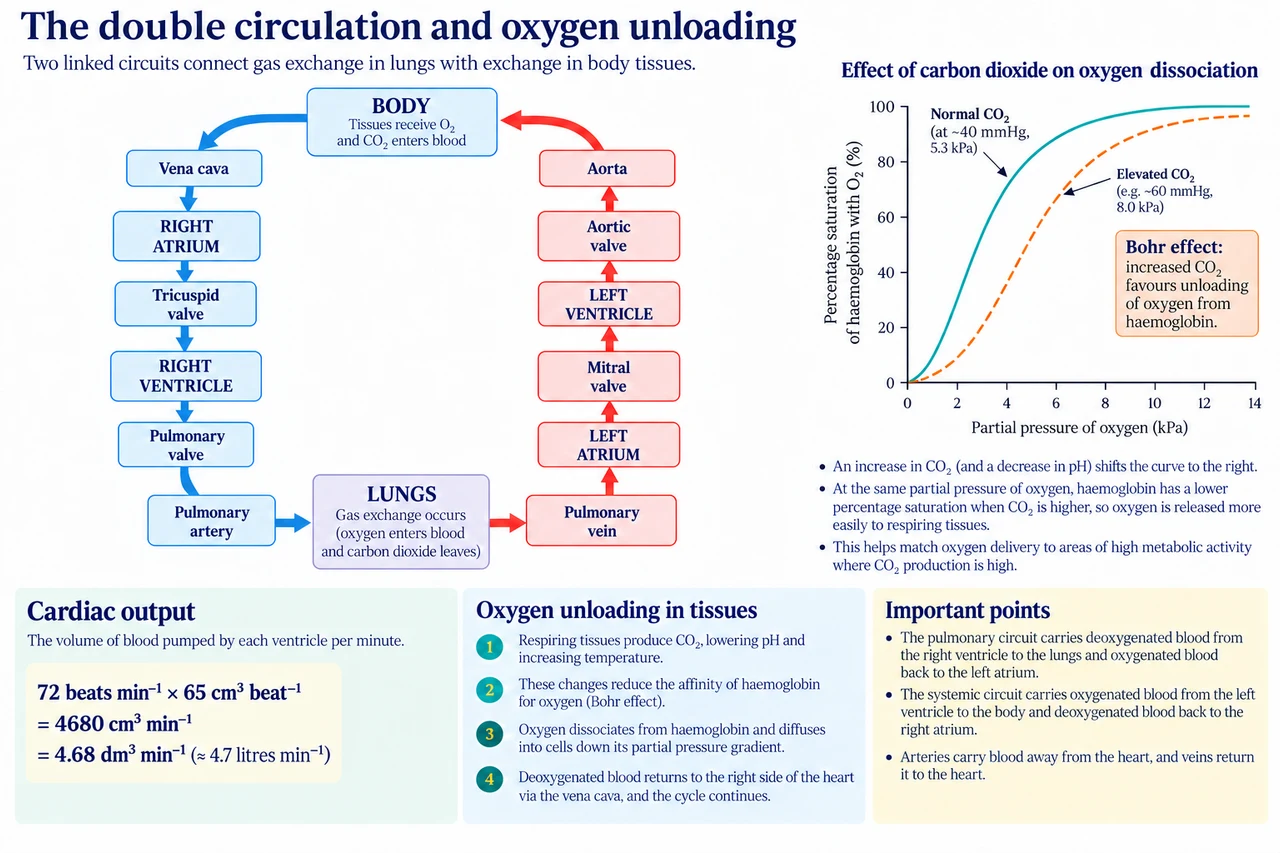
Original myAudience scientific illustration; not a documentary photograph or measured specimen. · Original generated project artwork; no source textbook figures reused. Sources support scientific review, not copied-art licensing.
Blood transport links distant tissues
Blood circulation moves substances between organs. The heart generates pressure differences, while valves support one-way movement. Arteries, veins and capillaries have structures suited to different pressures and exchange roles; artery does not always mean oxygenated.
Haemoglobin binds oxygen cooperatively. Conditions in active tissues can favour unloading, including increased carbon dioxide. At capillary beds, pressure and water-potential differences contribute to tissue-fluid movement, with lymphatic drainage returning fluid to circulation.
Increasing carbon dioxide can shift the oxyhaemoglobin curve toward easier unloading at a given oxygen partial pressure, the Bohr effect. Tissue-fluid formation depends on pressure differences and the effects of plasma proteins on water potential; blood cells and most large proteins remain in circulation. Lymph drainage returns excess fluid. Cardiac-output calculations multiply volume per beat by beats per minute, so units explain why 4,680 cm³/min equals 4.68 dm³/min rather than 4.68 cm³/min.
Worked example: Heart rate is 72 beats per minute and stroke volume is 65 cm³. Calculate cardiac output.
Output = rate × volume per beat.
72 × 65 = 4680 cm³ per minute.
Answer: 4.68 dm³ per minute.
Check your understanding: Which artery carries blood from the heart toward the lungs?
Answer: The pulmonary artery.
Why: It carries blood away from the heart even though that blood has relatively low oxygen content.