Plants move water and assimilates differently
By UK A Level Biology · independent study · myAudience
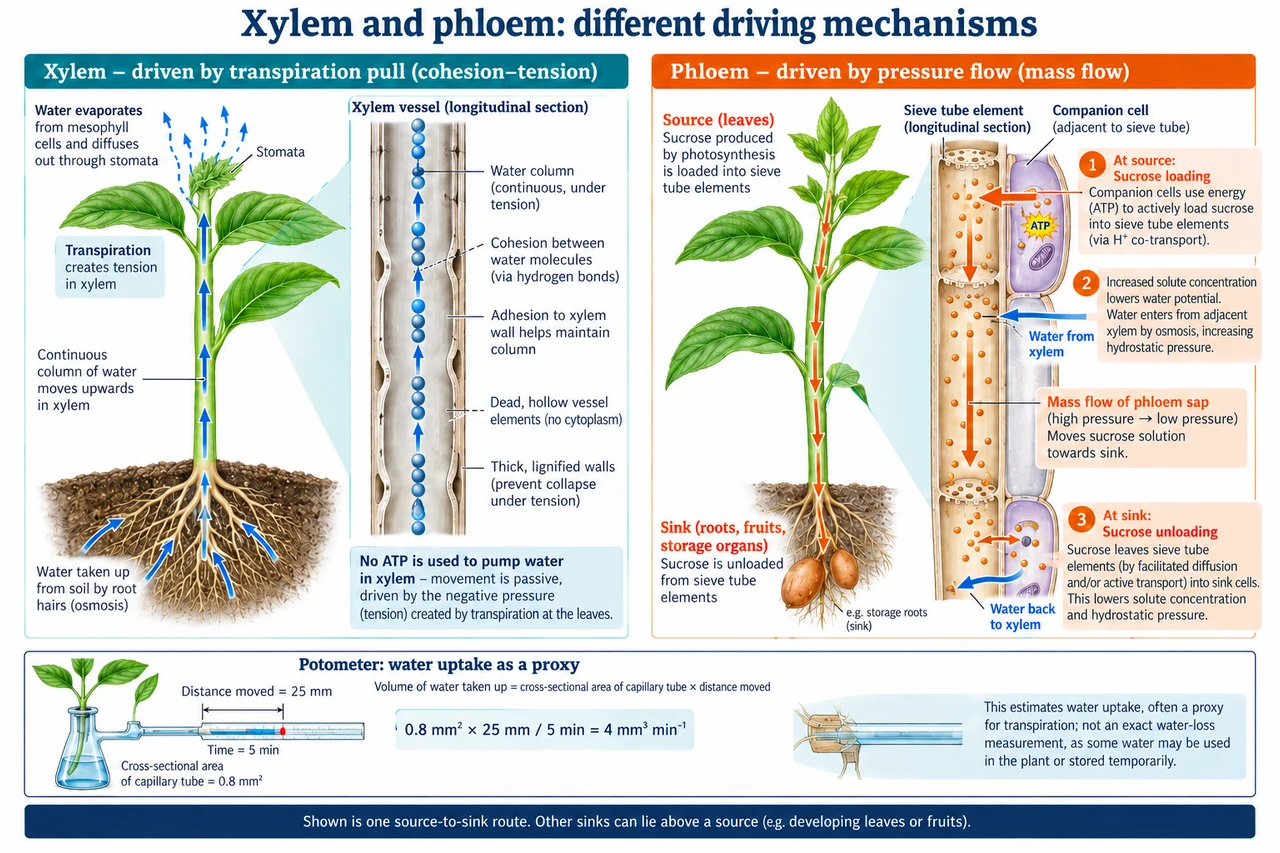
Original myAudience scientific illustration; not a documentary photograph or measured specimen. · Original generated project artwork; no source textbook figures reused. Sources support scientific review, not copied-art licensing.
Plants move water and assimilates differently
Evaporation from leaves helps create tension in a continuous water column in xylem. Cohesion supports the column, while water entering roots replaces losses. This movement is not caused by every xylem cell pumping water with ATP; mature vessel elements are not living pump cells.
Phloem moves substances such as sucrose between sources and sinks. Loading and unloading can establish pressure differences that drive flow. A potometer measures water uptake, which is a useful proxy but not exactly the same measurement as transpiration loss.
Evaporation lowers leaf-water potential and supports tension transmitted through cohesive xylem water. Sugar loading into a phloem source can draw in water and increase hydrostatic pressure, while unloading at a sink helps maintain a pressure difference. Tracer evidence follows labelled material; ringing interrupts tissues and needs careful interpretation about which structures were affected. A transport model is strengthened by appropriate evidence, not by a single arrow or by calling a potometer reading identical to measured water loss.
Worked example: A potometer capillary has cross-sectional area 0.8 mm² and its bubble moves 25 mm in 5 minutes. Estimate uptake rate.
Volume displaced = 0.8 × 25 = 20 mm³.
Divide by 5 minutes.
Answer: 4 mm³ per minute.
Check your understanding: Is a developing fruit usually a source or sink for sucrose?
Answer: A sink.
Why: It receives assimilates for growth or storage rather than necessarily exporting them.