Genes are instructions within organised DNA
By UK A Level Biology · independent study · myAudience
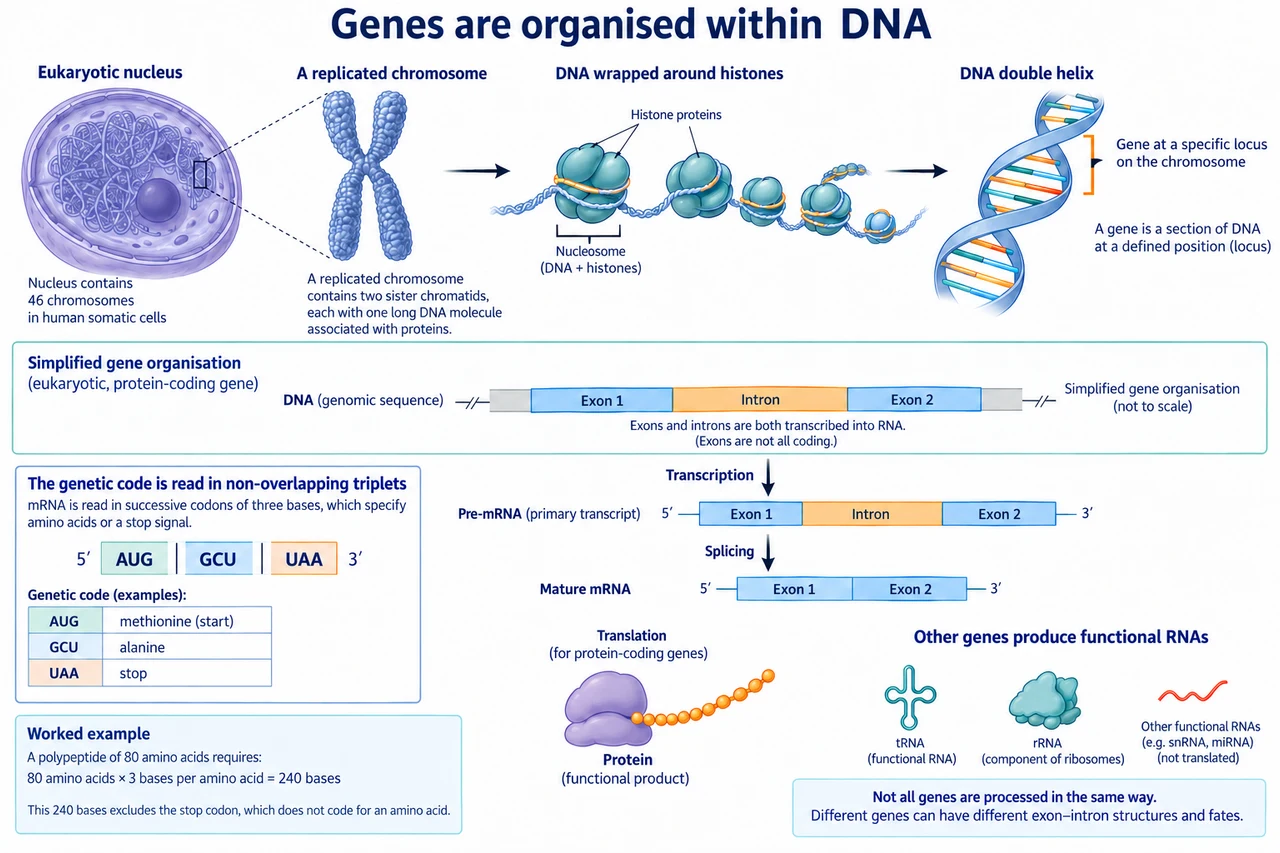
Original myAudience scientific illustration; not a documentary photograph or measured specimen. · Original generated project artwork; no source textbook figures reused. Sources support scientific review, not copied-art licensing.
Genes are instructions within organised DNA
A gene is a DNA sequence that contributes instructions for a polypeptide or a functional RNA. The order of bases matters because it can determine the order of amino acids. Not every stretch of a chromosome is a protein-coding gene.
Eukaryotic chromosomes contain DNA associated with proteins. Many eukaryotic genes include regions retained in mature RNA and intervening regions removed during processing. Bacterial chromosomes have a different organisation; comparing bacteria with eukaryotes is more precise than assuming every organism organises DNA identically.
A locus is the position of a gene in the relevant DNA molecule. Degenerate describes a code in which more than one codon can specify the same amino acid; non-overlapping describes reading successive triplets in a defined frame. The code is nearly universal rather than proving no biological exception exists. Nuclear eukaryotic DNA is associated with histones, while mitochondria and chloroplasts have their own DNA. Organellar information is not represented by a claim that every DNA molecule lies in the nucleus.
Worked example: A coding region specifies a chain of 80 amino acids. How many bases specify those amino acids, excluding a stop signal?
Each amino acid is specified by a three-base codon.
80 × 3 = 240.
Answer: 240 bases.
Check your understanding: Does every gene produce a polypeptide?
Answer: No; some produce functional RNA.
Why: Gene products include RNA molecules that act without being translated into a protein.