From DNA instructions to a protein
By UK A Level Biology · independent study · myAudience
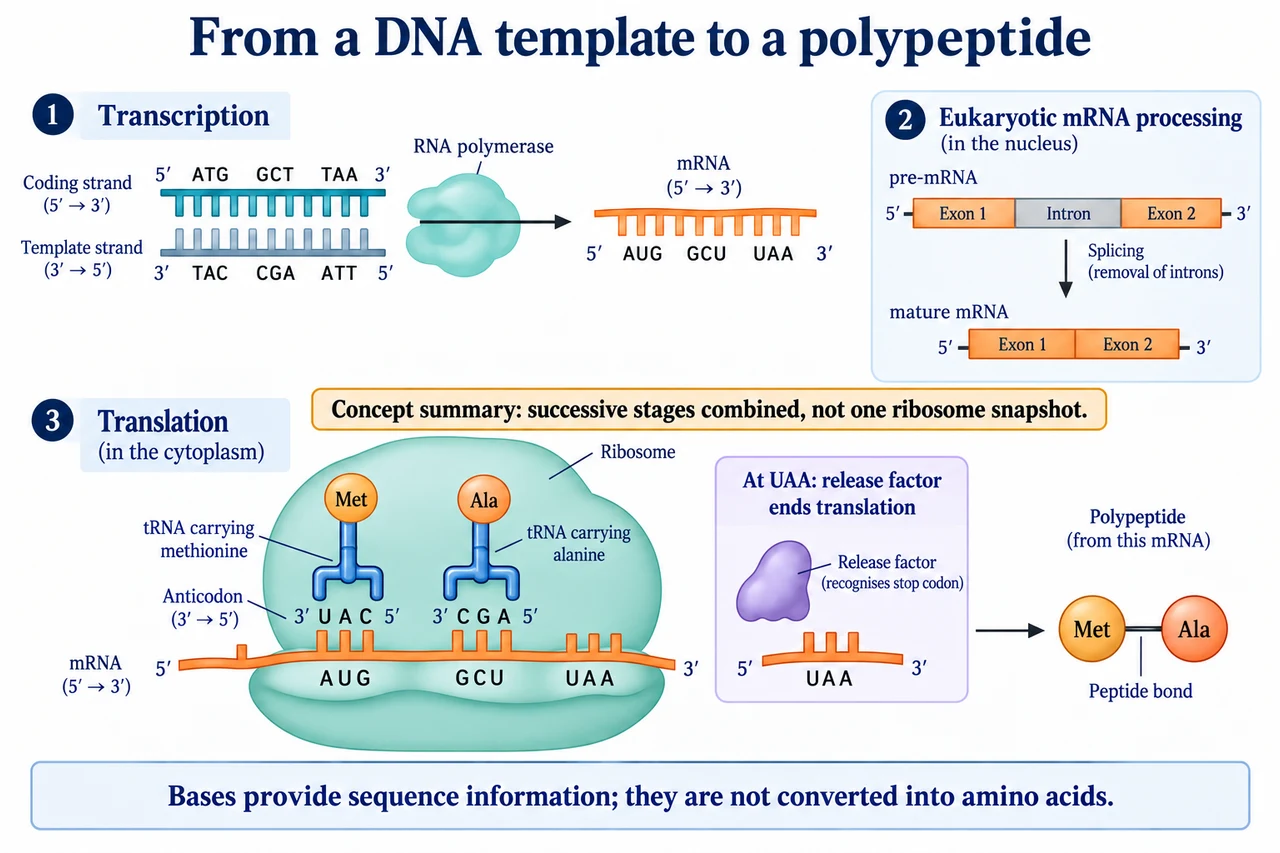
Original myAudience scientific illustration; not a documentary photograph or measured specimen. · Original generated project artwork; no source textbook figures reused. Sources support scientific review, not copied-art licensing.
From DNA instructions to a protein
Transcription produces an RNA copy using a DNA template. In eukaryotes, processing can remove introns and join exons before mature messenger RNA reaches a ribosome. The RNA carries codons, while transfer RNAs bring amino acids using complementary anticodons.
Translation links amino acids in the order specified by the message. A stop codon ends translation rather than adding another amino acid. A supplied code table lets you interpret a short message without memorising every codon.
The proteome describes a cell’s protein repertoire and can change with gene activity, even when its genome remains the same. A DNA template is copied by RNA polymerase into RNA; eukaryotic pre-mRNA is processed before translation. A tRNA carries an amino acid and complementary anticodon, while ATP-dependent steps support the overall synthesis process. Reading AUG–GCU–UAA gives two amino acids because the stop signal ends the chain rather than becoming a third amino acid.
Worked example: A supplied table gives AUG = methionine, GCU = alanine and UAA = stop. Interpret AUG–GCU–UAA.
Read the codons in order.
Add methionine, then alanine.
UAA ends translation.
Answer: A two-amino-acid chain: methionine–alanine.
Check your understanding: What is the role of a tRNA anticodon?
Answer: It pairs with a complementary mRNA codon.
Why: This pairing helps position the corresponding amino acid during translation.