Why offspring inherit different combinations
By UK A Level Biology · independent study · myAudience
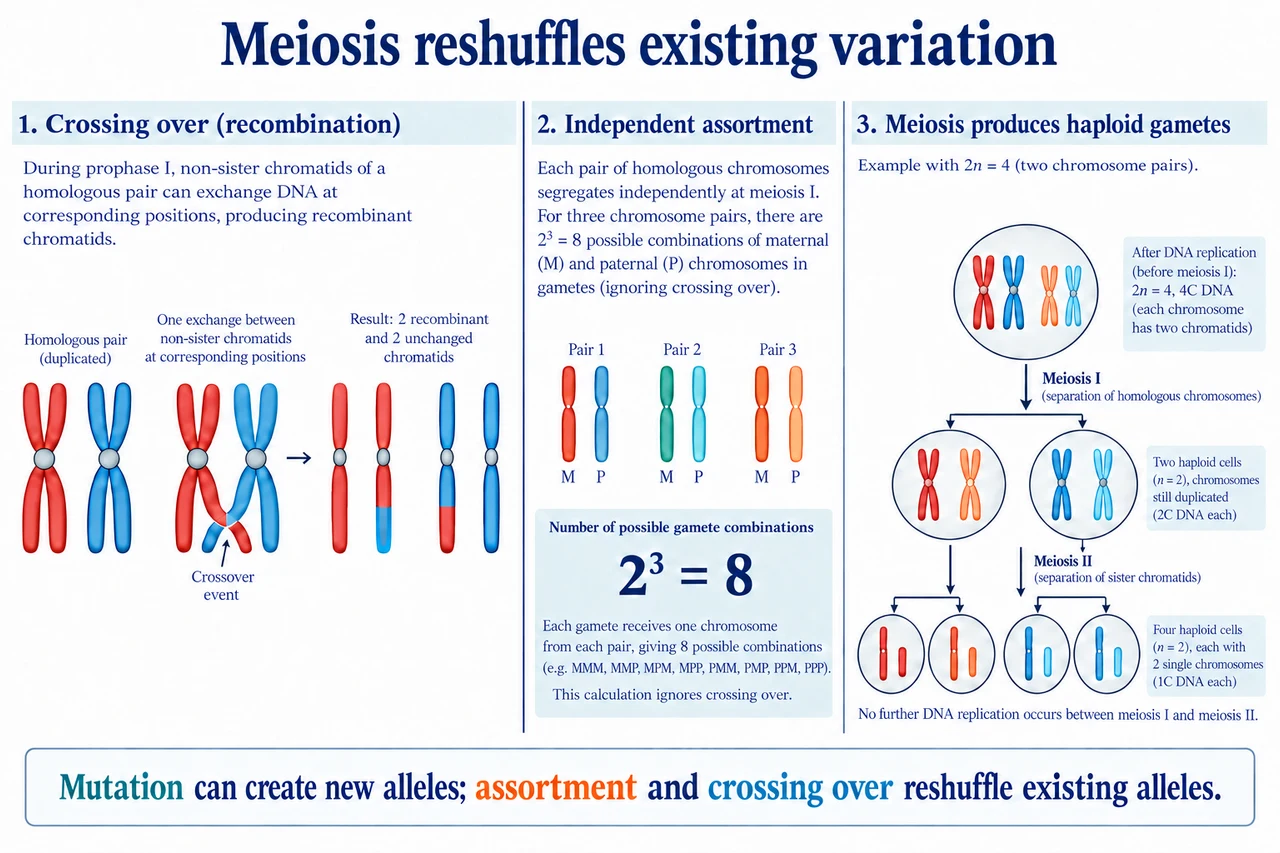
Original myAudience scientific illustration; not a documentary photograph or measured specimen. · Original generated project artwork; no source textbook figures reused. Sources support scientific review, not copied-art licensing.
Why offspring inherit different combinations
Mutations can create new alleles. Meiosis then reshuffles existing variation: homologous chromosomes can exchange corresponding DNA segments, and different chromosome pairs orient independently. Fertilisation combines two gametes, adding another source of different combinations.
Meiosis separates homologous chromosomes and later sister chromatids, normally producing haploid cells. Non-disjunction is a failure of separation that can change chromosome number. Crossing over changes combinations along chromosomes, so a calculation that ignores it gives only part of the possible variation.
A base substitution may leave amino-acid identity unchanged because the code is degenerate, while a deletion not divisible by three can change the downstream reading frame. Chromosome non-disjunction changes number rather than merely replacing one base. For n chromosome pairs, independent assortment supplies 2ⁿ combinations ignoring crossing over; combining two such gametes yields 2²ⁿ pairings under the same simplified assumptions. Crossing over adds variation beyond that count.
Worked example: An organism has three chromosome pairs. Ignoring crossing over, how many combinations can independent assortment produce in its gametes?
Use 2 to the power of the number of pairs.
2³ = 8.
Answer: Eight combinations.
Check your understanding: Does meiosis normally create new alleles through independent assortment?
Answer: No; it rearranges existing alleles.
Why: Mutation creates new sequence variants, while assortment distributes chromosomes carrying variants already present.