Selection changes populations over generations
By UK A Level Biology · independent study · myAudience
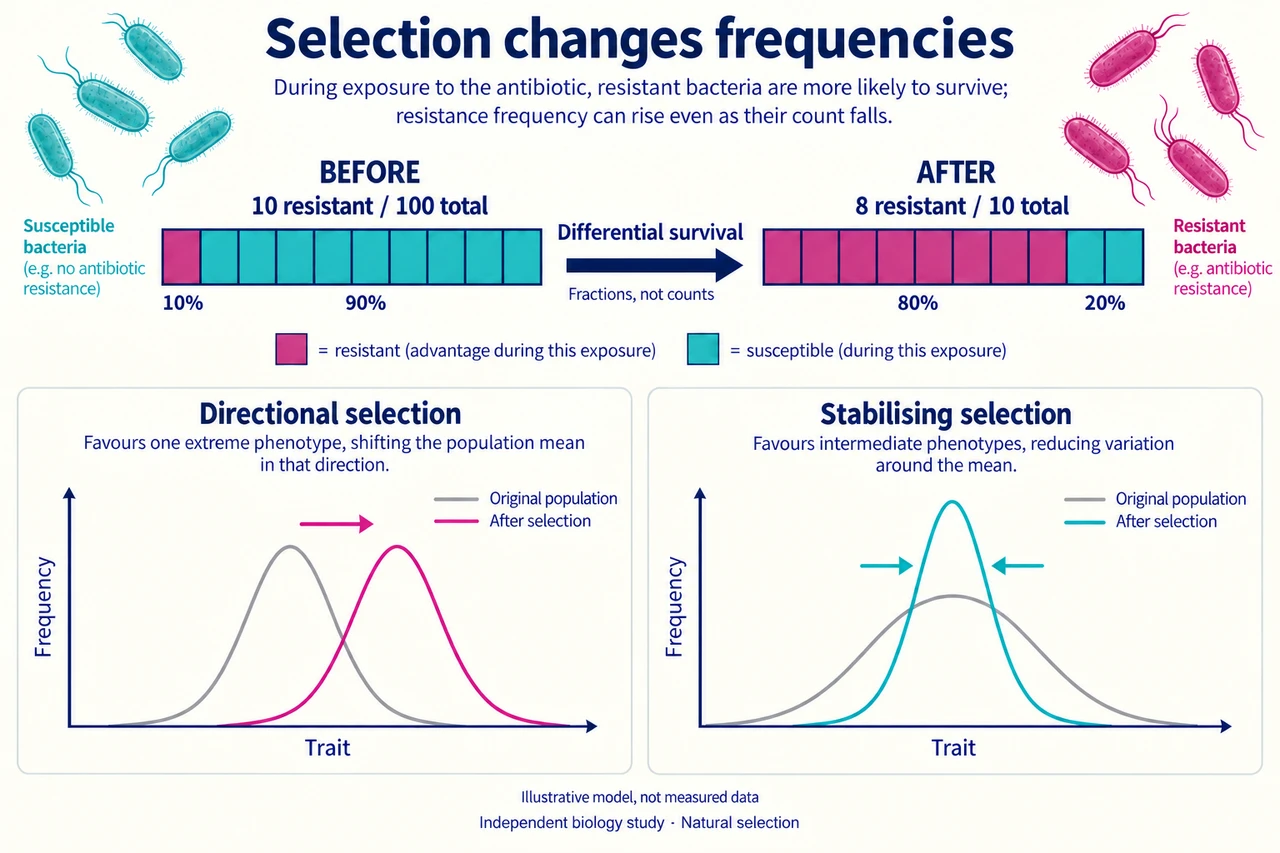
Original myAudience scientific illustration; not a documentary photograph or measured specimen. · Original generated project artwork; no source textbook figures or paragraphs reused. Sources support concept review, not copied-art licensing.
Selection changes populations over generations
Inherited variation can affect survival and reproductive success in a particular environment. Individuals carrying advantageous variants may contribute more offspring, so allele frequencies can change over generations. Selection acts on existing variation; an organism does not acquire a useful inherited mutation because it needs one.
Directional selection favours variation toward one end of a distribution. Stabilising selection favours an intermediate range. Antibiotic exposure can favour resistant bacteria already present or arising by mutation, while susceptible competitors decline. The environment determines the advantage, not a universal ranking of better organisms.
The resistant fraction can rise even when the number of resistant cells falls. In the worked sample it goes from ten resistant cells among 100 to eight among ten: 10% becomes 80%, although the resistant count drops by two. This distinction separates survival proportions from population size. Directional selection shifts a distribution toward one side; stabilising selection favours an intermediate range. Neither pattern means each surviving individual changed its own inherited genotype intentionally.
Worked example: A sample contains 10 resistant and 90 susceptible bacteria. After exposure, 8 resistant and 2 susceptible bacteria remain. Calculate the resistant proportion before and after.
Initially: 10 ÷ 100 = 0.10.
After exposure: 8 ÷ 10 = 0.80.
Answer: 10% before and 80% after.
Check your understanding: Did the exposure prove that each susceptible bacterium deliberately became resistant?
Answer: No.
Why: The change is consistent with differential survival, not purposeful mutation.