Classification is a testable account of relationships
By UK A Level Biology · independent study · myAudience
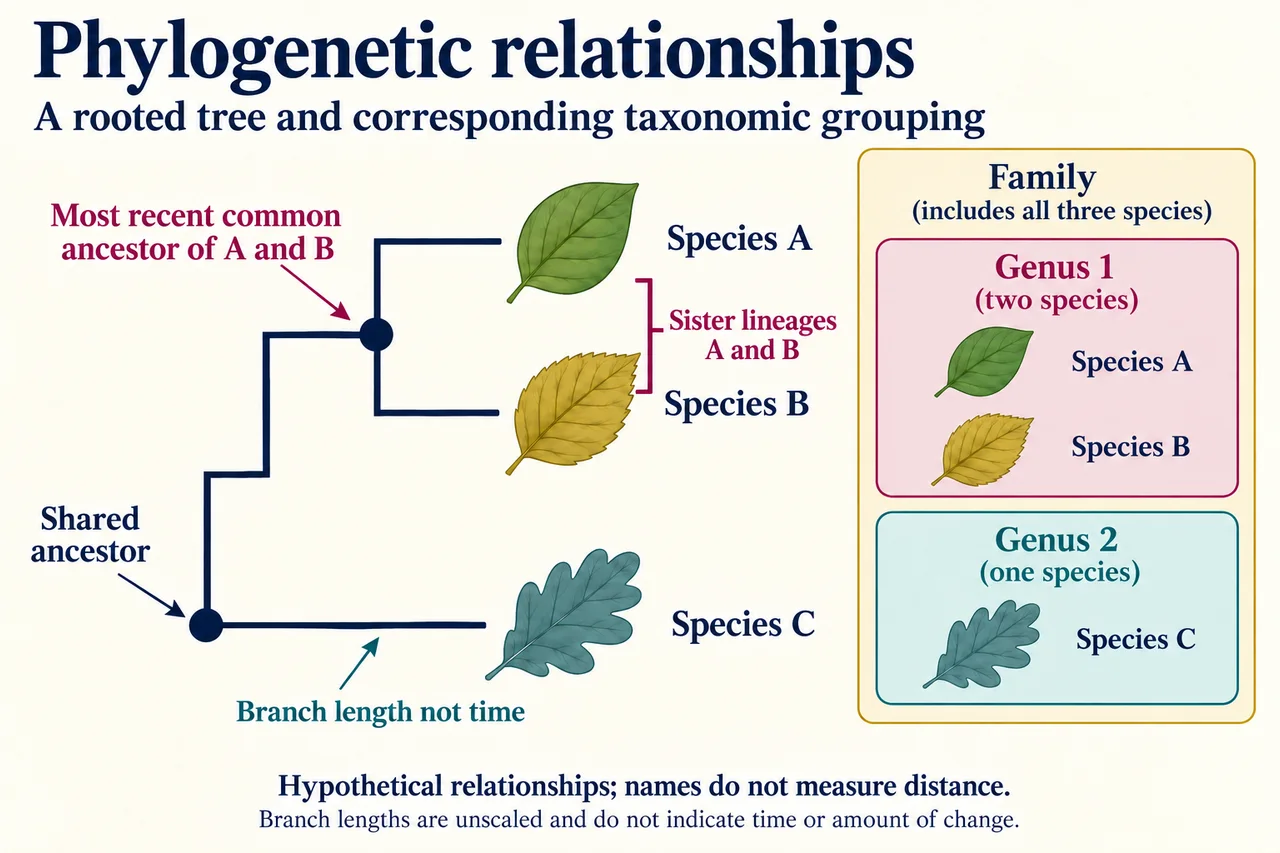
Original myAudience scientific illustration; not a documentary photograph or measured specimen. · Original generated project artwork; no source textbook figures or paragraphs reused. Sources support concept review, not copied-art licensing.
Classification is a testable account of relationships
Classification groups organisms using shared characteristics and evidence about ancestry. A hierarchy can describe increasingly specific groups, and a two-part scientific name identifies a genus and species. Molecular evidence may reveal relationships that appearance alone obscures.
The biological species concept groups organisms able to interbreed and produce fertile offspring. It is useful in many cases but difficult to apply to fossils, asexual organisms and some hybridising populations. A classification is a model that can change when stronger evidence becomes available.
Courtship signals can help compatible individuals recognise potential mates, contributing to reproductive isolation where signals differ. A taxon is a named grouping, and the usual hierarchy narrows from domain through kingdom, phylum, class, order, family and genus to species. Molecular and immunological evidence can revise inferred relationships. Branch rotation in a phylogenetic tree does not alter which lineages share a node; closeness on the page is not itself evolutionary evidence.
Worked example: Two organisms share a genus but have different species names. A third belongs to a different genus. What relationship does the naming suggest?
The first two are grouped together at genus level.
The third is outside that genus.
Answer: The first two are classified more closely at that level; the names alone do not measure exact evolutionary distance.
Check your understanding: Why can DNA evidence alter a classification based on appearance?
Answer: Similar-looking features can evolve independently.
Why: Sequence comparisons can provide evidence of ancestry beyond superficial resemblance.