Biodiversity includes abundance as well as richness
By UK A Level Biology · independent study · myAudience
Original myAudience scientific illustration; not a documentary photograph or measured specimen. · Original generated project artwork; no source textbook figures or paragraphs reused. Sources support concept review, not copied-art licensing.
Biodiversity includes abundance as well as richness
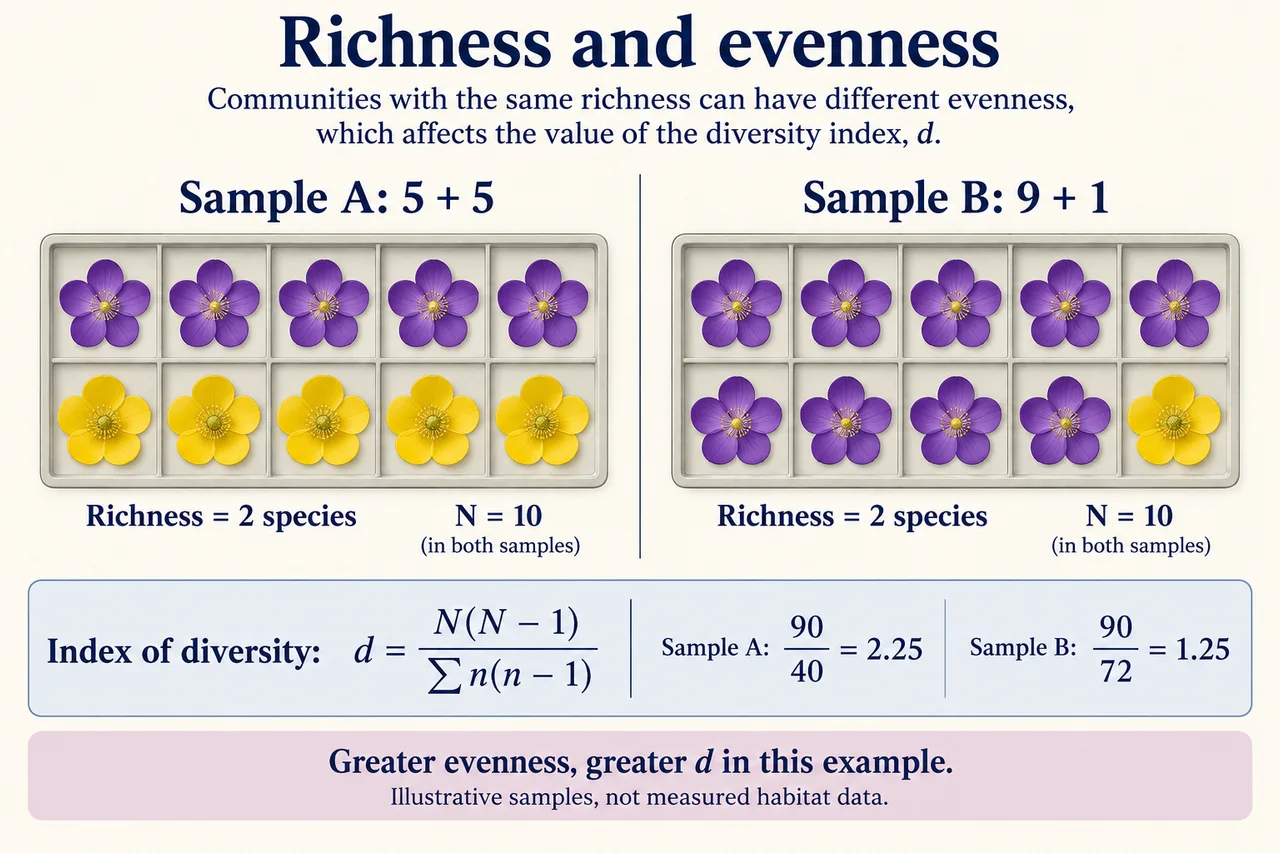
Species richness counts the different species recorded in a community. Diversity also considers how individuals are distributed among those species. Two communities can have the same richness while one is dominated by a single species.
Agriculture and habitat management can alter biodiversity through habitat loss, resource changes and chemical inputs. Comparisons need a consistent sampling method and an awareness of what was not detected. An index summarises a sample; it does not capture every ecological value of a habitat.
The stated index d = N(N − 1) / Σn(n − 1) gives 2.25 for a 5-and-5 sample and 1.25 for a 9-and-1 sample, with N = 10 in both. It is this defined index, not every diversity metric, for which the larger result indicates greater sample diversity. Agricultural decisions can alter habitat structure and chemical inputs; comparing yield with conservation needs ecological evidence as well as an index. Equal sample richness does not establish equivalent habitats.
Worked example: Use d = N(N−1) ÷ Σn(n−1). Sample A contains 5 individuals of each of two species; sample B contains 9 and 1. Compare d.
For A: N = 10; denominator = 5×4 + 5×4 = 40; d = 90/40.
For B: denominator = 9×8 + 1×0 = 72; d = 90/72.
Answer: A: 2.25; B: 1.25. Under this supplied index, A is more diverse.
Check your understanding: Do equal species counts guarantee equal diversity?
Answer: No.
Why: Relative abundance can differ even when species richness is identical.