Compare variation with fair sampling
By UK A Level Biology · independent study · myAudience
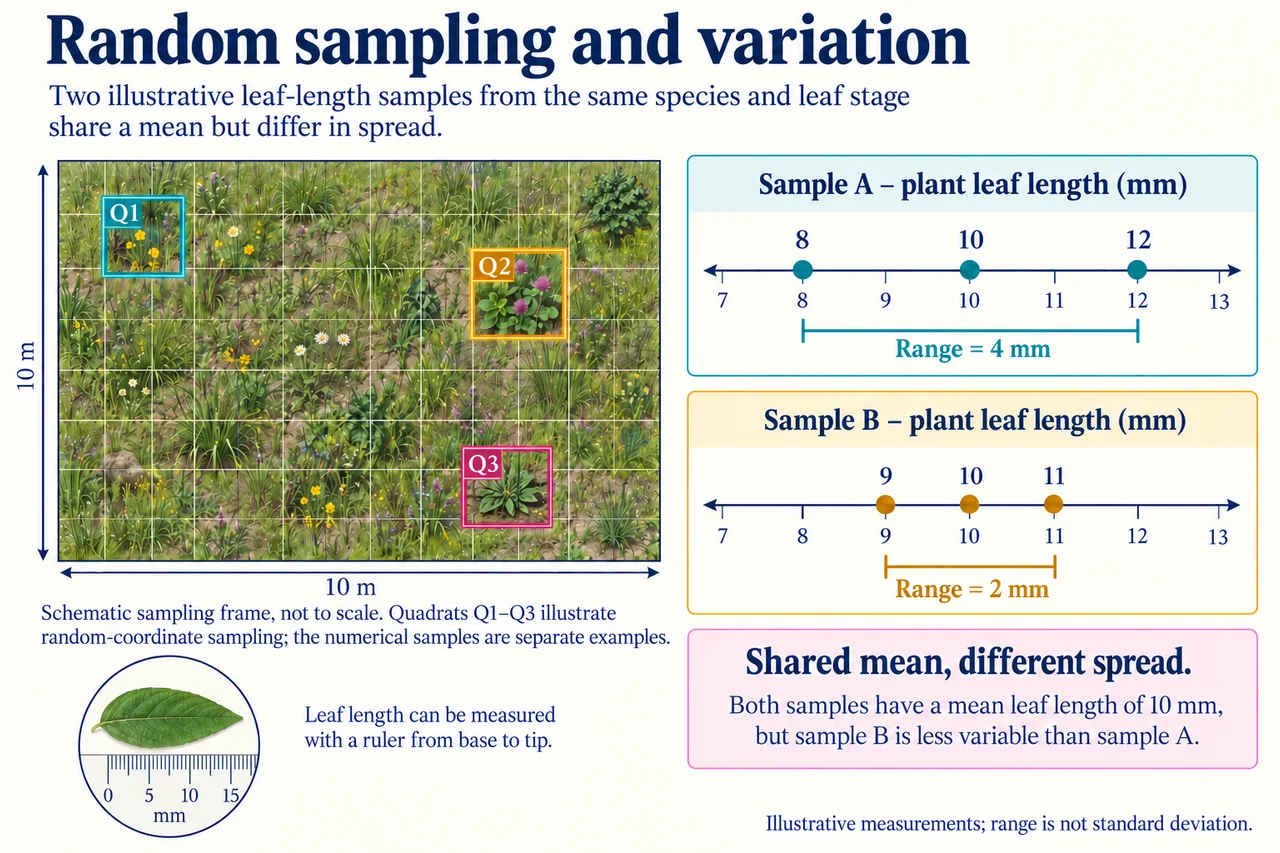
Original myAudience scientific illustration; not a documentary photograph or measured specimen. · Original generated project artwork; no source textbook figures or paragraphs reused. Sources support concept review, not copied-art licensing.
Compare variation with fair sampling
Comparisons may use observable characteristics, DNA sequences or amino-acid sequences. Each provides different evidence, and a larger difference is not automatically a precise measure of time since divergence. Interpretation depends on the feature and the assumptions behind the comparison.
Random sampling reduces deliberate selection bias. A mean describes a central value; spread describes how variable the measurements are. Replicates and consistent measurement methods help separate a real pattern from sampling noise. Similar means can conceal very different distributions.
Random location selection reduces deliberate bias, but the sampling frame still needs to include the population of interest. A standard deviation describes variation around a mean under the stated calculation; it is not the same measure as the range. Two samples may share a mean and differ in spread, as the example shows. DNA, RNA or protein comparisons require corresponding regions and positions, so missing or mismatched sequence sections should not be counted as simple biological differences without interpretation.
Worked example: Two samples have lengths 8, 10, 12 mm and 9, 10, 11 mm. Compare their means and ranges.
Both sums are 30 mm; divide by 3 to obtain 10 mm.
First range: 12−8 = 4 mm; second: 11−9 = 2 mm.
Answer: Both means are 10 mm, but the first sample has the larger range.
Check your understanding: Why choose sample locations randomly rather than selecting the most impressive plants?
Answer: To reduce selection bias.
Why: Choosing conspicuous individuals systematically can distort the distribution being estimated.