Photosynthesis links light reactions to carbon fixation
By UK A Level Biology · independent study · myAudience
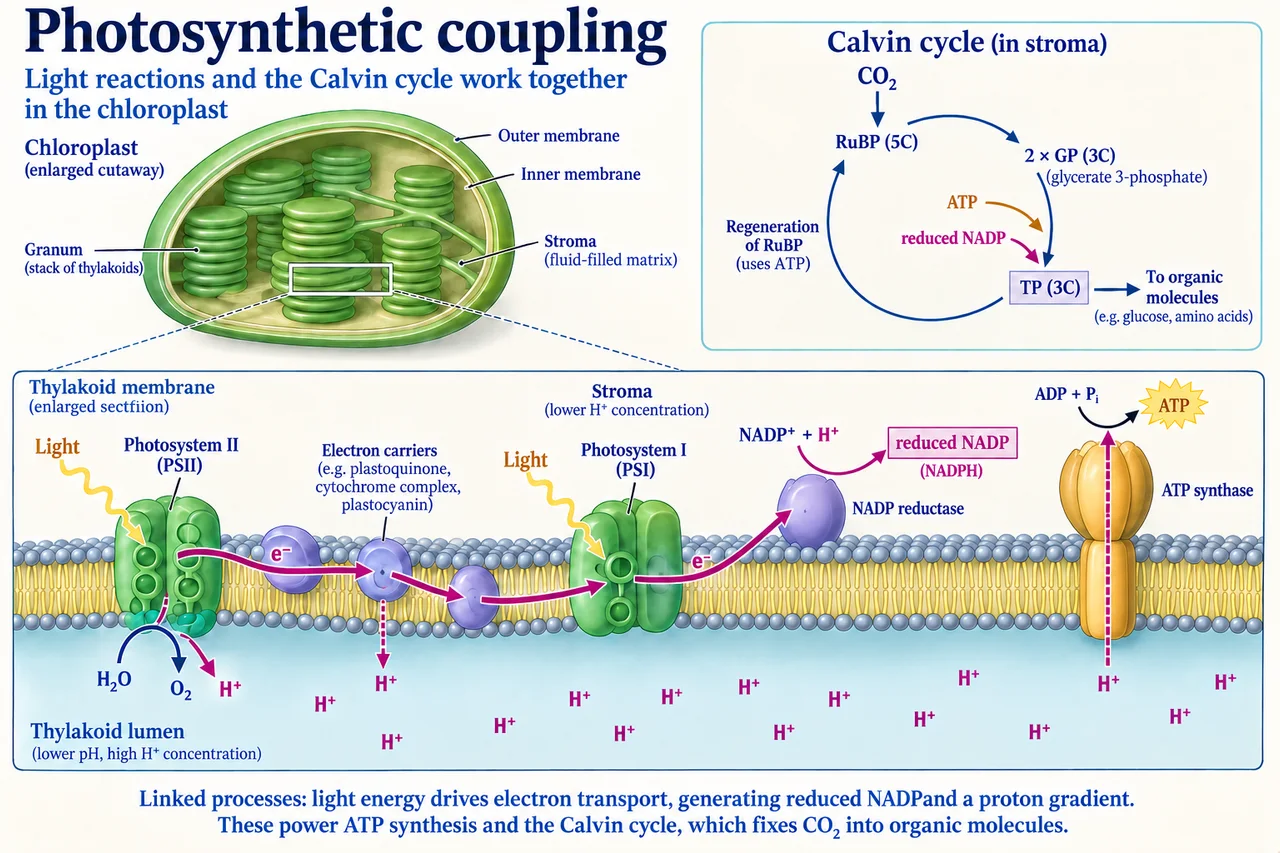
Original myAudience scientific illustration; not a documentary photograph or measured specimen. · Original generated project artwork; no source textbook figures or paragraphs reused. Sources support concept review, not copied-art licensing.
Photosynthesis links light reactions to carbon fixation
At thylakoid membranes, absorbed light drives electron transfer. Water supplies electrons through photolysis, releasing oxygen. Electron transfer helps establish a proton gradient used to synthesise ATP, while reduced NADP carries reducing power.
In the Calvin cycle, carbon dioxide combines with RuBP. Subsequent reactions use ATP and reduced NADP to produce triose phosphate and regenerate RuBP. Light intensity, carbon dioxide availability and temperature can limit rate at different times; raising one factor does little when another becomes limiting.
Light excites electrons in photosynthetic pigments, and electron transfer supports proton accumulation used by ATP synthase. In carbon fixation, RuBP combines with carbon dioxide and the unstable product gives GP; ATP and reduced NADP support conversion to TP, with much TP used to regenerate RuBP. Some supplies other organic compounds. These stages explain why limiting carbon dioxide affects fixation even when light-dependent machinery has a strong illumination supply.
Worked example: A plant produces 6 units of oxygen per minute at one light level and 6 units after the light level doubles, with temperature and carbon dioxide unchanged. What can you conclude?
The measured rate did not rise with this light increase.
Another factor may now limit the rate; the observation does not identify which one.
Answer: Light is not demonstrably the limiting factor across these two conditions.
Check your understanding: Where does the oxygen released during photosynthesis originate?
Answer: Water.
Why: Photolysis supplies electrons and releases oxygen; the released oxygen is not taken directly from carbon dioxide.