Respiration transfers energy through linked reactions
By UK A Level Biology · independent study · myAudience
Original myAudience scientific illustration; not a documentary photograph or measured specimen. · Original generated project artwork; no source textbook figures or paragraphs reused. Sources support concept review, not copied-art licensing.
Respiration transfers energy through linked reactions
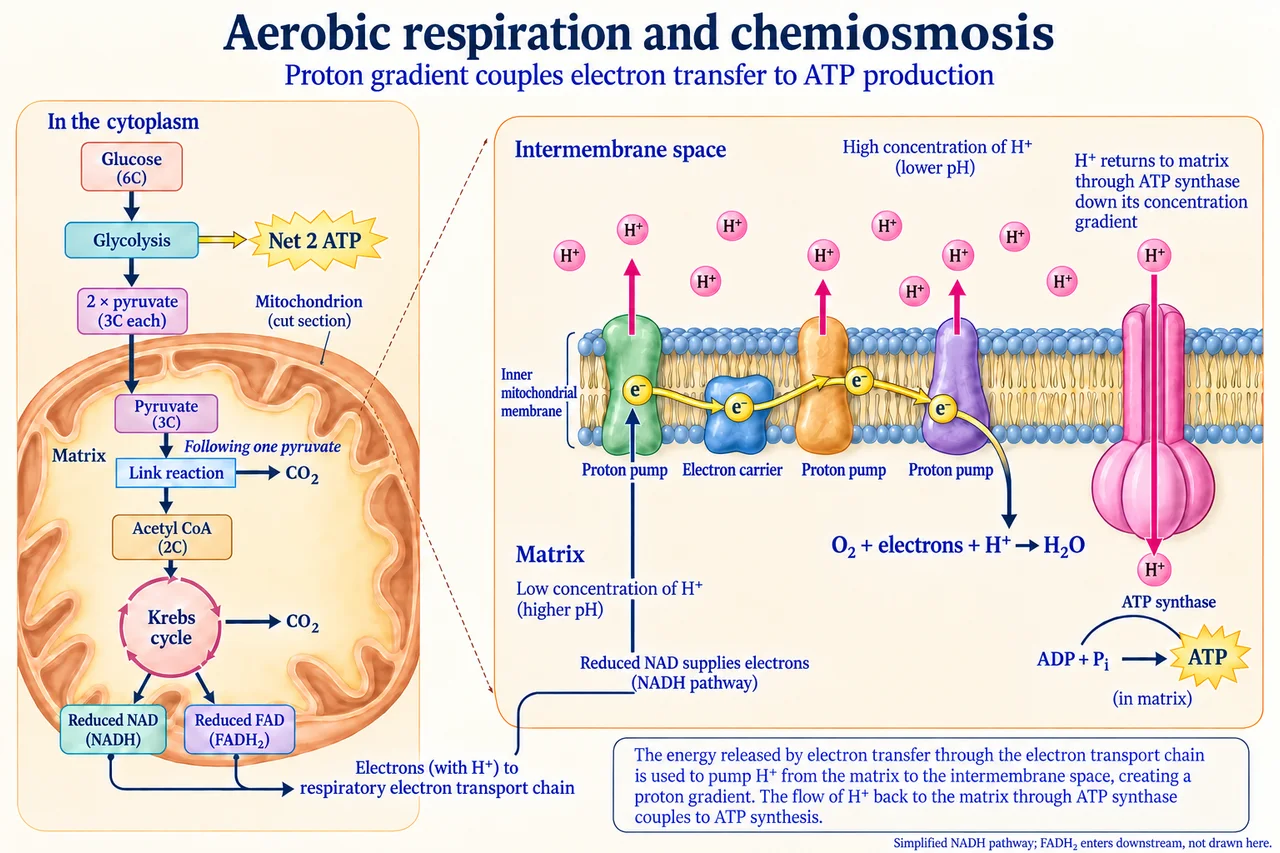
Glycolysis occurs in the cytoplasm and converts glucose into pyruvate, producing a small net ATP gain and reduced NAD. In aerobic respiration, the link reaction and Krebs cycle generate reduced carriers, while electron transfer at the inner mitochondrial membrane supports a proton gradient and ATP synthesis.
Oxygen accepts electrons at the end of the aerobic electron-transfer pathway. When oxygen is unavailable, fermentation can regenerate NAD so glycolysis continues. Mammalian cells can form lactate; yeast can form ethanol and carbon dioxide. ATP yield depends on conditions and accounting, so there is no single universal total for every cell.
The link reaction converts pyruvate to acetyl coenzyme A, releasing carbon dioxide and reducing NAD. The Krebs cycle releases further carbon dioxide and supplies reduced carriers as well as a small direct ATP contribution. The respiratory chain regenerates oxidised carriers while establishing a proton gradient; ATP synthase couples proton flow to ATP formation. Reduced NAD must also be reoxidised during fermentation for glycolysis to continue when the aerobic chain cannot serve that role.
Worked example: Glycolysis uses 2 ATP and produces 4 ATP per glucose. What is its net ATP gain?
Subtract the initial ATP investment from ATP produced.
4−2 = 2.
Answer: A net gain of 2 ATP per glucose.
Check your understanding: Why does regenerating NAD matter during fermentation?
Answer: It allows glycolysis to continue accepting electrons.
Why: Without available NAD, the relevant oxidation step in glycolysis cannot continue at the same rate.