Energy budgets explain trophic transfer
By UK A Level Biology · independent study · myAudience
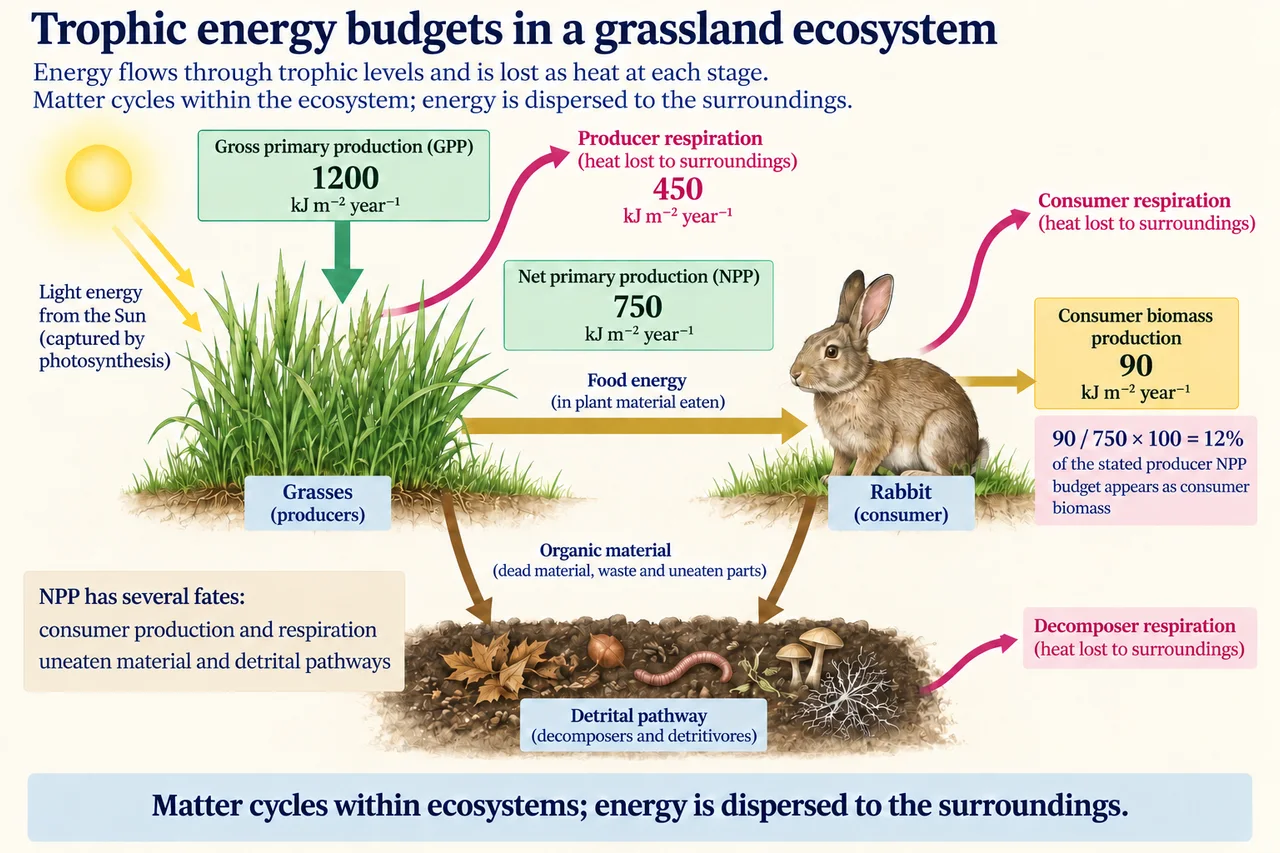
Original myAudience scientific illustration; not a documentary photograph or measured specimen. · Original generated project artwork; no source textbook figures or paragraphs reused. Sources support concept review, not copied-art licensing.
Energy budgets explain trophic transfer
Gross primary production is the energy incorporated by producers over a stated area and time. Some is used in producer respiration. Net primary production is the remainder available for growth and transfer to consumers or decomposers.
Only a fraction of the energy at one trophic level becomes new biomass at the next. Material may remain uneaten, pass through without being absorbed, or be used in respiration. Nutrients can cycle, while energy flows through ecosystems and is eventually dispersed as heat.
For consumer production, distinguish food taken in from material assimilated after egestion. Net production subtracts appropriate losses, including respiration, from the stated energy input. An efficiency using producer NPP as the denominator cannot be compared fairly with one using ingested consumer food unless the definitions are aligned. Intensive farming may alter energy allocation but also changes inputs and welfare or ecological outcomes; an energy budget provides evidence for one criterion rather than an automatic overall verdict.
Worked example: GPP is 1200 kJ m⁻² year⁻¹ and producer respiration is 450 in the same units. Consumers incorporate 90. Calculate NPP and transfer efficiency from NPP.
NPP = 1200−450 = 750 kJ m⁻² year⁻¹.
Efficiency = 90/750 ×100.
Answer: NPP = 750 kJ m⁻² year⁻¹; efficiency = 12%.
Check your understanding: Can energy be recycled indefinitely through a food web like nitrogen atoms?
Answer: No.
Why: Energy is progressively dispersed, while matter can be incorporated into new organisms.