Microorganisms help recycle nutrients
By UK A Level Biology · independent study · myAudience
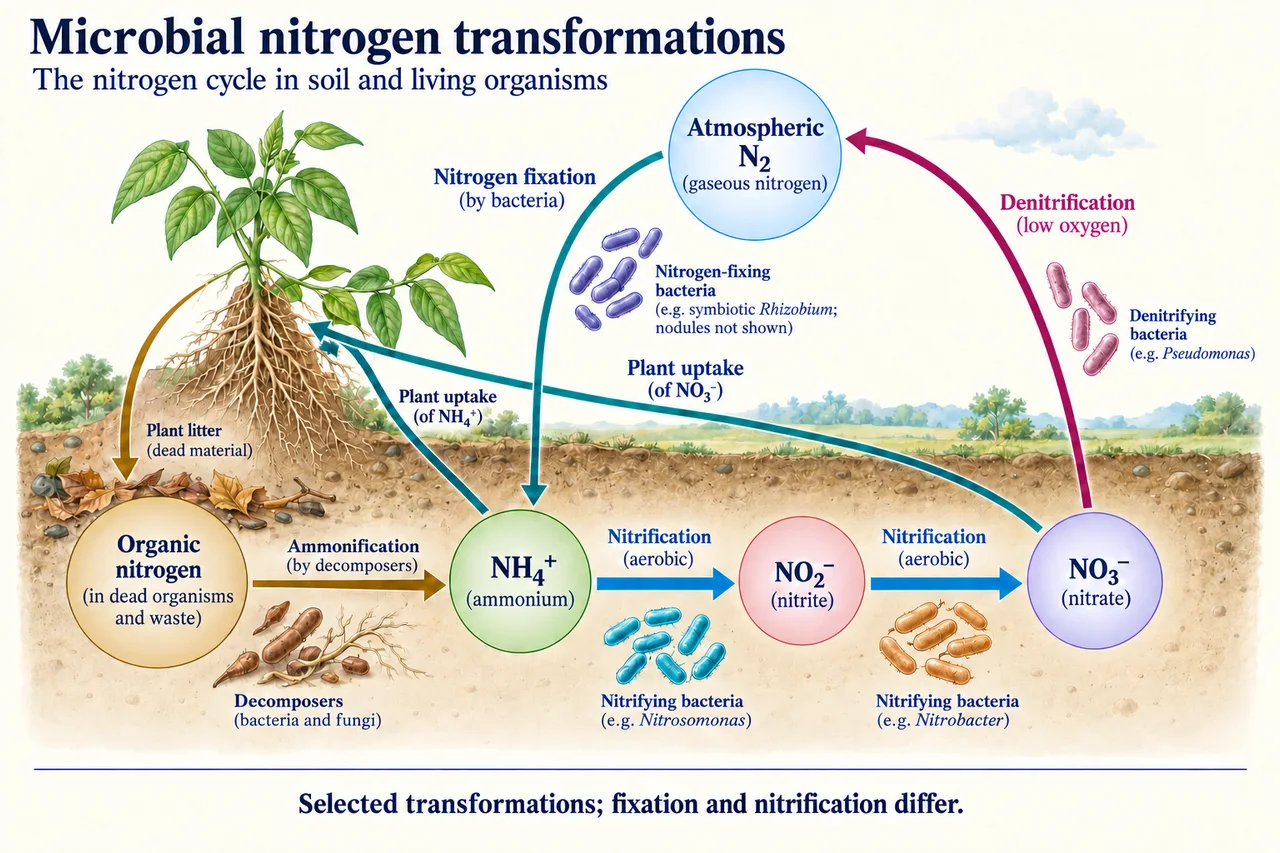
Original myAudience scientific illustration; not a documentary photograph or measured specimen. · Original generated project artwork; no source textbook figures or paragraphs reused. Sources support concept review, not copied-art licensing.
Microorganisms help recycle nutrients
Decomposers break down organic material and release substances that can return to soil or water. Nitrogen-fixing organisms convert atmospheric nitrogen into biologically usable forms. Other microorganisms contribute ammonification, nitrification and denitrification under different conditions.
Plants acquire nitrogen-containing ions and phosphate for molecules such as proteins and nucleic acids. Fertilisers can increase nutrient supply, but runoff can promote excessive growth in water bodies. Decomposition of that growth can increase oxygen demand, linking nutrient management to aquatic conditions.
Ammonification supplies reduced nitrogen from organic matter; nitrification oxidises reduced nitrogen through nitrite to nitrate under suitable aerobic conditions. Denitrification can return nitrate-derived nitrogen to atmospheric forms under suitable oxygen-limited conditions, while fixation begins with atmospheric nitrogen. Roots can acquire appropriate nitrogen ions rather than absorbing nitrogen gas directly as a universal route. Nutrient runoff can stimulate aquatic growth whose later decomposition raises oxygen demand; that chain differs from an immediate poison effect.
Worked example: A monitored field receives 40 kg of nitrogen and exports 25 kg in harvested crops. Ignoring other transfers, calculate the balance.
Inputs minus measured outputs = 40−25.
Other losses or stores would need measurement for a complete budget.
Answer: A positive balance of 15 kg; this is not proof that all 15 kg remains in the soil.
Check your understanding: Does nitrification convert atmospheric nitrogen gas directly into protein?
Answer: No.
Why: It involves oxidation of reduced nitrogen compounds; nitrogen fixation is a different process.