Responses connect a stimulus to survival
By UK A Level Biology · independent study · myAudience
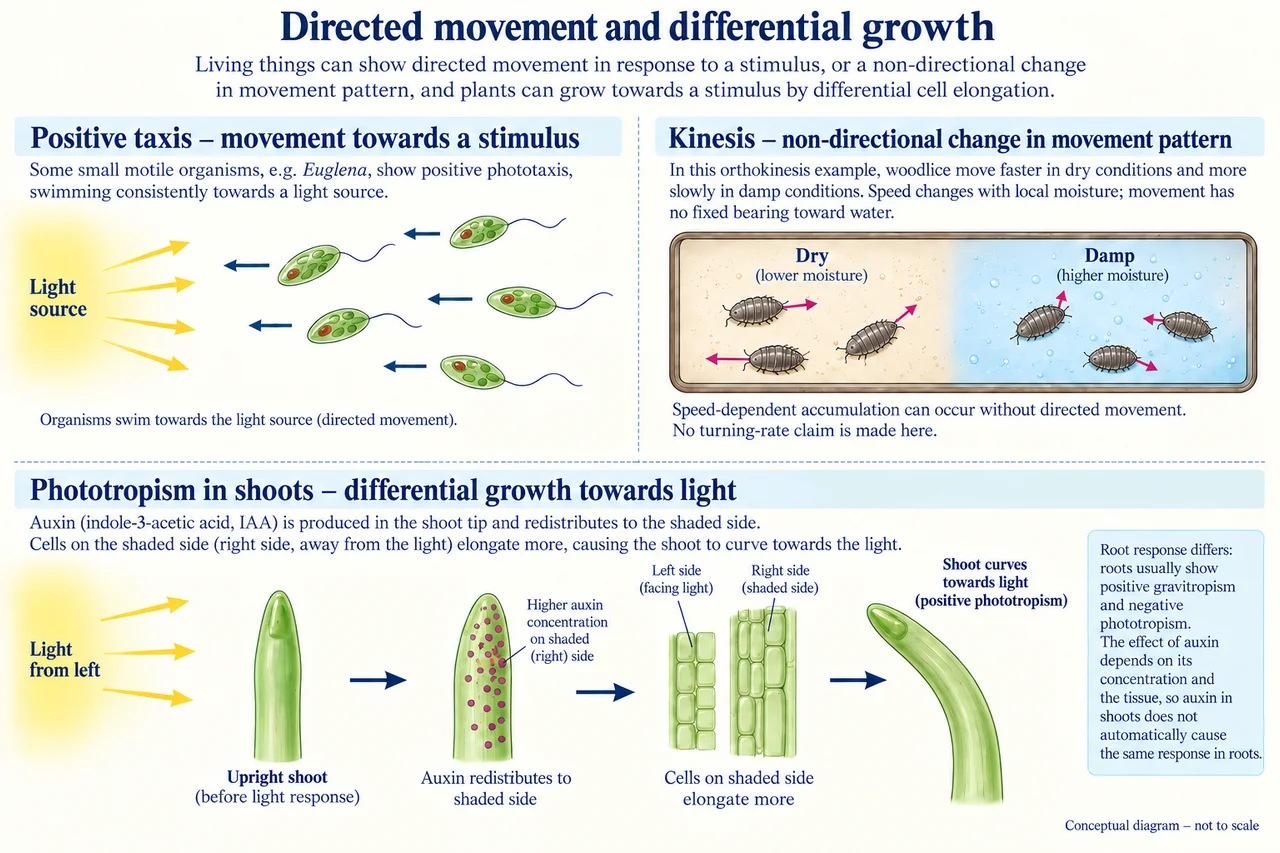
Original myAudience scientific illustration; not a documentary photograph or measured specimen. · Original generated project artwork; no source textbook figures or paragraphs reused. Sources support concept review, not copied-art licensing.
Responses connect a stimulus to survival
A stimulus is a detectable change. A response can alter an organism’s position or growth in ways that affect survival. In taxis, movement has a direction relative to the stimulus. In kinesis, a stimulus changes movement rate or turning without setting a direction toward or away from it.
Plants can respond through differential growth. In a shoot, an unequal distribution of auxin can produce unequal elongation, bending the shoot. The response depends on the organ and conditions; a description of shoots should not be transferred unchanged to roots.
IAA concentration can promote shoot elongation while inhibiting elongation in a root at a relevant higher concentration. Unequal growth can therefore give different bends in different organs. A three-neurone withdrawal model connects sensory, relay and motor cells without waiting for conscious decision. In a movement investigation, distinguish a directed response from changes in speed or turning, record comparable observation periods and protect organisms through supervised ethical handling.
Worked example: Woodlice turn more often and move more slowly in damp conditions without heading toward a detected water source. Which response fits this description?
The change concerns rate and turning, not a directed bearing.
That pattern fits kinesis.
Answer: Kinesis.
Check your understanding: How does taxis differ from kinesis?
Answer: Taxis is directed relative to a stimulus.
Why: Changing activity without a directed orientation is kinesis rather than taxis.