Receptors convert changes into signals
By UK A Level Biology · independent study · myAudience
Original myAudience scientific illustration; not a documentary photograph or measured specimen. · Original generated project artwork; no source textbook figures or paragraphs reused. Sources support concept review, not copied-art licensing.
Receptors convert changes into signals
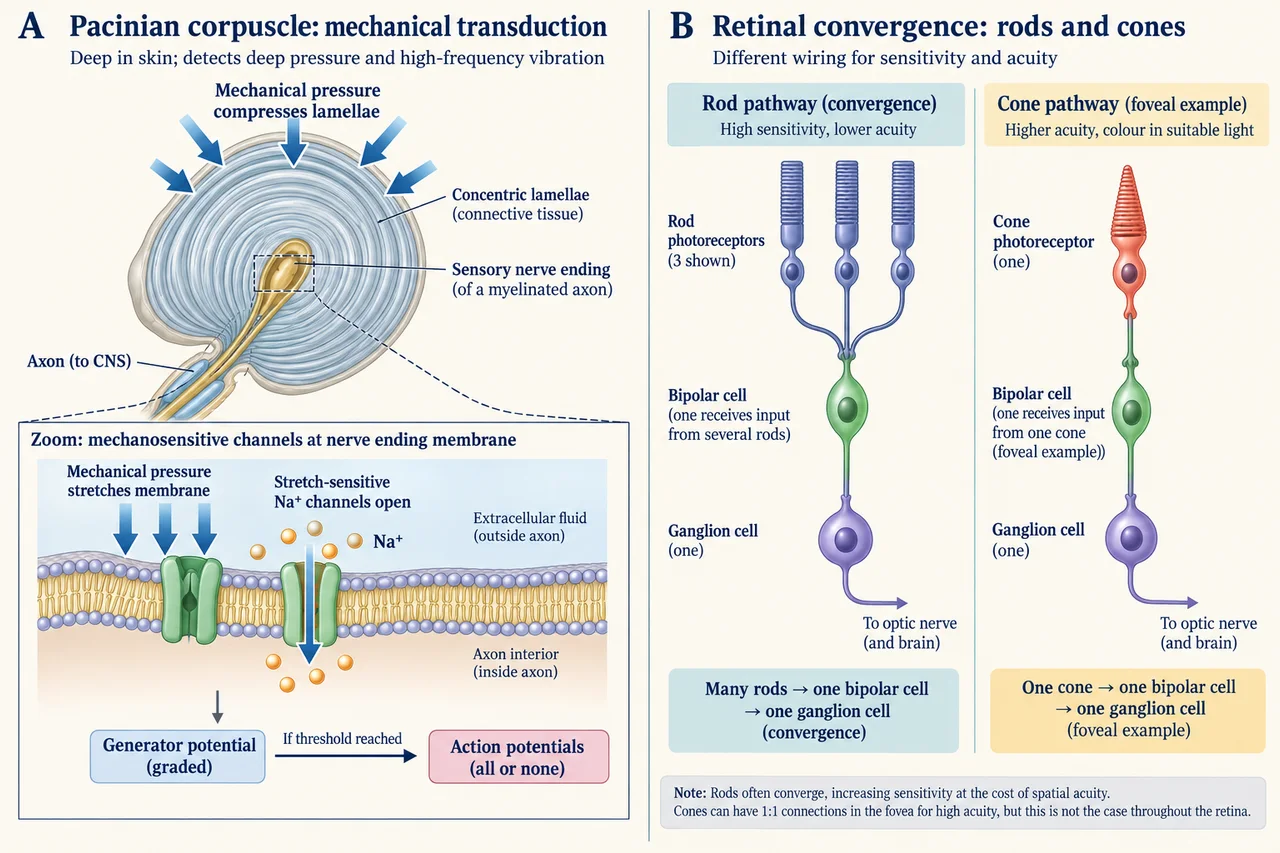
Receptors respond to particular forms of stimulation and can produce a generator potential. If the resulting signal reaches threshold in a connected sensory pathway, action potentials follow. A larger stimulus can alter firing frequency without making each action potential proportionally larger.
Pacinian corpuscles respond to pressure changes through deformation of their layered structure and sensory ending. In the retina, rods support sensitivity in dim conditions, while cones support colour discrimination and high acuity in suitable light. Convergence of signals increases sensitivity but can reduce spatial precision.
In a Pacinian corpuscle, stretch-sensitive sodium channels connect deformation with the generator potential. Compare that transduction step with coding in the sensory pathway: a graded generator potential can vary in size, whereas action potentials are all-or-none events. Rod pathways pool signals from a larger area, so two nearby weak stimuli may be detected but not resolved as two separate positions.
Worked example: In a simplified retinal network, several receptors share one downstream pathway. Explain the sensitivity–acuity trade-off.
Small signals can combine to reach a threshold.
The shared pathway does not identify which individual receptor contributed.
Answer: Greater sensitivity can accompany poorer spatial resolution.
Check your understanding: Do rods provide the same colour discrimination as cones?
Answer: No.
Why: Rods are useful in low light; colour discrimination depends on comparing cone responses.