An action potential is a travelling membrane change
By UK A Level Biology · independent study · myAudience
Original myAudience scientific illustration; not a documentary photograph or measured specimen. · Original generated project artwork; no source textbook figures or paragraphs reused. Sources support concept review, not copied-art licensing.
An action potential is a travelling membrane change
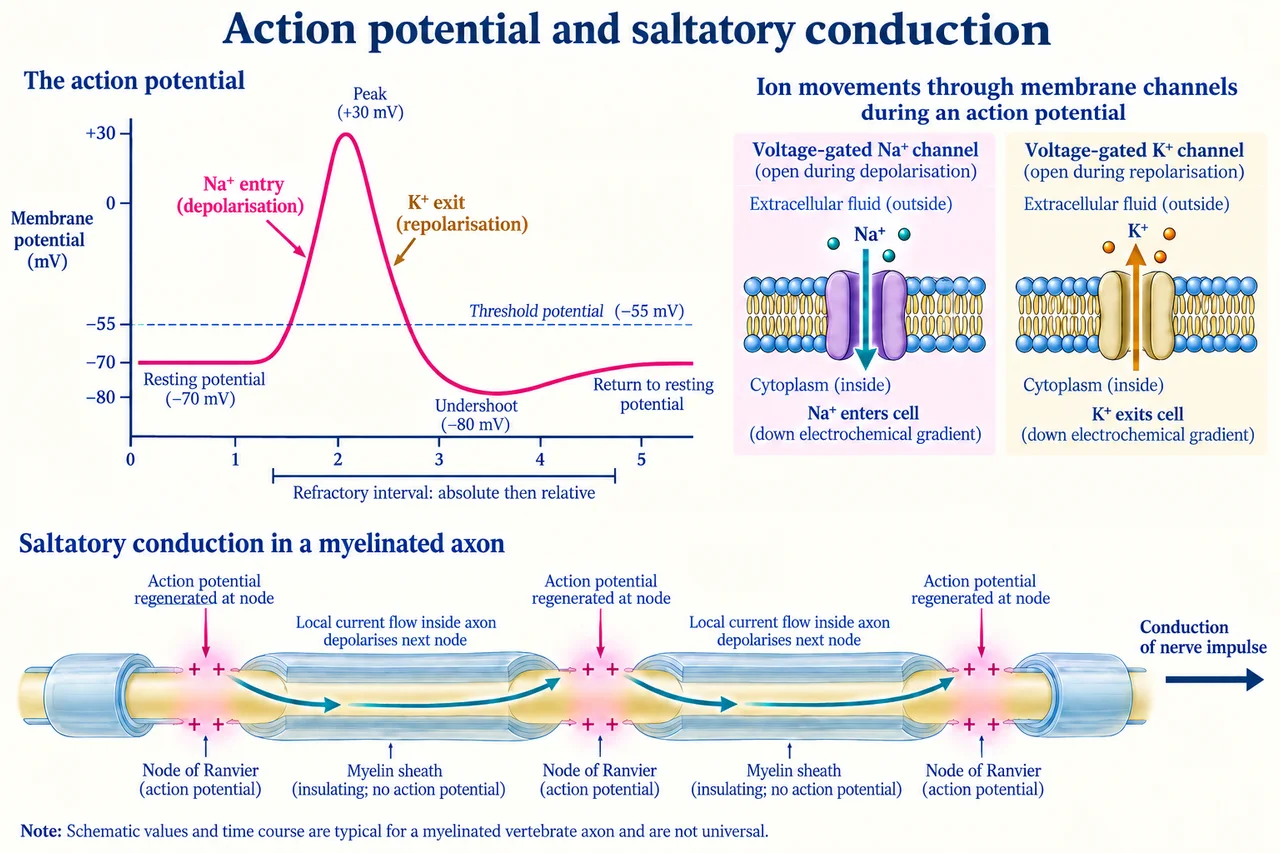
Ion gradients and selective membrane permeability support a resting potential. Once a stimulus reaches threshold, voltage-gated channels generate an action potential through changing sodium and potassium movement. The sodium–potassium pump maintains gradients over time; it is not the direct cause of every rapid voltage change.
Action potentials are all-or-none events. Stimulus intensity can be represented by firing frequency, while refractory periods help limit frequency and prevent immediate backward re-excitation. Myelin supports saltatory conduction between nodes rather than a signal passing continuously through every covered membrane segment.
During depolarisation, sodium entry makes the interior less negative; subsequent potassium movement supports repolarisation. Sodium-channel inactivation contributes to the absolute refractory period. A simplified 2 ms minimum interval corresponds to 1 / 0.002 = 500 impulses/s, but actual firing can be slower. Conduction speed in metres per second is a different measurement from firing frequency in impulses per second.
Worked example: A signal travels 1.2 metres in 0.02 seconds. Calculate average conduction speed.
Speed = distance/time.
1.2/0.02 = 60.
Answer: 60 metres per second.
Check your understanding: Does a stronger above-threshold stimulus normally double the amplitude of every action potential?
Answer: No.
Why: Intensity can be encoded by frequency; individual action potentials follow an all-or-none pattern.