Synapses transform one signal into another
By UK A Level Biology · independent study · myAudience
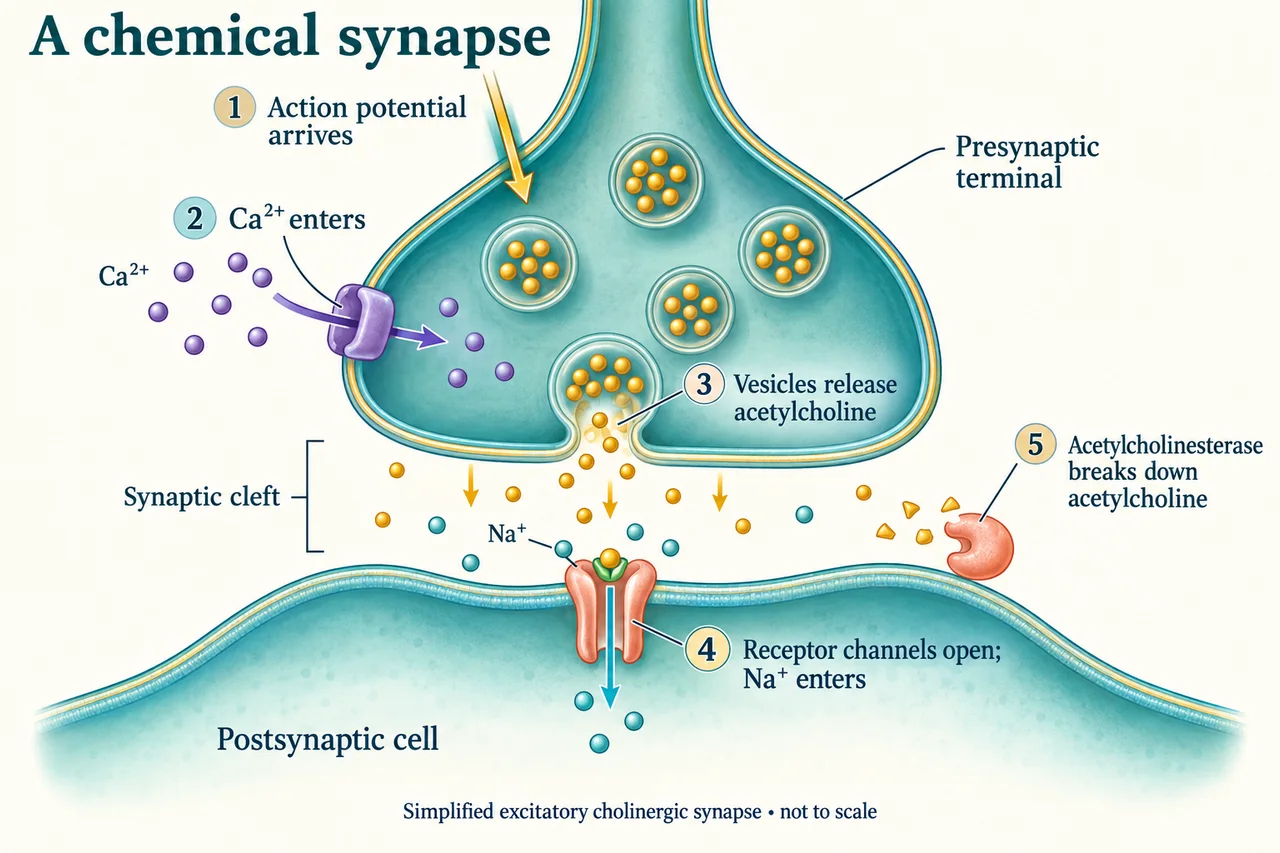
Original AI-generated myAudience scientific concept illustration; not a micrograph or measured specimen. · Original generated project artwork; no source textbook figures reused. Reference links support subject review, not a copied-art license.
Synapses transform one signal into another
At a chemical synapse, an arriving action potential can open calcium channels in the presynaptic ending. Calcium entry promotes vesicle fusion and neurotransmitter release. Transmitter diffuses across the cleft and binds receptors that change the postsynaptic membrane’s behaviour.
Signals can be excitatory or inhibitory, and inputs can sum across time or different synapses. Removal or breakdown of transmitter limits its action; acetylcholinesterase is important at cholinergic junctions. The positions of release machinery and receptors help make transmission directional.
Spatial summation combines inputs from different endings; temporal summation combines inputs arriving sufficiently close together in time. Both change whether the postsynaptic membrane reaches threshold. A neuromuscular junction instead links a motor neurone to a muscle fibre, and is excitatory in the standard skeletal-muscle model. The identity of the target matters when predicting the response.
Worked example: A simplified postsynaptic cell needs 10 units to reach threshold. Two simultaneous excitatory inputs contribute 6 and 5 units, while one inhibitory input reduces the total by 3. Is threshold reached?
Net input = 6+5−3 = 8.
Compare 8 with the threshold of 10.
Answer: No, in this simplified model.
Check your understanding: Why is neurotransmitter removal necessary?
Answer: To limit stimulation and allow subsequent signals to remain distinct.
Why: Persistent transmitter binding could prolong or distort the response.