Muscles contract by sliding filaments
By UK A Level Biology · independent study · myAudience
Original myAudience scientific illustration; not a documentary photograph or measured specimen. · Original generated project artwork; no source textbook figures or paragraphs reused. Sources support concept review, not copied-art licensing.
Muscles contract by sliding filaments
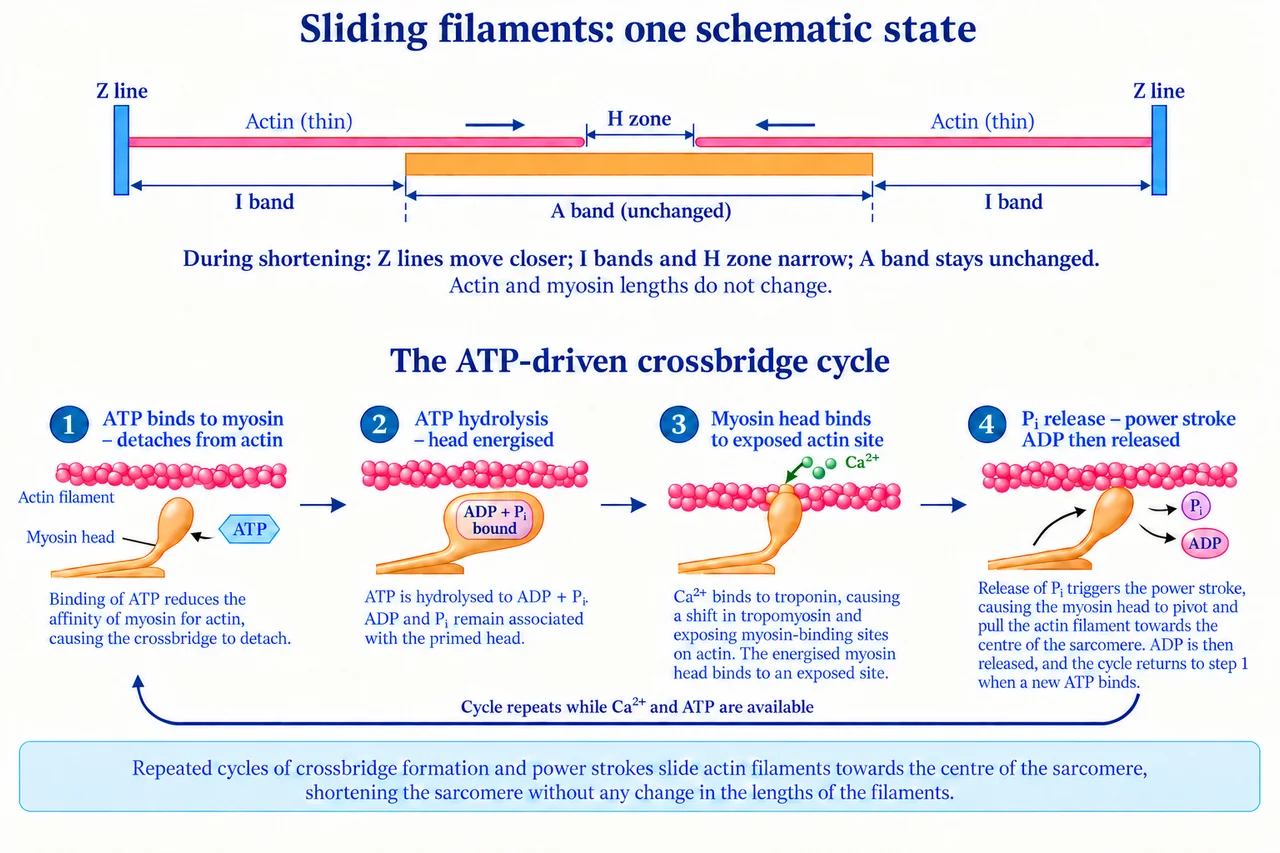
At a neuromuscular junction, signalling can initiate an electrical change in a muscle fibre. Calcium release inside the fibre exposes binding sites on actin. Myosin heads form and release cross-bridges, shifting thin filaments relative to thick filaments.
ATP is needed for detachment and re-energising of myosin heads, as well as calcium handling. A sarcomere shortens because overlap changes; actin and myosin filaments do not themselves become shorter. Different fibres differ in properties suited to sustained or rapid activity.
Tropomyosin blocks suitable actin sites until calcium-related regulatory changes permit cross-bridge formation. Phosphocreatine helps rapidly regenerate ATP during appropriate activity. Slow fibres support sustained aerobic work; fast fibres have features suited to more rapid force generation with different fatigue properties. Antagonistic muscle pairs pull in opposing actions: a shortening muscle does not actively push a bone.
Worked example: A sarcomere shortens from 2.5 to 2.0 micrometres. Calculate percentage shortening.
Change = 2.5−2.0 = 0.5 micrometres.
0.5/2.5 ×100 = 20.
Answer: 20%.
Check your understanding: Does sliding-filament contraction require actin filaments to shrink?
Answer: No.
Why: Filaments slide past one another, increasing their overlap.