Negative feedback stabilises internal conditions
By UK A Level Biology · independent study · myAudience
Original myAudience scientific illustration; not a documentary photograph or measured specimen. · Original generated project artwork; no source textbook figures or paragraphs reused. Sources support concept review, not copied-art licensing.
Negative feedback stabilises internal conditions
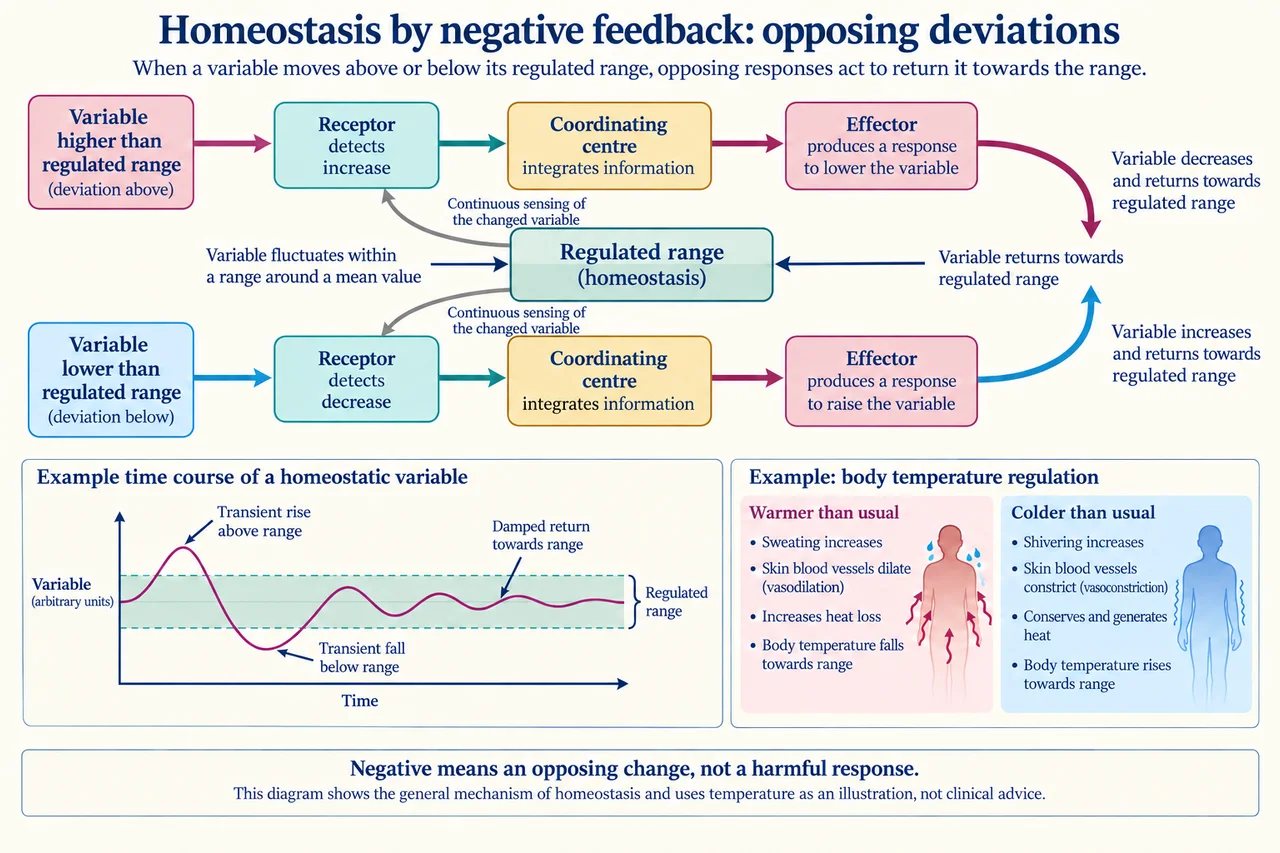
Homeostasis maintains internal conditions within workable ranges despite external changes. A receptor detects a variable, a control system coordinates a response, and effectors influence that variable. Negative feedback opposes a deviation rather than reinforcing it.
Regulation does not mean a perfectly fixed value at every moment. Delays, changing demands and opposing responses can produce fluctuations around a range. Temperature control illustrates the principle: responses that increase heat loss differ from responses that conserve or generate heat.
Core temperature and blood pH influence enzyme-mediated processes, while blood glucose supplies a respiratory substrate and contributes to water potential. A useful comparison identifies the regulated variable, the deviation and the direction of the corrective response. Cooling after a temperature rise is negative feedback; a process that amplifies the original rise would be positive feedback, regardless of whether its outcome is described as beneficial.
Worked example: An internal variable rises above its regulated range. An effector lowers it toward the range. Identify the feedback type.
The response opposes the original rise.
Opposing a deviation is negative feedback.
Answer: Negative feedback.
Check your understanding: Is every fluctuation evidence that homeostasis has failed?
Answer: No.
Why: Regulated variables can fluctuate within workable ranges, especially when responses take time.