Hormones coordinate blood-glucose regulation
By UK A Level Biology · independent study · myAudience
Original myAudience scientific illustration; not a documentary photograph or measured specimen. · Original generated project artwork; no source textbook figures or paragraphs reused. Sources support concept review, not copied-art licensing.
Hormones coordinate blood-glucose regulation
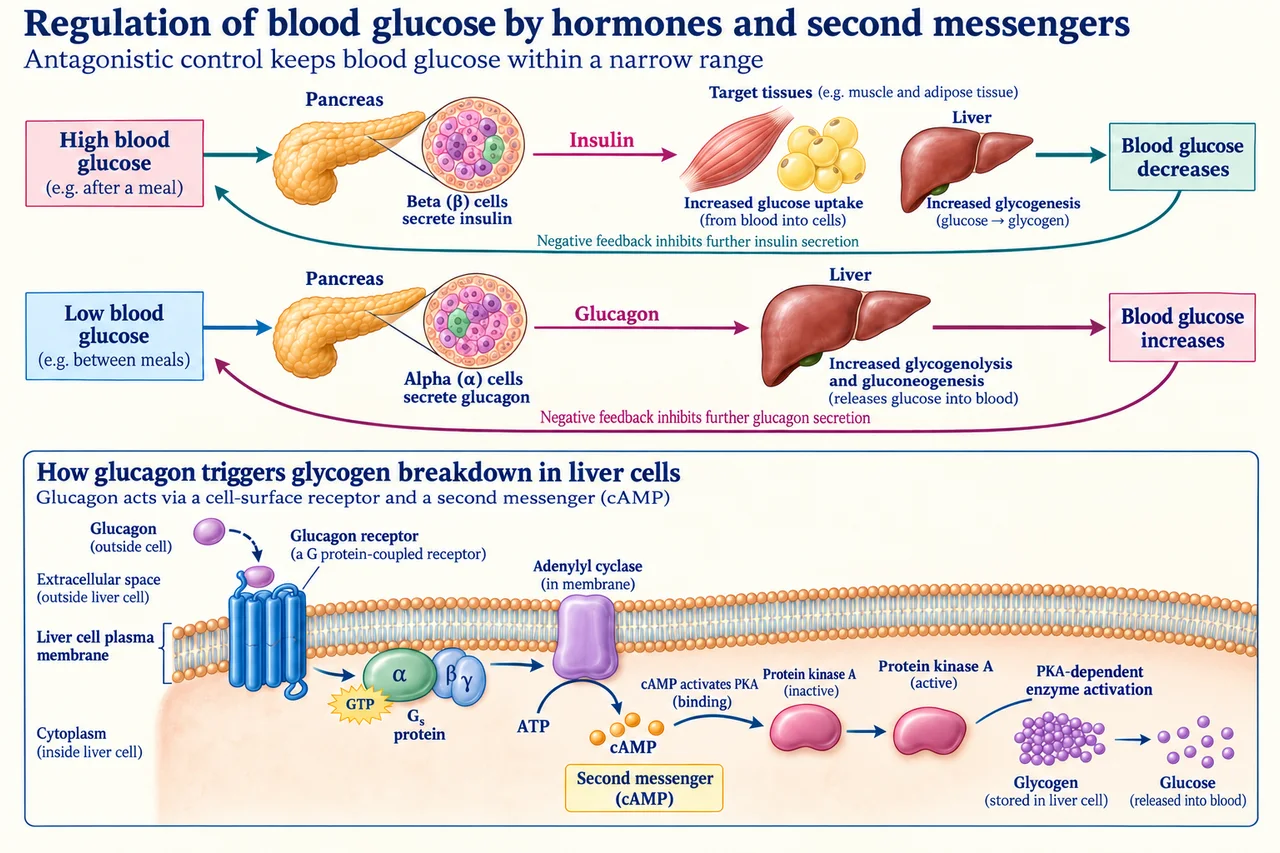
Pancreatic beta cells release insulin in response to appropriate signals, promoting processes that reduce elevated blood glucose, including uptake and storage. Alpha cells release glucagon, which can increase glucose availability through liver responses. These hormones form part of a feedback system rather than acting identically on every tissue.
Glucagon can act through a receptor and intracellular second-messenger pathway. Diabetes can involve inadequate insulin production or reduced responsiveness, with important differences between forms. Treatments and personal management require clinical guidance; this model explains regulation and does not diagnose an individual.
Glycogenesis forms glycogen; glycogenolysis breaks it down, and gluconeogenesis forms glucose from suitable non-carbohydrate starting material. In the second-messenger model, glucagon binds a membrane receptor and activates an adenylate-cyclase pathway, increasing cAMP-related protein-kinase activity. This sequence connects an extracellular signal with intracellular reactions: the hormone need not enter the cell or become glucose.
Worked example: In a simplified feedback model, glucose rises after a meal. Which hormone response is expected to help return it toward the regulated range?
The deviation is an increase.
Insulin promotes processes including storage and uptake.
Answer: An appropriate increase in insulin signalling.
Check your understanding: Do insulin and glucagon always have identical effects on liver glycogen?
Answer: No.
Why: Their regulatory roles differ: insulin favours storage, while glucagon can favour mobilisation.