Kidneys balance water and dissolved substances
By UK A Level Biology · independent study · myAudience
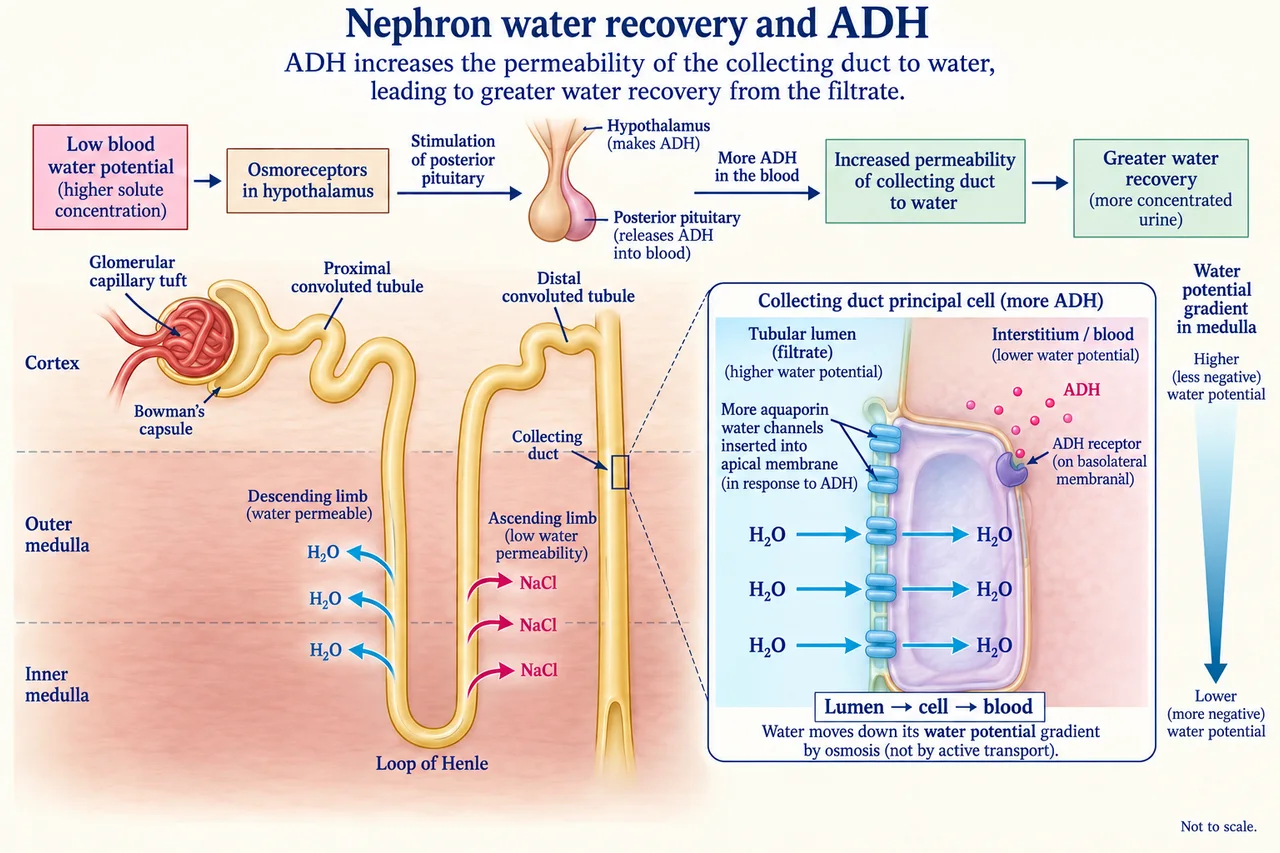
Original myAudience scientific illustration; not a documentary photograph or measured specimen. · Original generated project artwork; no source textbook figures or paragraphs reused. Sources support concept review, not copied-art licensing.
Kidneys balance water and dissolved substances
Filtration places small substances into the nephron, and selective reabsorption returns useful material to the blood. Transport processes and the loop of Henle help establish conditions that support water recovery. The amount of water retained affects blood water potential.
Osmoreceptors contribute to control of ADH release from the posterior pituitary. When blood water potential falls, increased ADH can increase collecting-duct water permeability through aquaporins. More water is recovered, tending to produce a smaller volume of concentrated urine. This is a feedback account, not an instruction to change fluid intake.
The glomerular pressure-driven filter retains cells and most large proteins. The proximal convoluted tubule reabsorbs useful solutes, including glucose, with associated water recovery. The descending and ascending limbs of the loop of Henle differ in permeability and transport, supporting the medullary gradient. Aquaporins provide a route for water movement down that gradient; they are not water pumps.
Worked example: Filtered fluid entering a simplified segment contains 100 mL of water. The segment reabsorbs 85 mL. How much remains?
Remaining water = 100−85.
This isolated calculation does not describe a whole kidney’s urine production.
Answer: 15 mL remains in this simplified segment.
Check your understanding: What does increased collecting-duct permeability allow when a suitable gradient exists?
Answer: More water reabsorption.
Why: Water moves down a water-potential gradient through the more permeable duct.