Inheritance models predict probabilities
By UK A Level Biology · independent study · myAudience
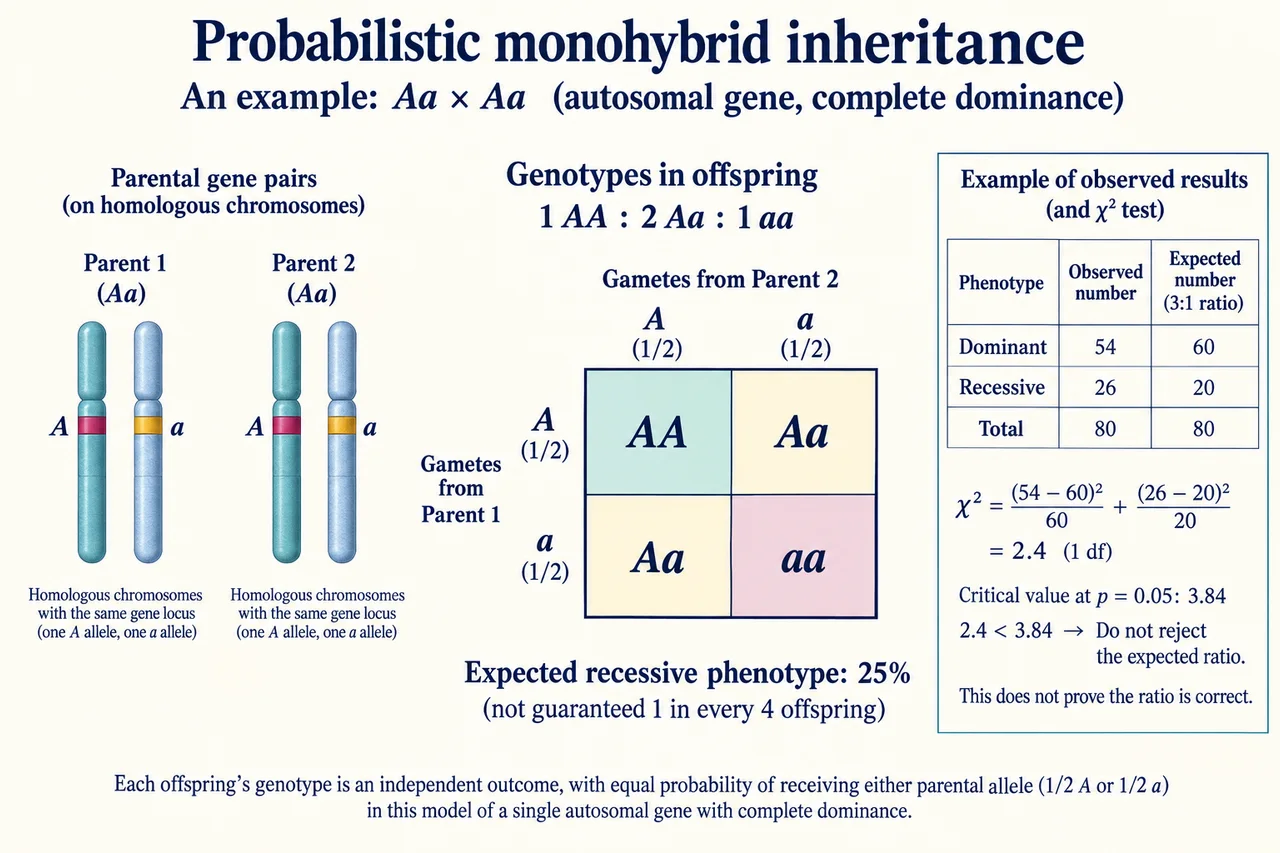
Original myAudience scientific illustration; not a documentary photograph or measured specimen. · Original generated project artwork; no source textbook figures or paragraphs reused. Sources support concept review, not copied-art licensing.
Inheritance models predict probabilities
An allele combination can be represented by a genotype, while the resulting characteristic is the phenotype. Dominant, recessive and codominant relationships describe particular patterns rather than an allele’s strength or frequency. Inheritance predictions depend on the model and parental genotypes.
More complex patterns include sex linkage, linked genes and interactions between genes. A probability predicts proportions across many outcomes, not a guaranteed sequence of children. Statistical comparisons can test whether an observed distribution is consistent with a stated model, subject to assumptions.
Epistasis concerns one gene influencing the expression of another, unlike codominance at one locus. A 9:3:3:1 expectation assumes independent loci and complete dominance in the specified cross. For observed 54:26 against expected 60:20, χ² = 36/60 + 36/20 = 2.4. With one degree of freedom and a supplied 5% critical value of 3.84, this does not reject the model; it does not prove the mechanism.
Worked example: For an autosomal gene with complete dominance, cross Aa with Aa. Find the probability of genotype aa.
Each parent supplies A or a with probability one half.
aa requires a from both parents: 1/2 ×1/2.
Answer: One quarter, or 25%, under this model.
Check your understanding: Does a predicted one-in-four outcome mean exactly one of every four offspring must have it?
Answer: No.
Why: Each outcome is probabilistic; small samples can differ from the expected proportions.