Reproductive isolation can lead to speciation
By UK A Level Biology · independent study · myAudience
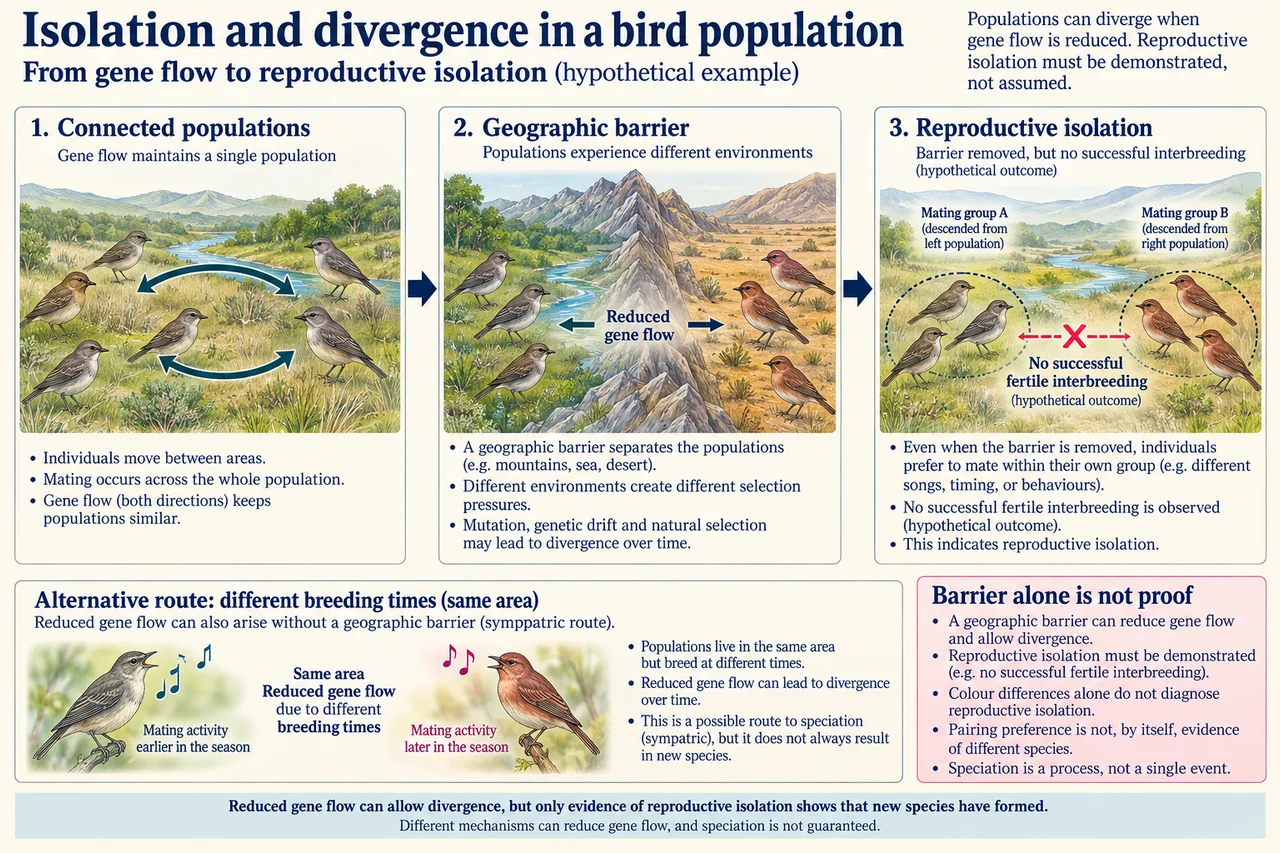
Original myAudience scientific illustration; not a documentary photograph or measured specimen. · Original generated project artwork; no source textbook figures or paragraphs reused. Sources support concept review, not copied-art licensing.
Reproductive isolation can lead to speciation
Speciation involves divergence that establishes reproductive isolation. A geographic barrier can reduce gene flow between populations; different selection pressures, mutation and drift may then produce divergence. A barrier alone does not immediately make the populations different species.
Reproductive isolation can also develop without geographic separation. Changes in mating patterns, timing, ecology or chromosome organisation can reduce successful interbreeding. Evidence for speciation must therefore consider reproduction and gene flow, not just visible differences.
Disruptive selection can favour both ends of a trait distribution rather than its middle. If individuals also mate mainly within those groups, gene flow may decline and divergence may accumulate without an initial geographical barrier. That is a possible mechanism for sympatric divergence, not proof that every two-peaked distribution already represents separate species.
Worked example: Two bird populations live on separate islands but produce fertile offspring when they meet. Has geography alone established reproductive isolation?
A physical separation reduces opportunities to meet.
The stated interbreeding result shows that fertility-based isolation has not been demonstrated.
Answer: No; the evidence does not demonstrate reproductive isolation.
Check your understanding: What does reduced gene flow allow during divergence?
Answer: Differences can accumulate more independently.
Why: Continual exchange of alleles can counter some divergence between populations.