Populations change within interacting habitats
By UK A Level Biology · independent study · myAudience
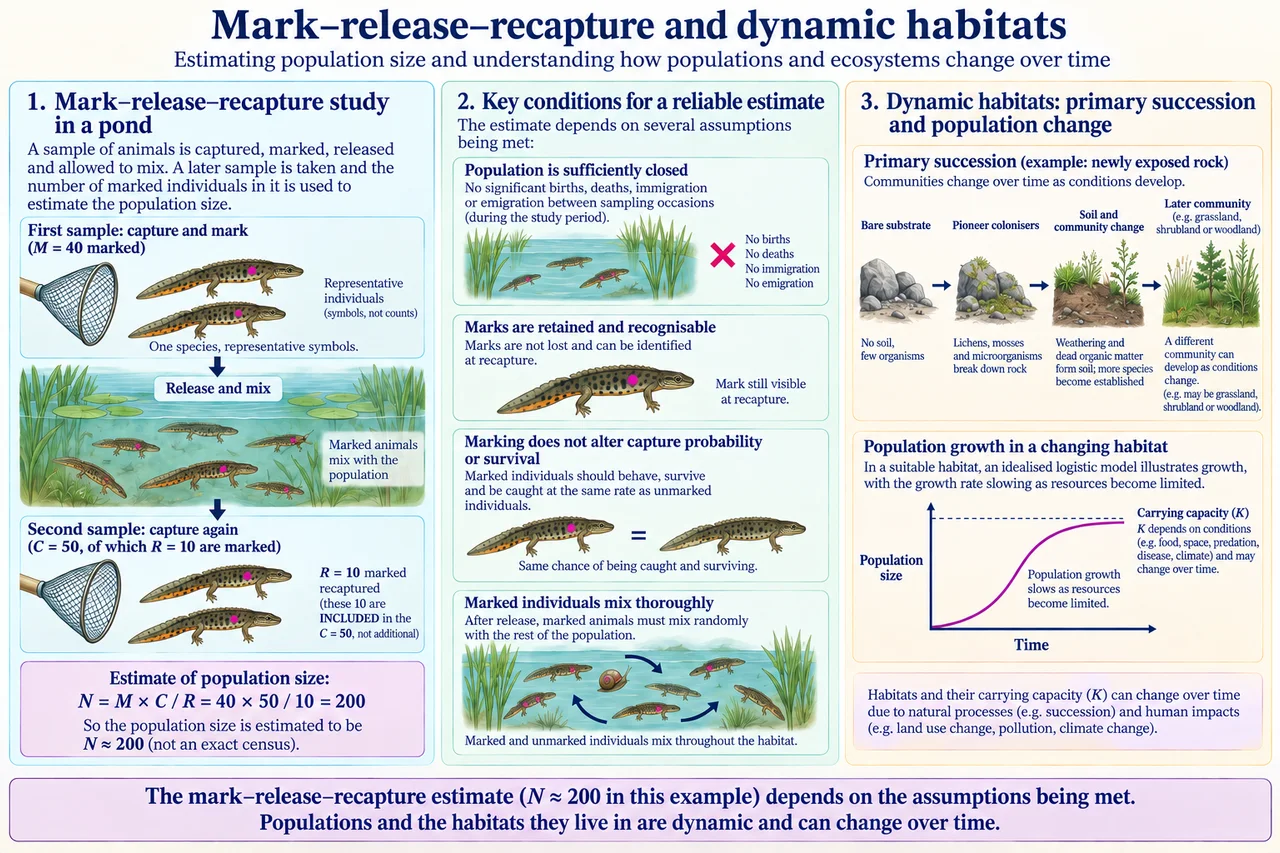
Original myAudience scientific illustration; not a documentary photograph or measured specimen. · Original generated project artwork; no source textbook figures or paragraphs reused. Sources support concept review, not copied-art licensing.
Populations change within interacting habitats
Population size reflects births, deaths and movement. Abiotic conditions, competition and predation affect these processes. Carrying capacity is context-dependent: resources and environmental conditions can change, so it is not a permanent numerical ceiling for every habitat.
Sampling helps estimate abundance without counting every organism. Random quadrats suit some stationary organisms, while mark–release–recapture uses assumptions about mixing, mark retention and population closure. Succession changes communities over time; conservation decisions balance evidence, habitats and competing demands.
For mark–release–recapture, marking must not alter survival or capture probability, individuals must mix appropriately and the population must remain sufficiently stable. The estimate 40 × 50 / 10 = 200 is highly sensitive to a small recaptured count. In primary succession, pioneers can alter substrate and conditions, permitting later communities to establish; management may deliberately interrupt that sequence to conserve a chosen habitat.
Worked example: In a simplified mark–release–recapture study, 40 animals are marked, then 50 are caught later, including 10 marked animals. Estimate population size.
Use estimate = first marked ×second sample /marked recaptured.
40× 50/ 10 = 200.
Answer: Approximately 200 animals, if the method’s assumptions hold.
Check your understanding: Why can migration between samples distort this estimate?
Answer: It can violate the assumption of a closed population.
Why: Changes in population membership alter the marked fraction independently of the original population size.