Mutations have different consequences
By UK A Level Biology · independent study · myAudience
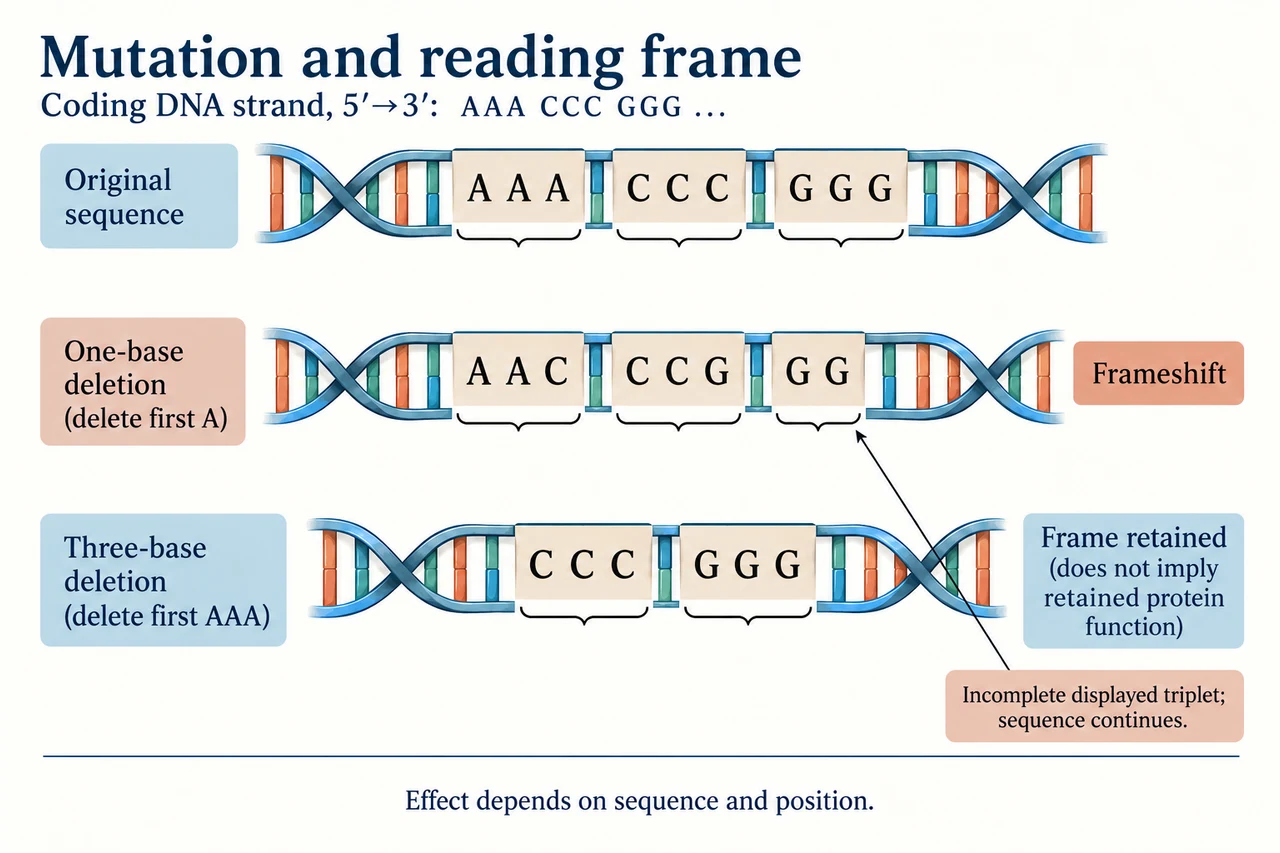
Original myAudience scientific concept illustration; not a photograph or measured specimen. · Original generated project artwork; no source textbook figures reused. Reference links support review, not a copied-art licence.
Mutations have different consequences
A change in DNA sequence can alter a codon, shift a reading frame or leave the amino-acid sequence unchanged. Consequences depend on the position and type of change. A changed amino acid can affect folding or function, but a sequence change does not automatically produce a large observable effect.
Substitutions alter bases without necessarily changing the reading frame. Insertions or deletions can shift the frame if their size is not a multiple of three. Mutations in regulatory regions can influence expression even when a protein-coding sequence remains unchanged.
Inversions reverse a DNA segment, duplications repeat material and translocations relocate material. These are different structural changes, not a severity ranking. A three-base deletion preserves the downstream reading frame but may remove an amino acid essential for binding or folding. Predict the changed message before making a claim about protein function or the phenotype.
Worked example: A coding region loses one base early in its sequence. Compare this with losing three bases.
A one-base deletion shifts the subsequent three-base grouping.
A three-base deletion preserves the downstream grouping, although it can remove an amino acid and still affect function.
Answer: The one-base deletion can cause a frameshift; the three-base deletion need not.
Check your understanding: Does every substitution change an amino acid?
Answer: No.
Why: Several codons can specify the same amino acid, so some substitutions are synonymous.