Stem-cell potential changes during differentiation
By UK A Level Biology · independent study · myAudience
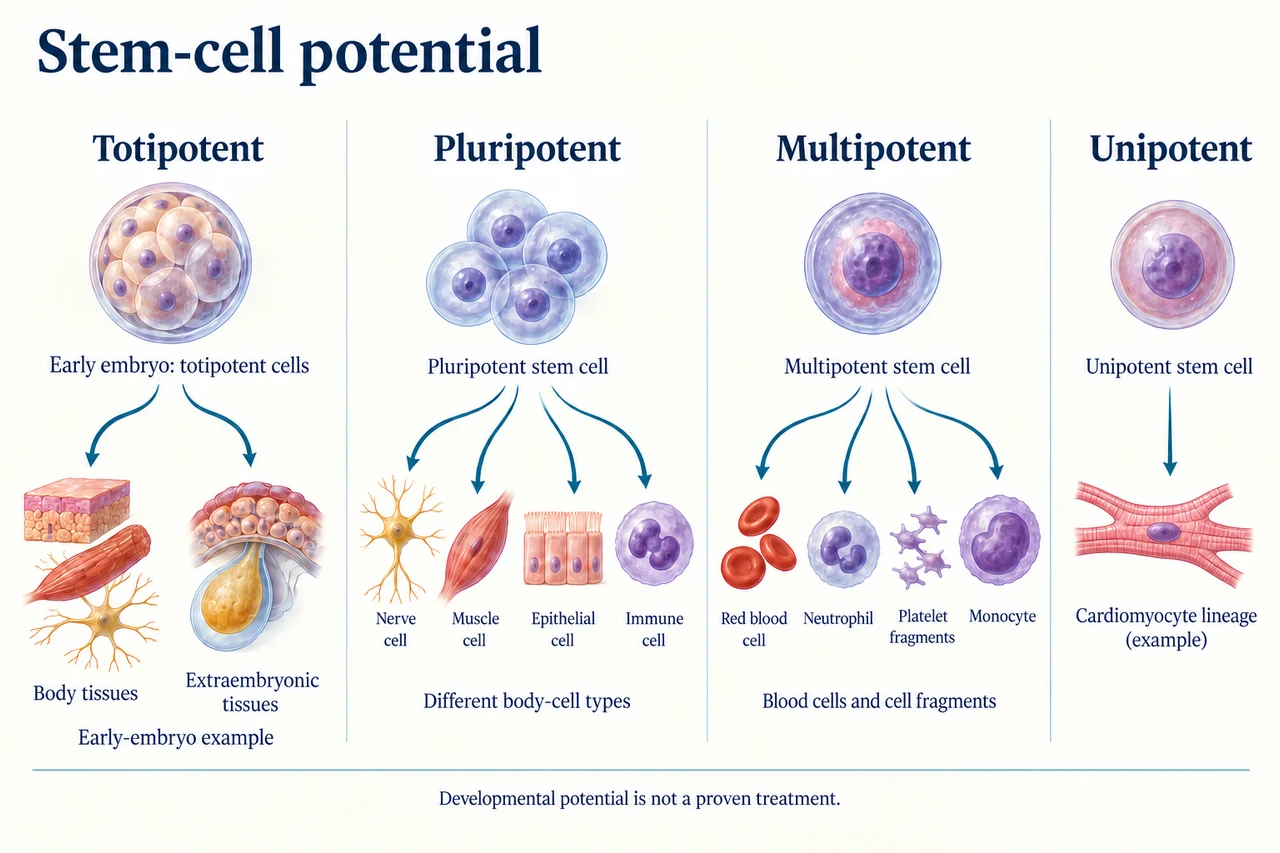
Original myAudience scientific concept illustration; not a photograph or measured specimen. · Original generated project artwork; no source textbook figures reused. Reference links support review, not a copied-art licence.
Stem-cell potential changes during differentiation
Cells with the same inherited genome can become specialised by expressing different genes. Stem cells can divide and give rise to more differentiated cells. Totipotent cells can contribute to embryonic and supporting extraembryonic tissues; pluripotent cells can form the major body-cell types. Multipotent cells have a restricted range, while unipotent cells generate one cell type. These terms describe developmental possibilities, not usefulness.
Induced pluripotent stem cells are generated by reprogramming suitable cells. Research and possible therapies require evidence, safety evaluation and ethical oversight; a cell’s potential does not establish a proven treatment.
Reprogramming somatic cells with appropriate transcription-factor interventions can generate induced pluripotent cells. Potential, continued self-renewal and a controlled useful outcome are separate properties. A proposed transplant also needs evidence about growth control and immune compatibility, so successful production of one cell lineage is an intermediate result rather than proof of a safe therapy.
Worked example: A stem-cell population can form several blood-cell types but not every body-cell type. Which category best fits?
Its potential includes multiple related cell types.
Its range is restricted rather than broadly pluripotent.
Answer: Multipotent.
Check your understanding: Does a specialised cell normally lack every gene used by other cell types?
Answer: No.
Why: Specialisation largely involves differences in gene expression rather than wholesale loss of unused genes.