Gene expression is controlled at several stages
By UK A Level Biology · independent study · myAudience
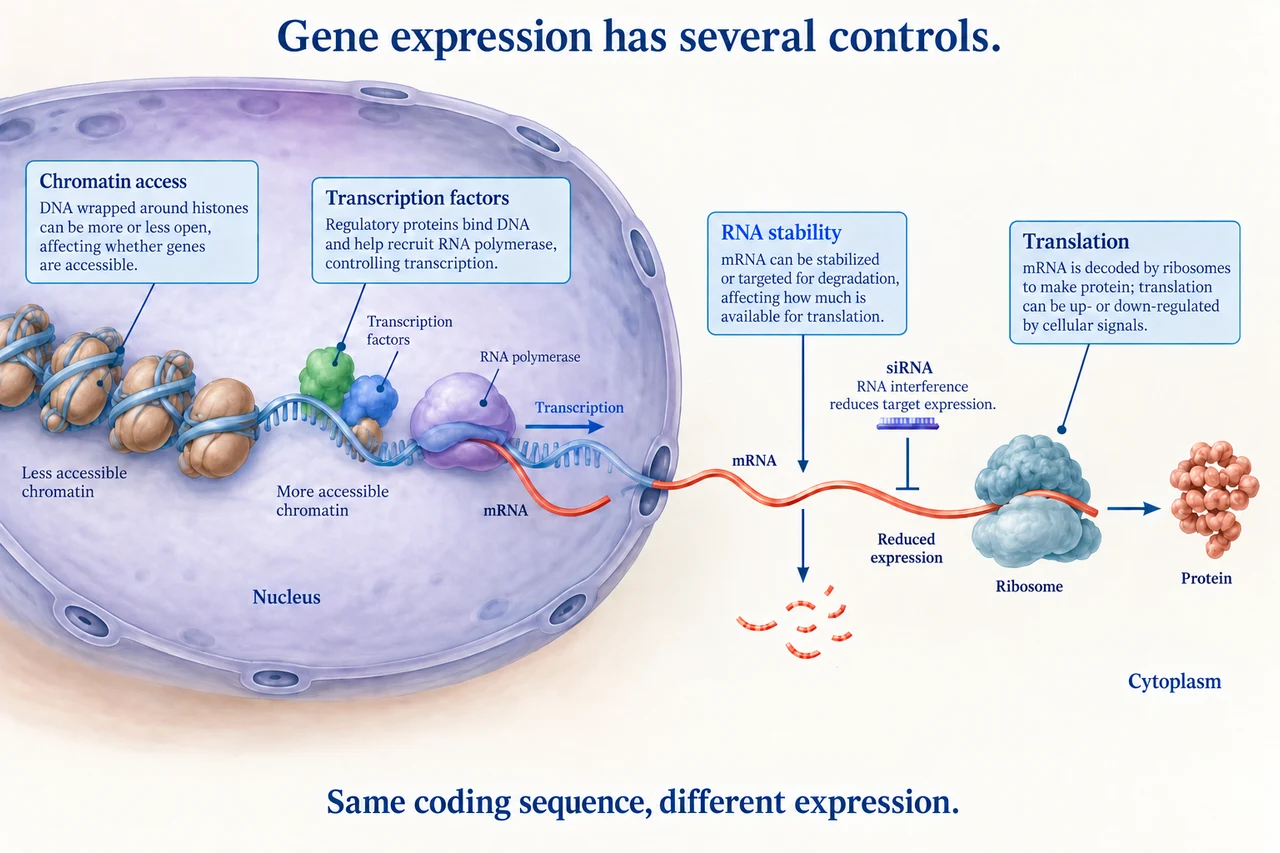
Original myAudience scientific concept illustration; not a photograph or measured specimen. · Original generated project artwork; no source textbook figures reused. Reference links support review, not a copied-art licence.
Gene expression is controlled at several stages
Transcription factors can influence whether a gene is transcribed. Some signalling molecules act through receptors that affect transcription-factor activity. Epigenetic regulation can alter access to DNA through processes such as DNA methylation and histone modification without changing the underlying base sequence.
Control also occurs after transcription. RNA interference can reduce expression through sequence-specific interactions with RNA. A gene’s presence therefore does not imply constant production of its protein. Regulation depends on context, and an association between a mark and expression does not establish every causal step.
In a simplified steroid-signalling model, oestrogen binds its receptor and the resulting regulatory activity can influence transcription in the nucleus. Increased DNA methylation or reduced histone acetylation can inhibit transcription in relevant contexts. Different mRNA amounts could also reflect differences in RNA stability; the measurements alone cannot uniquely identify an epigenetic cause.
Worked example: Two samples have identical coding sequences but different amounts of their mRNA. Suggest a regulatory explanation.
The coding sequence need not change for expression to differ.
Different transcription-factor activity or chromatin accessibility could affect transcription; RNA stability could also contribute.
Answer: Expression regulation can explain the difference, but further evidence is needed to identify the mechanism.
Check your understanding: Does adding a methyl group to DNA necessarily change its base sequence?
Answer: No.
Why: Epigenetic modifications can influence expression while the sequence remains the same.