Disrupted growth regulation can contribute to cancer
By UK A Level Biology · independent study · myAudience
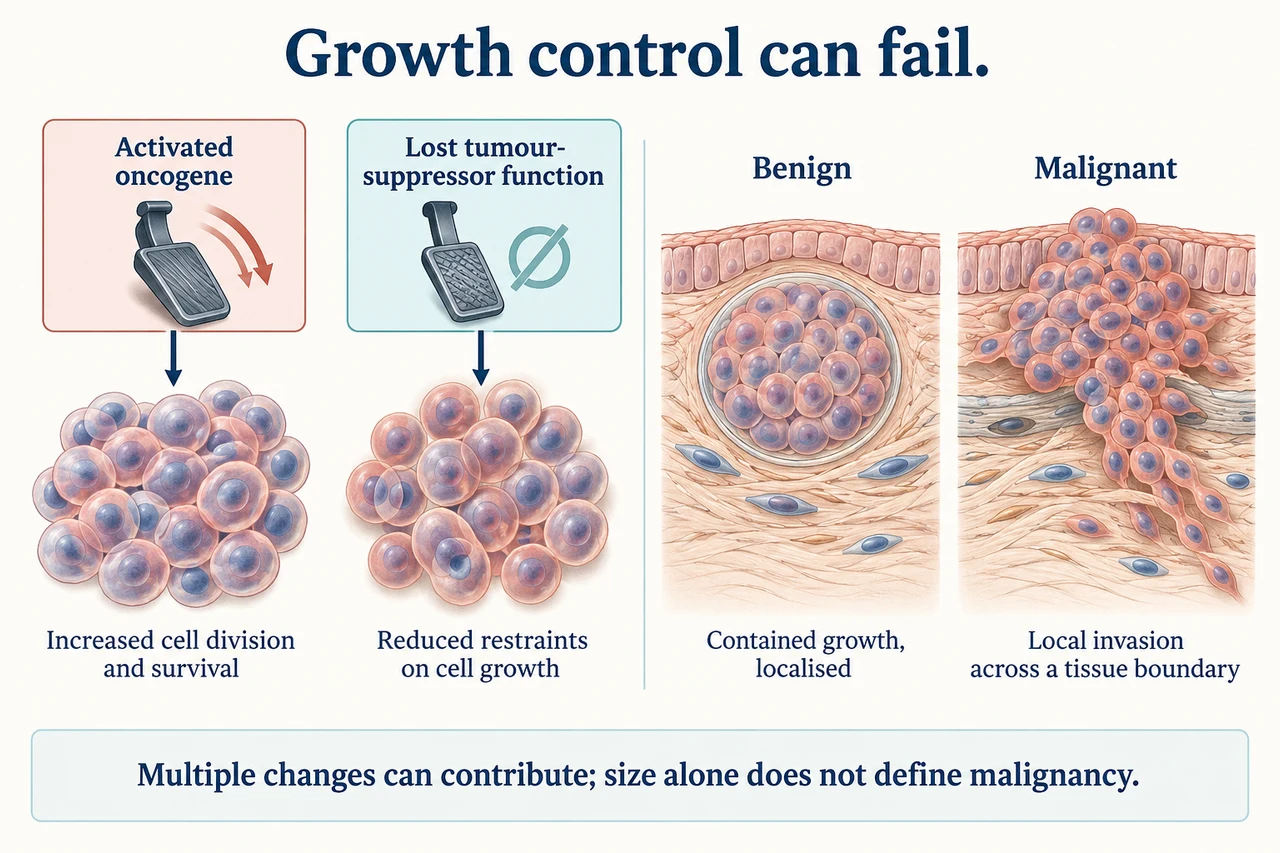
Original myAudience scientific concept illustration; not a photograph or measured specimen. · Original generated project artwork; no source textbook figures reused. Reference links support review, not a copied-art licence.
Disrupted growth regulation can contribute to cancer
Normal cell division is regulated by signals and checkpoints. Changes affecting genes that promote division or restrain it can contribute to uncontrolled proliferation. An activated oncogene and a disabled tumour-suppressor gene can disturb regulation through different mechanisms.
Benign and malignant tumours differ in invasion and spread, not simply size. Gene expression, epigenetic changes and some hormonal signals can influence particular cancers. Multiple changes and environmental factors can contribute, so a single finding is not an individual diagnosis or proof of a cause.
Abnormal methylation can suppress a protective gene without deleting its coding sequence. This differs from a coding mutation that changes the resulting protein. Some breast-cancer cells respond to oestrogen-related signalling, but that does not establish one identical mechanism for every breast cancer. A causal explanation must link the molecular change with cell behaviour and other evidence.
Worked example: A normal regulatory gene produces a protein that restrains division. A mutation prevents production of functional protein. Explain a possible consequence.
The restraining signal is weakened or lost.
Cells may divide more readily if other controls also permit it.
Answer: Loss of a tumour-suppressor function can contribute to excessive proliferation.
Check your understanding: Can a correlation between an exposure and cancer establish causation by itself?
Answer: No.
Why: Confounding, study design and other evidence must be considered before drawing a causal conclusion.