A genome sequence is a starting point
By UK A Level Biology · independent study · myAudience
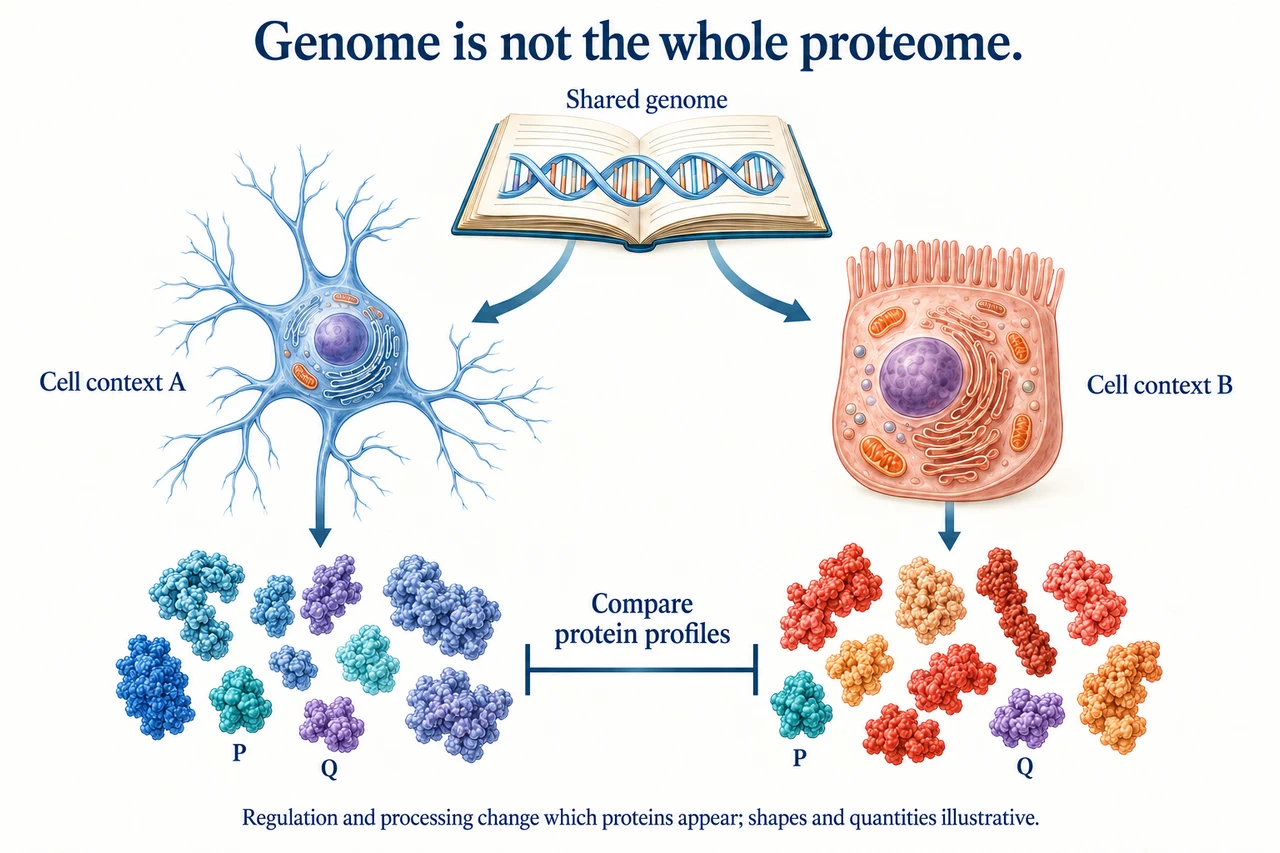
Original myAudience scientific concept illustration; not a photograph or measured specimen. · Original generated project artwork; no source textbook figures reused. Reference links support review, not a copied-art licence.
A genome sequence is a starting point
Sequencing identifies the order of bases in DNA. Comparing genomes can identify variants and suggest relationships or gene functions. A sequence alone does not directly reveal every protein present in a cell, because gene regulation, RNA processing and protein modification affect what is produced.
The proteome describes proteins in a particular biological context and can change across tissues or conditions. Many eukaryotic genomes contain substantial non-coding sequence. Interpreting sequence data therefore requires evidence beyond a simple count of apparent protein-coding genes.
Sequence data can suggest an antigen for vaccine research in a simpler organism, but expression, recognition and protection still require evidence. Alternative RNA processing and later protein modification can produce several forms from shared genetic material. Distinguish a predicted product from a measured one: sequencing alone does not provide its abundance or effect in a stated tissue and condition.
Worked example: Two tissues from one person have largely the same genome but different protein profiles. Is this contradictory?
The genome provides shared instructions.
Different expression and processing can produce different sets or amounts of proteins.
Answer: No; a shared genome can support different proteomes.
Check your understanding: Does identifying a DNA variant automatically establish its biological effect?
Answer: No.
Why: Functional evidence and the variant’s context are needed to interpret its consequences.