Recombinant DNA combines biological instructions
By UK A Level Biology · independent study · myAudience
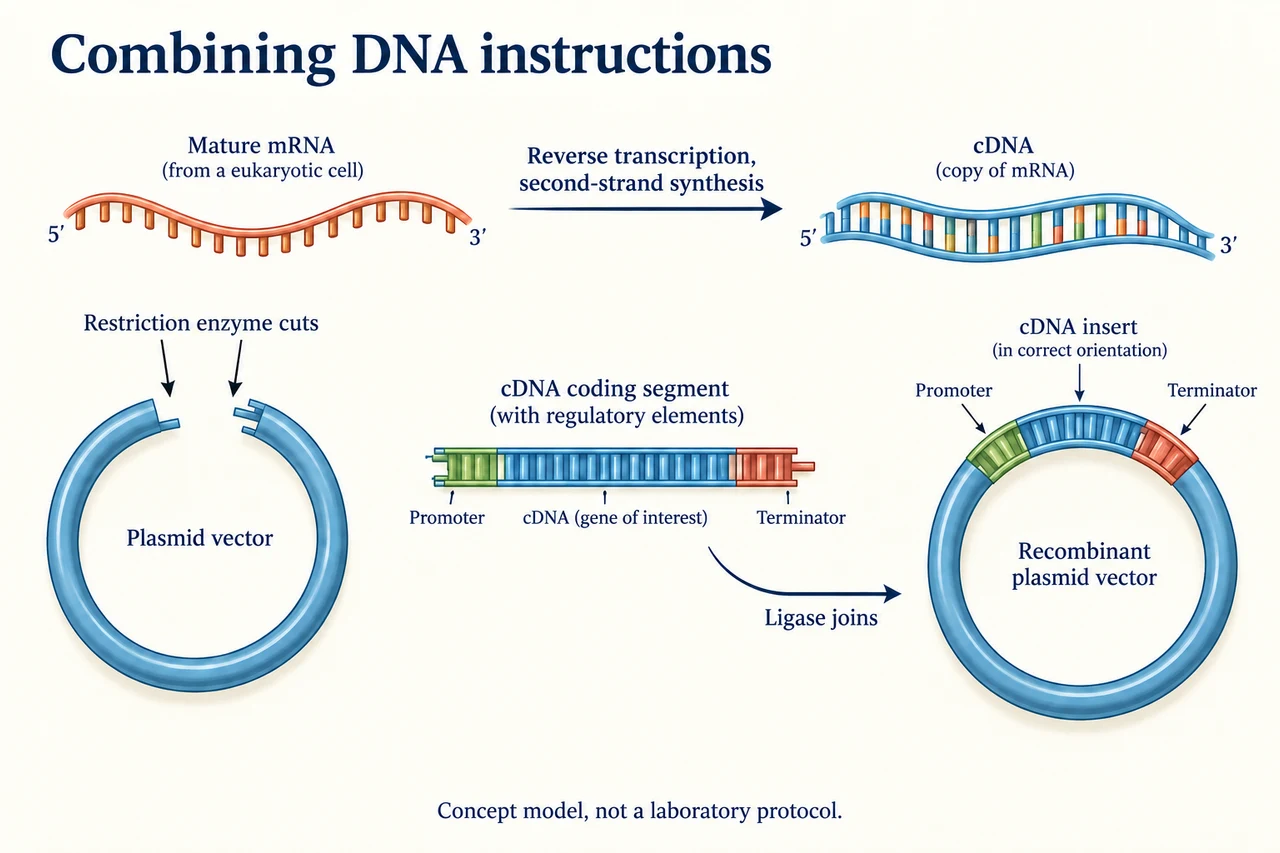
Original myAudience scientific concept illustration; not a photograph or measured specimen. · Original generated project artwork; no source textbook figures reused. Reference links support review, not a copied-art licence.
Recombinant DNA combines biological instructions
Recombinant DNA joins genetic material in a new combination. A coding sequence can be obtained from DNA or through a complementary DNA copy of RNA. Restriction enzymes and ligase have distinct roles in cutting and joining DNA, while vectors can carry a sequence into a suitable host.
Expression requires more than inserting a coding region: appropriate regulatory elements and host compatibility matter. PCR amplifies selected DNA sequences rather than automatically producing their proteins. Genetic modification raises questions about benefits, risks, consent and environmental consequences. This explanation is not a laboratory protocol.
Reverse transcriptase can produce cDNA from an RNA template, avoiding the introns present in suitable eukaryotic genomic sequences. Promoter and terminator regions help control expression in a compatible host. An ideal PCR doubling model gives 2ⁿ copies from one starting target after n rounds, but actual yield can depart from that model. Gene therapy additionally needs effective delivery and evidence of a useful outcome.
Worked example: A host bacterium cannot perform the same RNA splicing as a human cell. Why might a cDNA copy of mature mRNA be useful for expressing a human protein?
Mature mRNA has had relevant introns removed.
Its cDNA copy can provide a continuous coding sequence without requiring that human splicing process.
Answer: It can avoid the need for the bacterial host to remove those introns.
Check your understanding: Is DNA ligase the enzyme that selects and cuts a restriction site?
Answer: No.
Why: Restriction enzymes cut at their recognised sites; ligase joins suitable DNA ends.