DNA probes detect complementary sequences
By UK A Level Biology · independent study · myAudience
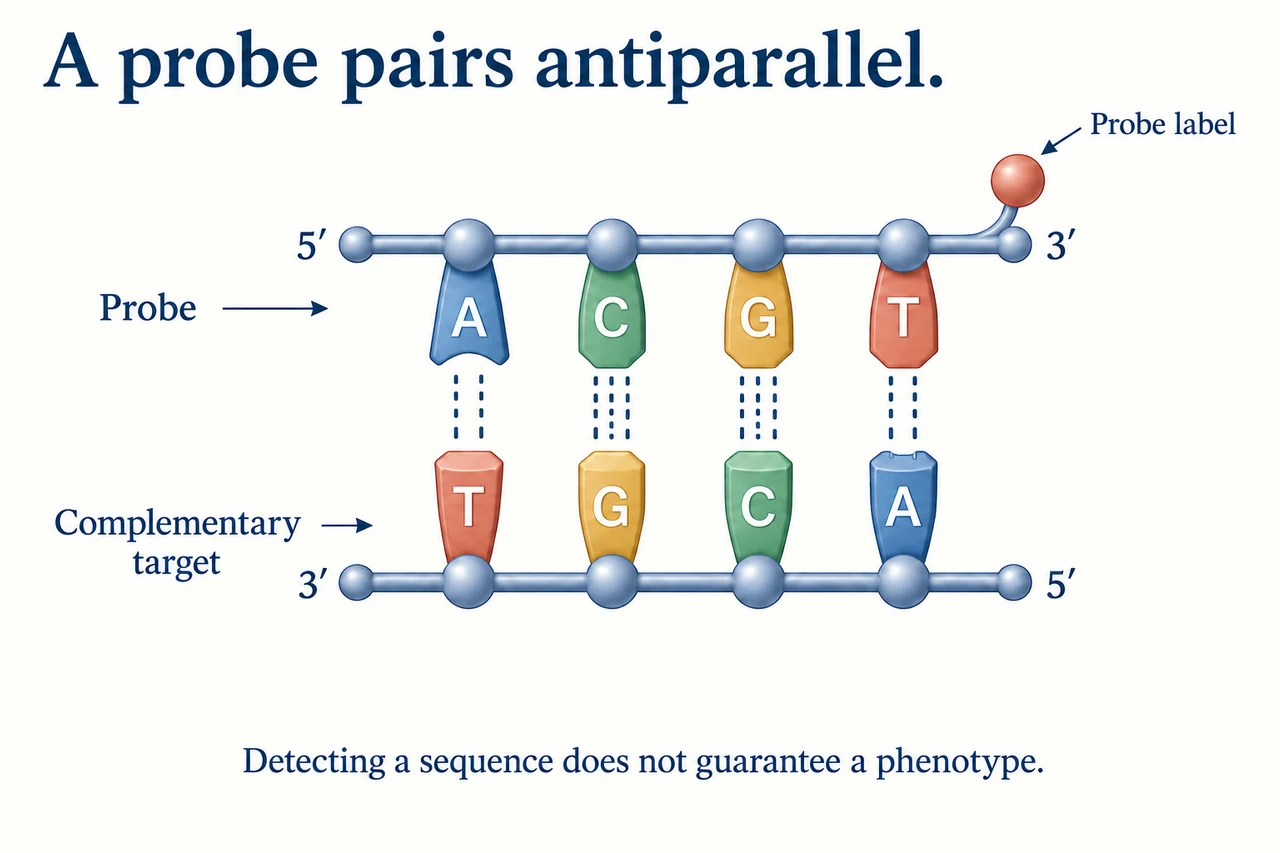
Original myAudience scientific concept illustration; not a photograph or measured specimen. · Original generated project artwork; no source textbook figures reused. Reference links support review, not a copied-art licence.
DNA probes detect complementary sequences
A DNA probe is a labelled sequence designed to pair with a complementary target under suitable conditions. Hybridisation can help detect a particular allele or sequence. Interpretation depends on probe specificity, experimental controls and the reliability of the test.
Genetic information can inform some diagnoses or drug-response predictions, but a result may be uncertain or only change a probability. Counselling can help people understand implications for themselves and relatives. Privacy, informed consent and the limits of prediction matter alongside the detection method.
Sequence direction matters: a probe written 5′–ACGT–3′ pairs with 3′–TGCA–5′. Writing the target in its own 5′-to-3′ direction reverses its order. A detected variant may have incomplete penetrance or interact with other variants and the environment. Separate the reliability of detecting a sequence from the strength of a prediction about its consequences.
Worked example: A short probe is 5′–ACGT–3′. Write its antiparallel complementary target.
Pair A with T and C with G.
Keep the strands antiparallel.
Answer: 3′–TGCA–5′.
Check your understanding: Does a detected risk-associated allele prove that a person will develop a condition?
Answer: No.
Why: Penetrance, environment and other variants can affect risk; a detection result is not necessarily a certain prediction.