DNA profiles compare variable regions
By UK A Level Biology · independent study · myAudience
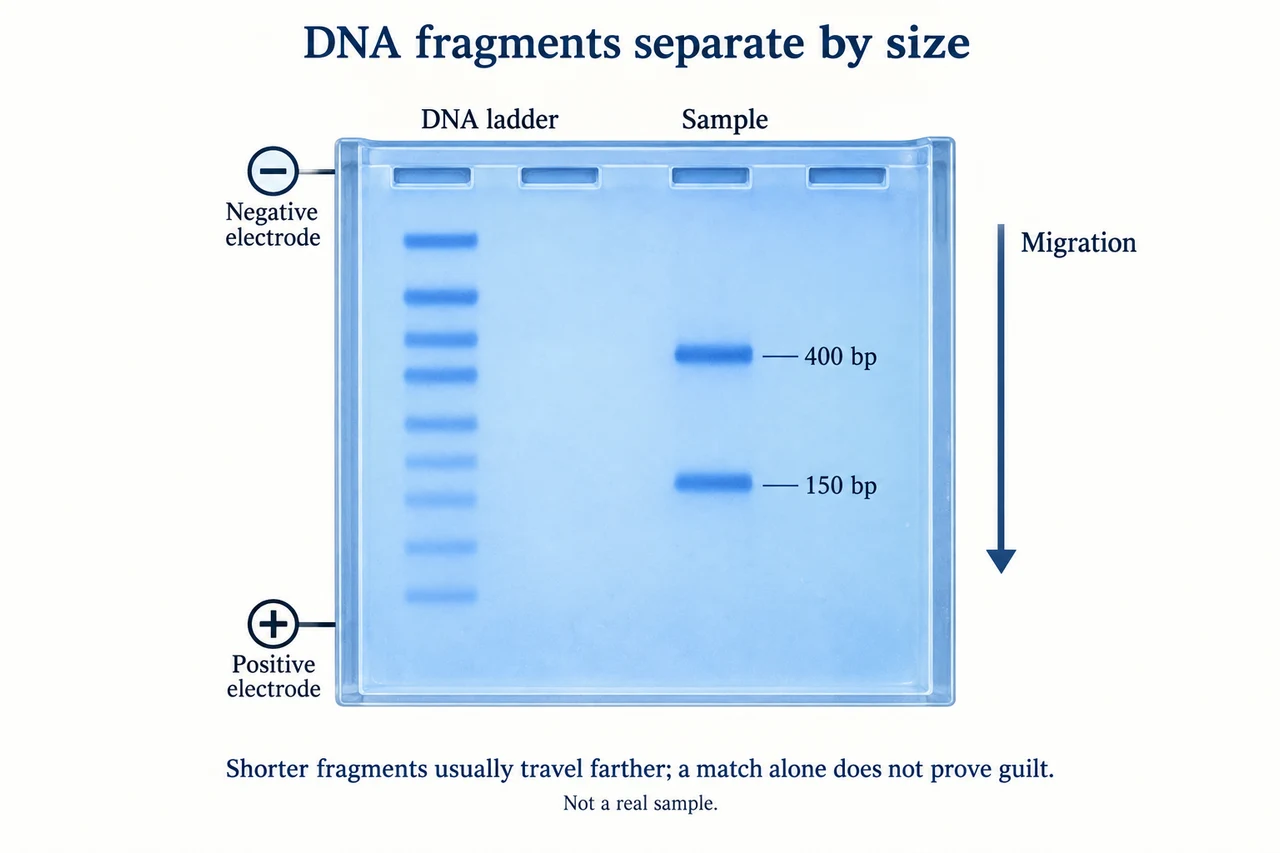
Original myAudience scientific concept illustration; not a photograph or measured specimen. · Original generated project artwork; no source textbook figures reused. Reference links support review, not a copied-art licence.
DNA profiles compare variable regions
DNA profiles can compare variable DNA regions, including regions with different repeat numbers. Amplified fragments can be separated by electrophoresis; under comparable conditions, shorter DNA fragments usually travel farther through the gel. Several regions provide more discrimination than one region alone.
A matching profile can support a relationship or identification hypothesis, but interpretation requires statistical context, sample quality and possible contamination. Identical twins can share the usual inherited profile. A profile match does not by itself show how DNA arrived at a location or establish guilt.
DNA’s negatively charged backbone explains migration toward the positive electrode in a standard gel. A size ladder is a reference for fragment length, not a scale of genetic similarity. Kinship comparisons use inheritance at several variable regions and statistical context: sharing one fragment does not uniquely establish a relationship. Mixed or degraded samples may complicate which contributors can be distinguished.
Worked example: Two fragments of 150 and 400 base pairs are separated under the same suitable gel conditions. Which usually travels farther?
Both DNA fragments migrate toward the positive electrode.
The smaller fragment moves more readily through the gel matrix.
Answer: The 150-base-pair fragment usually travels farther.
Check your understanding: Does a profile match alone prove a person committed an offence?
Answer: No.
Why: The match concerns biological material; timing, transfer, contamination and other evidence remain relevant.