Distinguishing initial rate from average rate
By UK A Level Biology · independent study · myAudience
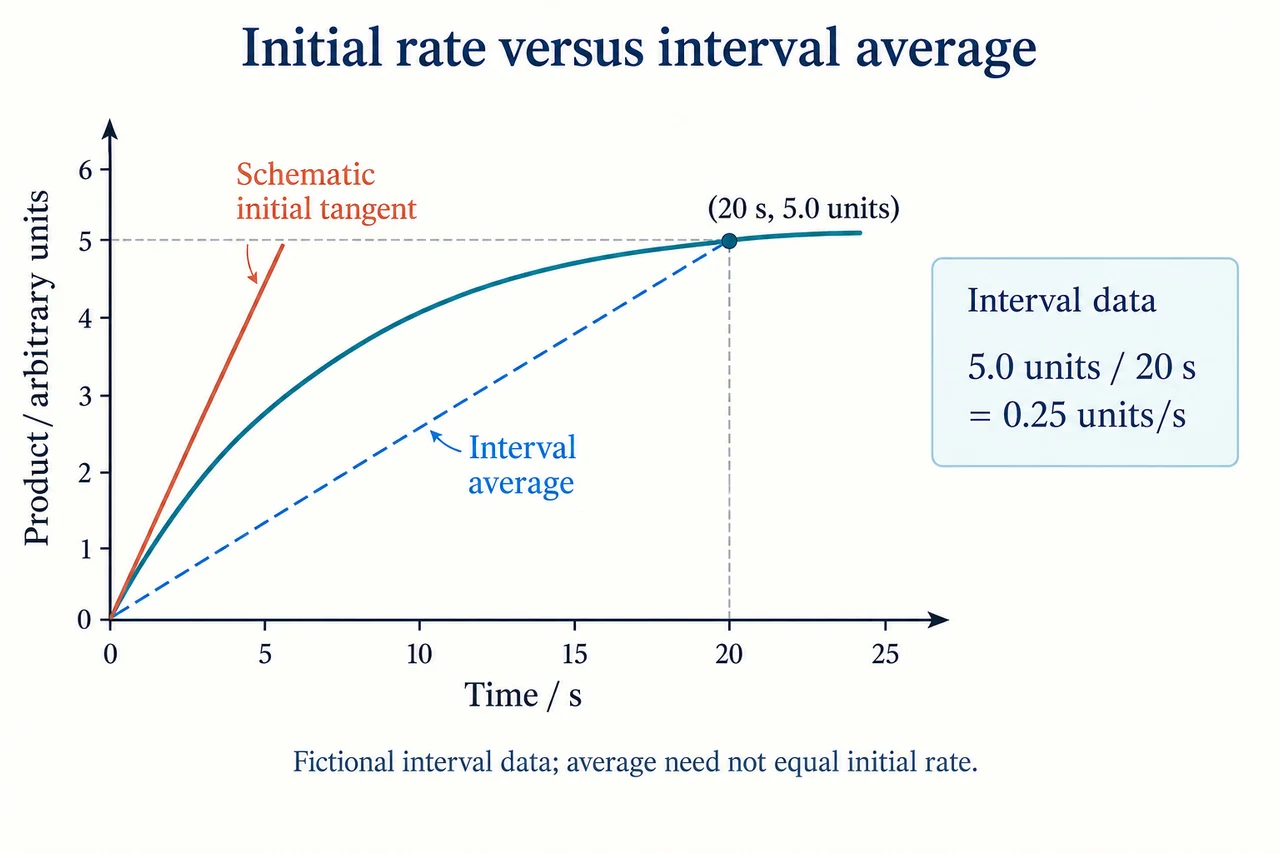
Original myAudience scientific concept illustration; not a photograph or measured specimen. · Original generated project artwork; no source textbook figures reused. Reference links support review, not a copied-art licence.
Distinguishing initial rate from average rate
An enzyme investigation compares a defined response when one factor changes. The dependent variable might be product formed per unit time, or a calibrated signal representing it. Initial rate is useful before substrate depletion or product accumulation substantially alters conditions. A tangent to a product–time curve at its start estimates that instantaneous rate; joining two observations gives an average over an interval.
Control enzyme amount, substrate conditions, pH, temperature and timing except the named independent variable. A blank can reveal a background signal unrelated to the intended reaction. Repeats help describe variation, but repeating a miscalibrated instrument does not remove its systematic error. State the units and how the measured signal is related to the biological process.
Compare rates rather than simply final product amounts if observation times differ. If using time to a common endpoint, 1/time can serve as a relative rate index, not an automatically calibrated concentration rate. This lesson prepares analysis for the practical study; reagents and equipment require supervised school methods. Reading it is not evidence of apparatus competence or practical endorsement.
Worked example: A reaction forms 5.0 arbitrary product units in its first 20 s. Calculate the interval-average rate.
Divide change in product by elapsed time: 5.0 / 20.
Retain both product and time units.
Answer: The average is 0.25 product units/s; it need not equal the instantaneous initial rate.
Check your understanding: Why might a later interval show a lower rate even at unchanged temperature?
Answer: Substrate may have been depleted or product accumulated.
Why: The reaction mixture can change during measurement, so time itself can alter the comparison.