Using a mitotic index with clear counting rules
By UK A Level Biology · independent study · myAudience
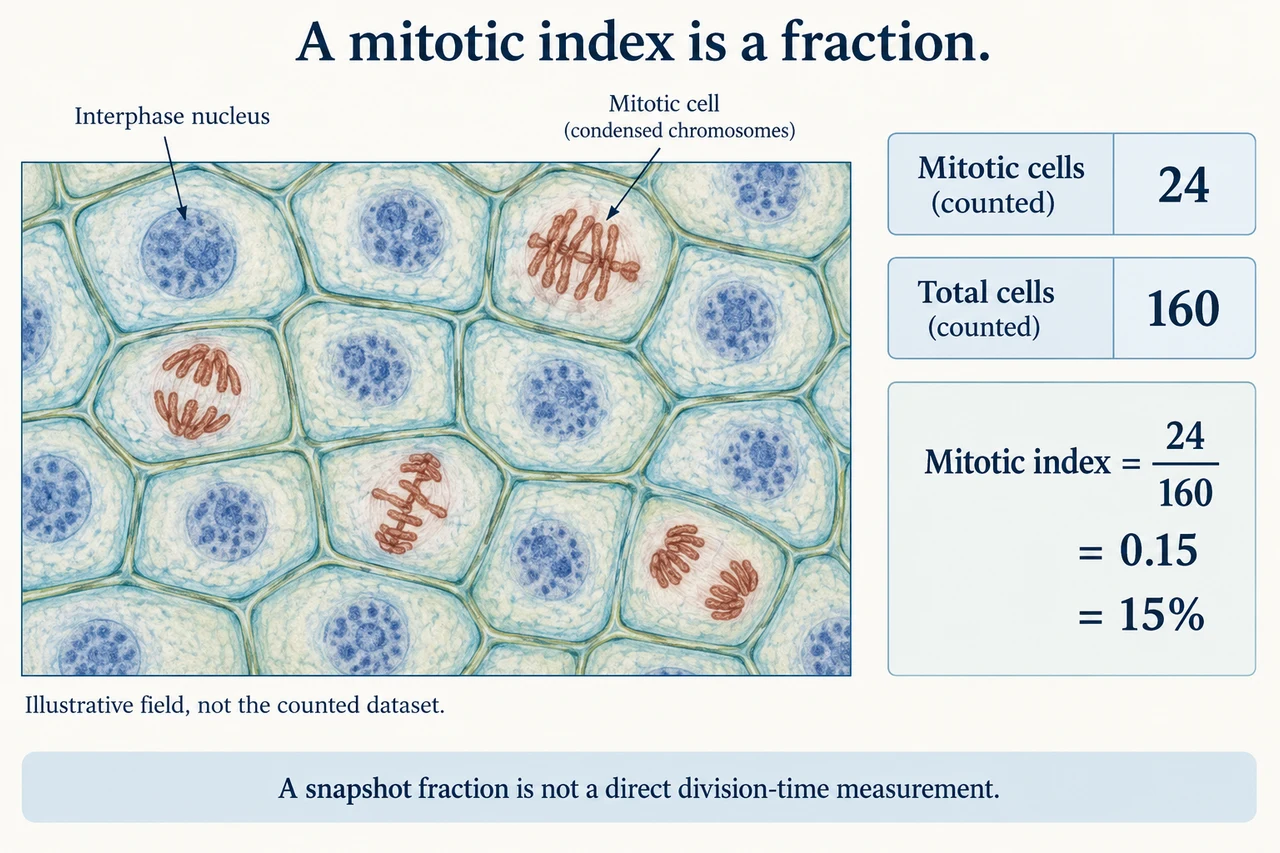
Original myAudience scientific concept illustration; not a photograph or measured specimen. · Original generated project artwork; no source textbook figures reused. Reference links support review, not a copied-art licence.
Using a mitotic index with clear counting rules
A root-tip field contains cells in different stages of the cell cycle. A mitotic index is the number classified as undergoing mitosis divided by the total counted. Identify stages from observed chromosome organisation, using consistent rules; a dark stain alone does not identify a dividing cell. Suitable representative fields and clear cell boundaries matter for the result.
A larger mitotic index means a larger observed fraction in mitosis, not automatically faster individual divisions. Cells can spend different lengths of time in phases. Estimating phase duration from a fraction requires a suitably sampled, approximately steady asynchronous population and a stated total cycle time. Damage, selection of unusually active regions or unclear images can invalidate that inference.
Record totals as well as fractions so sampling effort is visible. Repeated fields can reveal spatial variability; counting the same cell twice creates bias. Preparation, staining and optical-microscope work are supervised practical skills not demonstrated by reading an image. This lesson develops interpretation for the practical study using invented counts, not instructions for handling stains or squashing tissue.
Worked example: A supplied image set contains 24 mitotic cells among 160 cells. Find the mitotic index.
Divide the mitotic count by the total: 24 / 160 = 0.15.
Multiply by 100 if a percentage is requested.
Answer: The mitotic index is 0.15, or 15% of counted cells.
Check your understanding: Does an index of 0.15 prove mitosis lasts exactly 15% of every cell cycle?
Answer: No; that inference requires additional assumptions.
Why: A snapshot proportion is not a direct timing measurement of each cell.