Estimating tissue water potential from calibration data
By UK A Level Biology · independent study · myAudience
Original myAudience scientific concept illustration; not a photograph or measured specimen. · Original generated project artwork; no source textbook figures reused. Reference links support review, not a copied-art licence.
Estimating tissue water potential from calibration data
A solute dilution series provides known comparison solutions. Plant tissue can gain water from a solution with a higher water potential or lose water to one with a lower potential, through selectively permeable membranes. This practical study uses a calibration relationship to estimate tissue water potential. Use a stated relation between solution concentration and potential; concentration alone is not already a value in kPa.
Percentage mass change is (final − initial) / initial × 100. Standardised tissue dimensions, exposure time, temperature and surface-liquid removal support fair comparisons. A zero crossing estimates the condition with no measured net mass change under the chosen conditions. Water molecules still move in both directions at equilibrium, and different tissue pieces can vary.
Interpolation is an estimate within the observed range. A straight line between nearby points may be reasonable in a supplied simplified example, but curvature and measurement uncertainty limit its precision. Do not extrapolate far beyond the calibration as though its form were guaranteed. This is data-analysis preparation; solution preparation and measurement competence require supervised practical work.
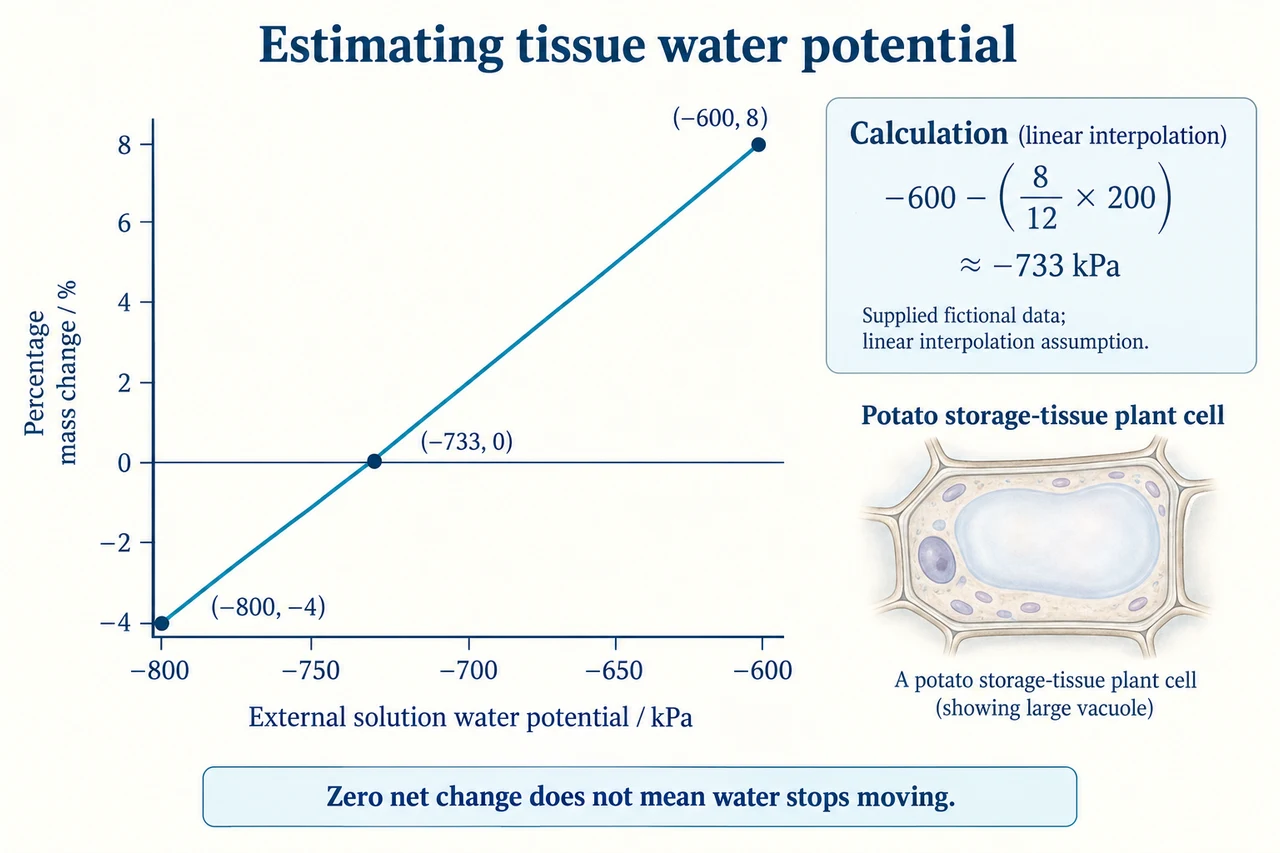
Worked example: At −600 kPa mass change is +8%; at −800 kPa it is −4%. Estimate the zero using linear interpolation.
The change spans 12 percentage points across 200 kPa.
Zero is 8/12 of the interval from −600 toward −800.
Calculate −600 − (8/12 × 200).
Answer: The estimated zero is about −733 kPa, subject to the local linear model and uncertainty.
Check your understanding: At zero net mass change, have water molecules stopped crossing membranes?
Answer: No.
Why: Opposing movements can balance without molecular motion stopping.