Interpreting pigment leakage through membranes
By UK A Level Biology · independent study · myAudience
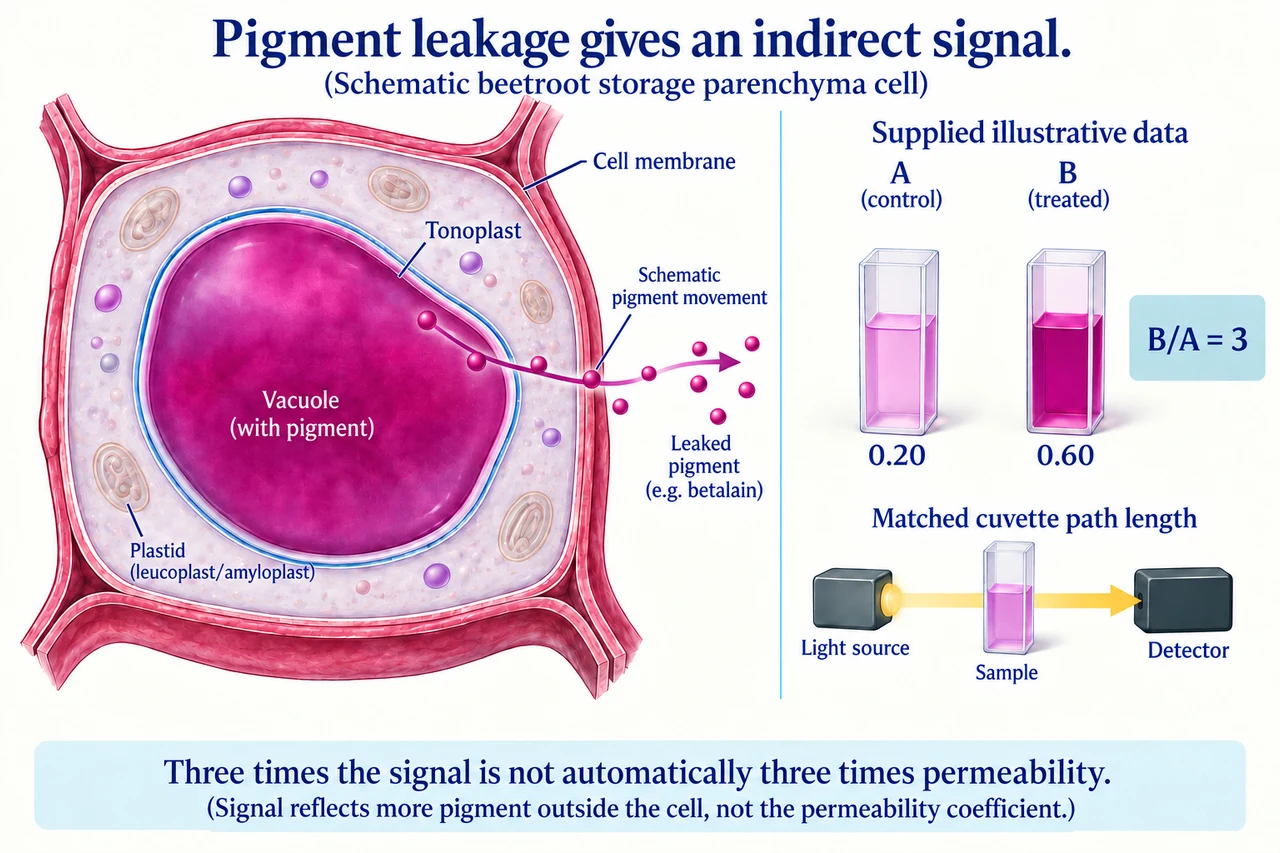
Original myAudience scientific concept illustration; not a photograph or measured specimen. · Original generated project artwork; no source textbook figures reused. Reference links support review, not a copied-art licence.
Interpreting pigment leakage through membranes
A membrane-permeability investigation can use pigment released from plant tissue as an indirect response. Pigment stored inside suitable cells reaches the surrounding solution when relevant membrane barriers permit leakage. Colour or absorbance therefore provides evidence under the conditions tested, rather than a direct count of damaged membranes.
Comparable tissue dimensions, starting material, exposure duration and measurement conditions matter. Pigment already on a cut surface can affect the initial background, so the approved method must address that source consistently. Temperature can influence membranes and protein structure; it may also affect other aspects of the measurement. Change the named variable while controlling plausible alternatives.
An absorbance difference is a signal difference. Turning it into pigment concentration requires a suitable calibration and working range; turning it into permeability requires further biological assumptions. A blank and repeats support interpretation, while cloudy samples can distort optical readings. This practical study includes supervised apparatus skills that this supplied-data lesson does not certify.
Worked example: Corrected absorbance is 0.20 in A and 0.60 in B. Compare the signals.
Divide B by A: 0.60 / 0.20 = 3.
State the measured quantity rather than substituting an unmeasured one.
Answer: B has three times the absorbance signal; this alone does not establish three times the membrane permeability.
Check your understanding: Why use comparable tissue surface area?
Answer: Exposed area can change the amount of pigment released.
Why: A difference caused by sample geometry could be mistaken for the effect of the named variable.