Separating antimicrobial effect from diffusion
By UK A Level Biology · independent study · myAudience
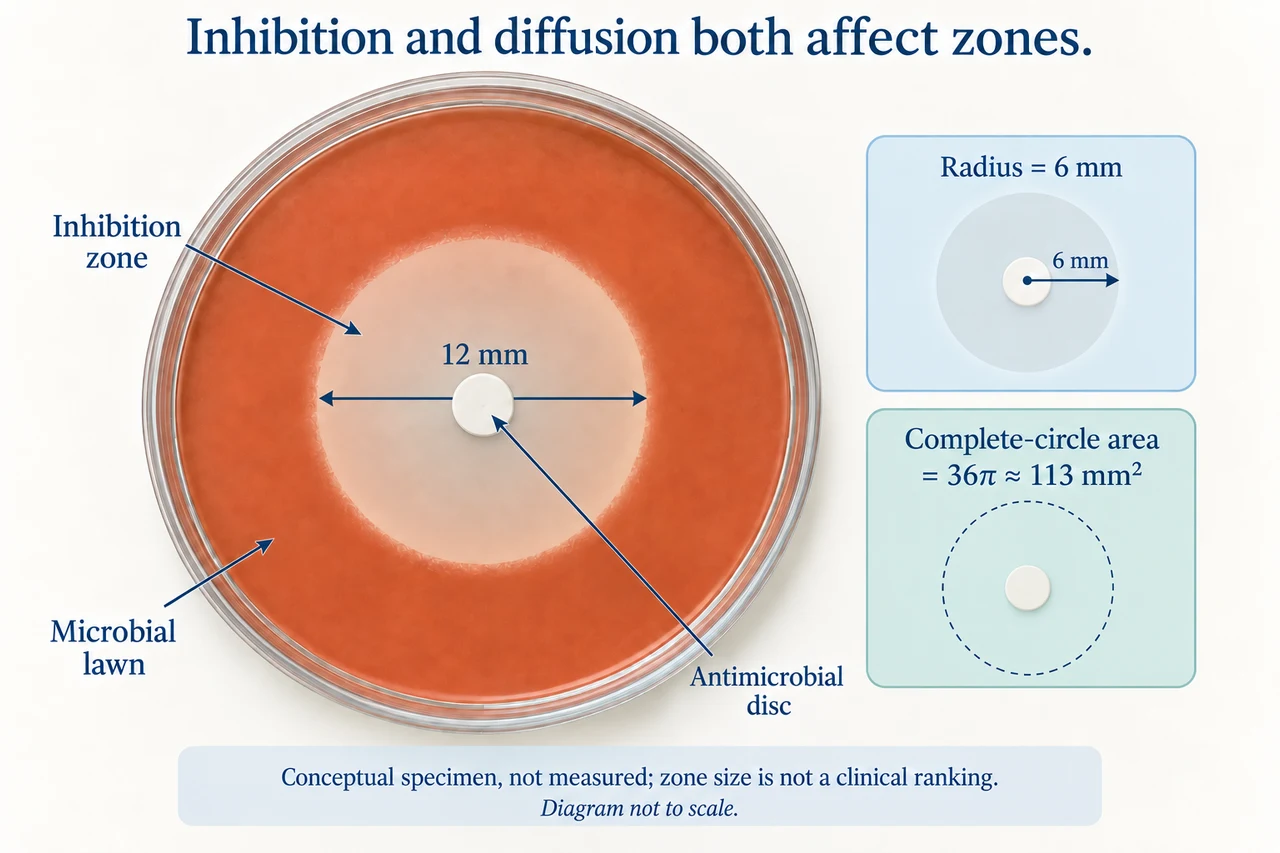
Original myAudience scientific concept illustration; not a photograph or measured specimen. · Original generated project artwork; no source textbook figures reused. Reference links support review, not a copied-art licence.
Separating antimicrobial effect from diffusion
A clear zone around an antimicrobial source indicates inhibited visible microbial growth under the assay conditions. Its size depends on the organism, dose, diffusion, medium and duration as well as antimicrobial action. A wider zone is not a universal ranking of clinical effectiveness and cannot prescribe treatment for a person.
Use a matched carrier control and comparable sources, medium and organism when evaluating supplied results. Aseptic technique aims to prevent contamination of the work and exposure of people or surroundings; it requires supervised training, containment and safe disposal. This lesson supplies no organism-growing protocol or home-culture instructions.
A zone’s diameter is not its radius. For a complete circular zone use πr²; if the question asks for only the clear area outside a disc, subtract the disc area. Irregular boundaries make the circular approximation uncertain. Repeat measurements and state the convention, because differently defined areas cannot be directly compared.
Worked example: A complete circular clear zone has diameter 12 mm. Calculate its area.
Radius is 6 mm.
Area is π × 6² = 36π mm².
Answer: The complete circle is approximately 113 mm²; a disc-excluded area needs the disc dimensions.
Check your understanding: Does a larger zone necessarily mean a better drug for a patient?
Answer: No.
Why: Assay conditions, diffusion and clinical evidence are different considerations.