Using an indicator to compare chloroplast activity
By UK A Level Biology · independent study · myAudience
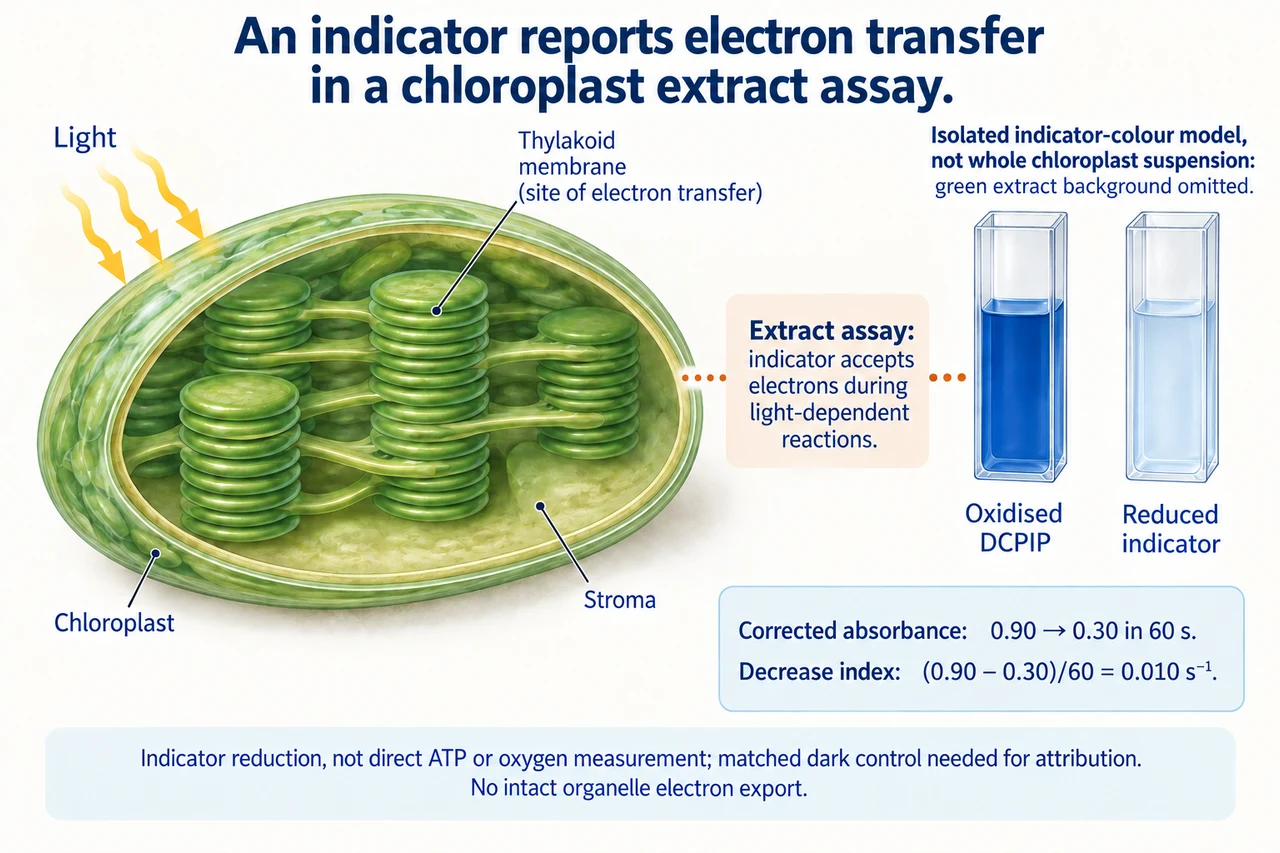
Original myAudience scientific concept illustration; not a photograph or measured specimen. · Original generated project artwork; no source textbook figures reused. Reference links support review, not a copied-art licence.
Using an indicator to compare chloroplast activity
In a suitable chloroplast-extract model, DCPIP acts as an electron-accepting indicator. Its oxidised form is blue; reduction decreases that colour. The signal can help compare electron-transfer-related activity under defined conditions. It is an assay response, not a direct measurement of oxygen volume, carbon fixation or ATP molecules produced.
Compare equal starting extract and indicator amounts, measurement conditions and elapsed time except the named variable. A dark comparison can test a light-dependent contribution, while other appropriate controls help distinguish activity from background colour or turbidity. The interpretation depends on which factor was changed; different control outcomes answer different questions.
A decrease in corrected absorbance per unit time gives an activity index. Calibration would be needed to convert it into a chemical amount, and early comparable intervals reduce effects of indicator depletion. Chloroplast extraction and reagent handling belong to supervised approved practical work. This lesson prepares interpretation of the practical study without copying a laboratory protocol.
Worked example: Corrected absorbance falls from 0.90 to 0.30 in 60 s. Find the magnitude of its interval rate of decrease.
Signal decrease is 0.90 − 0.30 = 0.60.
Divide by 60 s.
Answer: The decrease index is 0.010 absorbance units/s, not a direct ATP-production rate.
Check your understanding: What does colour loss in this indicator model support?
Answer: Reduction of the indicator under the assay conditions.
Why: That defined chemical signal should not be renamed as an unmeasured oxygen or ATP output.