Defining what a respiration assay measures
By UK A Level Biology · independent study · myAudience
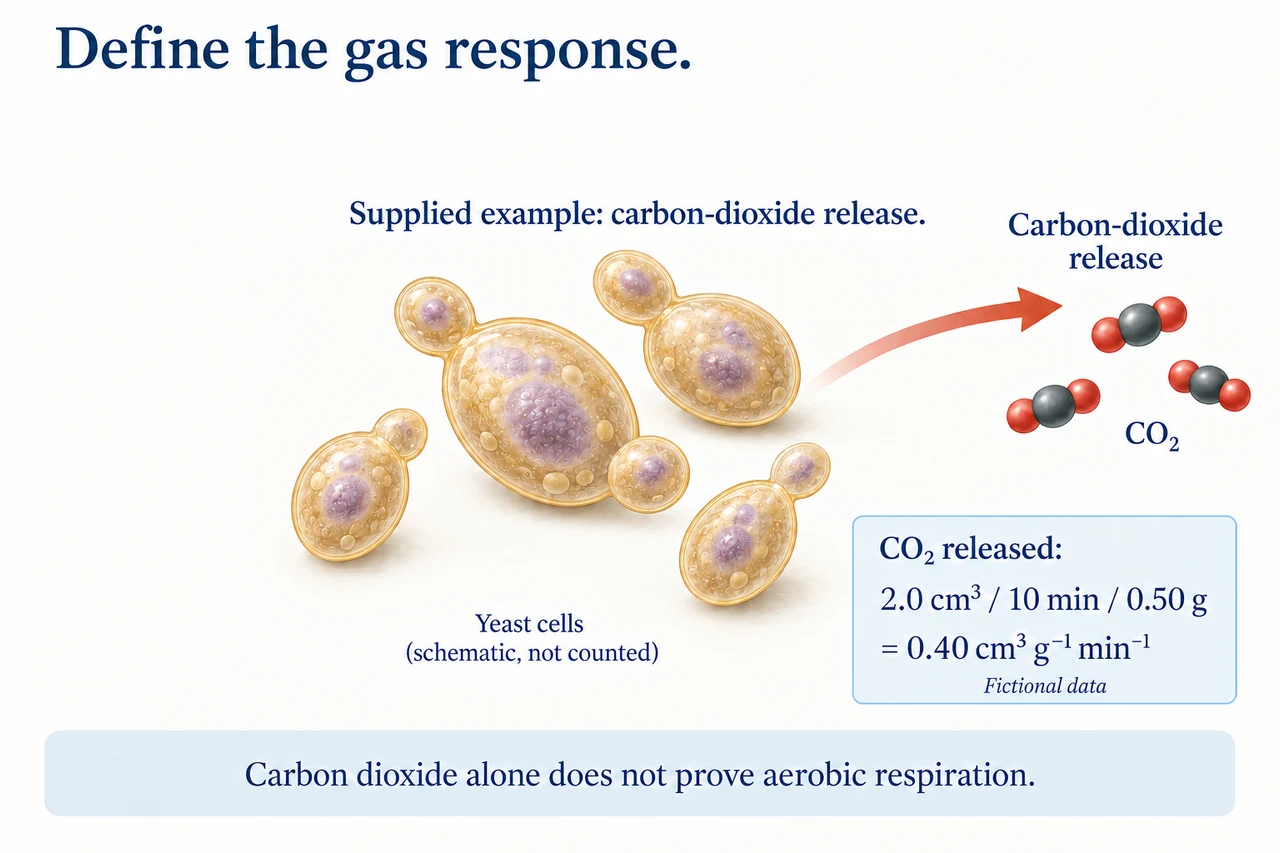
Original myAudience scientific concept illustration; not a photograph or measured specimen. · Original generated project artwork; no source textbook figures reused. Reference links support review, not a copied-art licence.
Defining what a respiration assay measures
A respiration investigation needs a defined measurable response. Oxygen consumption and carbon-dioxide release are different quantities; a gas-volume change may combine their effects unless the apparatus accounts for them. Temperature and pressure also affect volume, so matched conditions and appropriate controls are needed before assigning a change to respiration.
Express the response per time and, where appropriate, per stated mass or number of organisms. This allows comparisons between different amounts of biological material, but requires a clear definition of that amount. Yeast can release carbon dioxide during fermentation as well as aerobic respiration, so carbon-dioxide detection alone does not prove oxygen was consumed.
Use comparable starting cultures, substrate conditions and observation periods when interpreting supplied data. A blank helps identify non-biological apparatus changes; repeats describe variability. This practical study includes supervised microbial handling and measurement competence. This example is fictional analysis, with no culture-growing or gas-apparatus assembly procedure.
Worked example: A sample releases 2.0 cm³ of measured gas in 10 min and has stated mass 0.50 g. Calculate the mass-normalised rate.
Time rate is 2.0 / 10 = 0.20 cm³/min.
Divide by 0.50 g.
Answer: The measured gas rate is 0.40 cm³ g⁻¹ min⁻¹ under the stated conditions.
Check your understanding: Does carbon-dioxide release alone prove aerobic respiration?
Answer: No.
Why: Some organisms also release carbon dioxide in fermentation, so additional evidence is needed.