Interpreting an animal movement comparison
By UK A Level Biology · independent study · myAudience
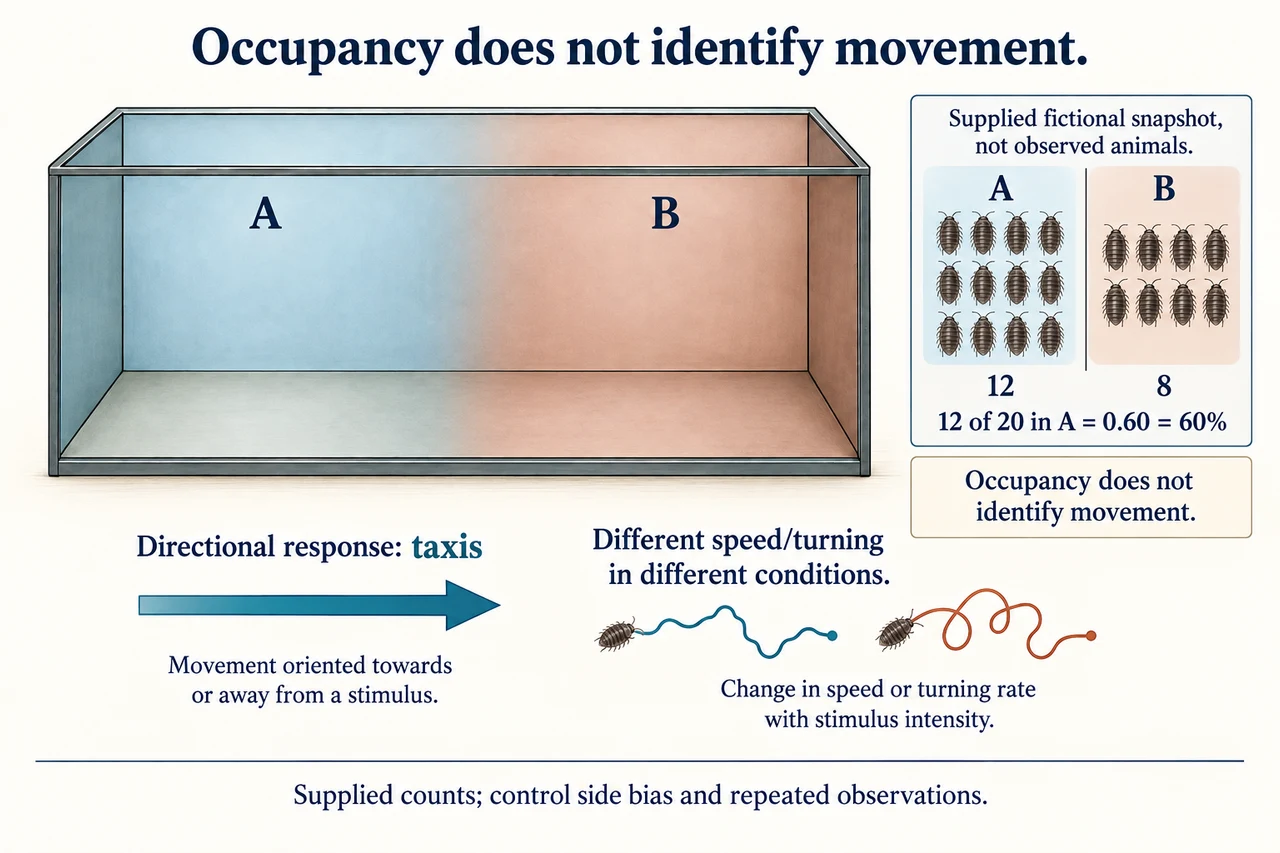
Original myAudience scientific concept illustration; not a photograph or measured specimen. · Original generated project artwork; no source textbook figures reused. Reference links support review, not a copied-art licence.
Interpreting an animal movement comparison
A choice chamber or maze can compare movement under a defined environmental factor. Record positions, transitions or movement measures at specified times. Occupancy alone shows where animals were observed; it does not establish whether they actively moved towards a stimulus or changed speed and turning in response to it.
Taxis is direction relative to a stimulus; kinesis changes movement rate or turning without a fixed direction toward it. To distinguish them, observations need relevant movement information. Apparatus-side preferences, handling, time and changing responses can confound a comparison. Suitable side randomisation and order control help separate the named factor from these alternatives.
Animals require species-appropriate, ethically approved conditions and supervised handling. Avoid treating repeated observations of the same individuals as independent new animals. State whether the denominator counts animals or observations, and keep interpretation within the evidence. This lesson analyses supplied counts for the practical study, not an instruction to expose animals to harmful conditions.
Worked example: At one observation, 12 of 20 animals are in compartment A. What fraction is in A?
Divide animals in A by the total: 12 / 20.
Express as a proportion or percentage.
Answer: The observed fraction is 0.60, or 60%; this does not by itself identify the movement mechanism.
Check your understanding: Why should apparatus sides be randomised in a suitable comparison?
Answer: To reduce a fixed side preference being confused with the treatment effect.
Why: An uncontrolled feature can influence position independently of the named environmental variable.