Reading a glucose calibration with dilution
By UK A Level Biology · independent study · myAudience
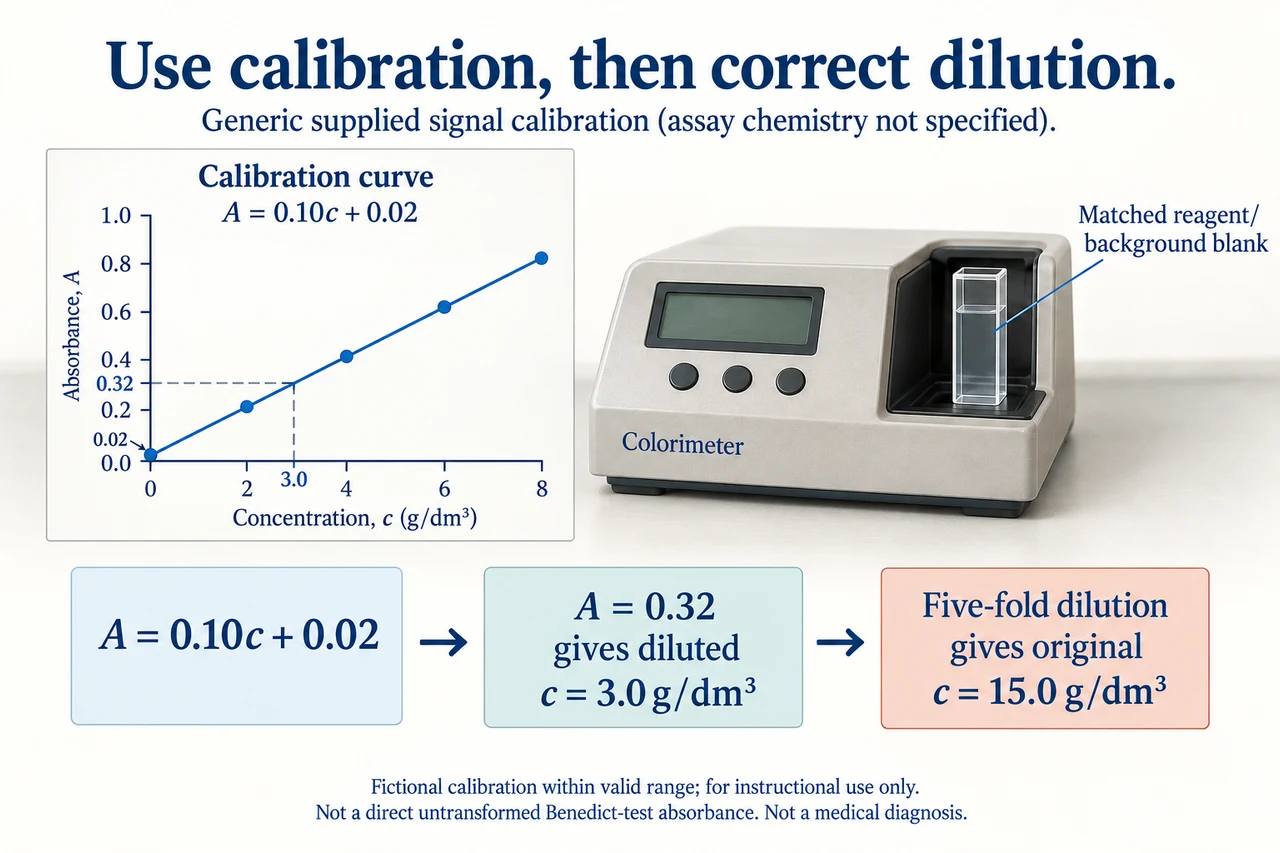
Original myAudience scientific concept illustration; not a photograph or measured specimen. · Original generated project artwork; no source textbook figures reused. Reference links support review, not a copied-art licence.
Reading a glucose calibration with dilution
A glucose calibration links responses from known concentrations with an unknown sample measured by the same method. Include a blank and use comparable reagent and measurement conditions. A dilution series defines the reference concentrations; labelling a sample unknown does not remove the need to know its dilution history.
Use the calibration within its suitable working range. Linear interpolation is appropriate only where the supplied relationship supports it; high absorbance or interference can require a validated alternative approach. An unknown may contain background colour or substances affecting the reaction. A matched blank and standards help evaluate those effects.
Correct for a known dilution after finding the concentration of the measured diluted sample. Concentration units and the dilution factor must be consistent. The school practical uses an artificial or otherwise approved sample context; fictional “urine” results here are not a diagnostic assessment. This practical study handling and apparatus skills remain supervised physical work, separate from this data-analysis lesson.
Worked example: A supplied calibration is A = 0.10c + 0.02, where c is g/dm³. A five-fold diluted sample gives A = 0.32. Find the original concentration.
Subtract the intercept: 0.32 − 0.02 = 0.30.
Divide by 0.10: diluted concentration is 3.0 g/dm³.
Multiply by the dilution factor 5.
Answer: The original concentration is 15 g/dm³, assuming the valid calibration and stated dilution.
Check your understanding: Why subtract the calibration intercept before finding concentration?
Answer: The response includes a background offset.
Why: Treating the entire response as glucose-related would overestimate concentration in this model.