Where electricity begins
By How things work · myAudience
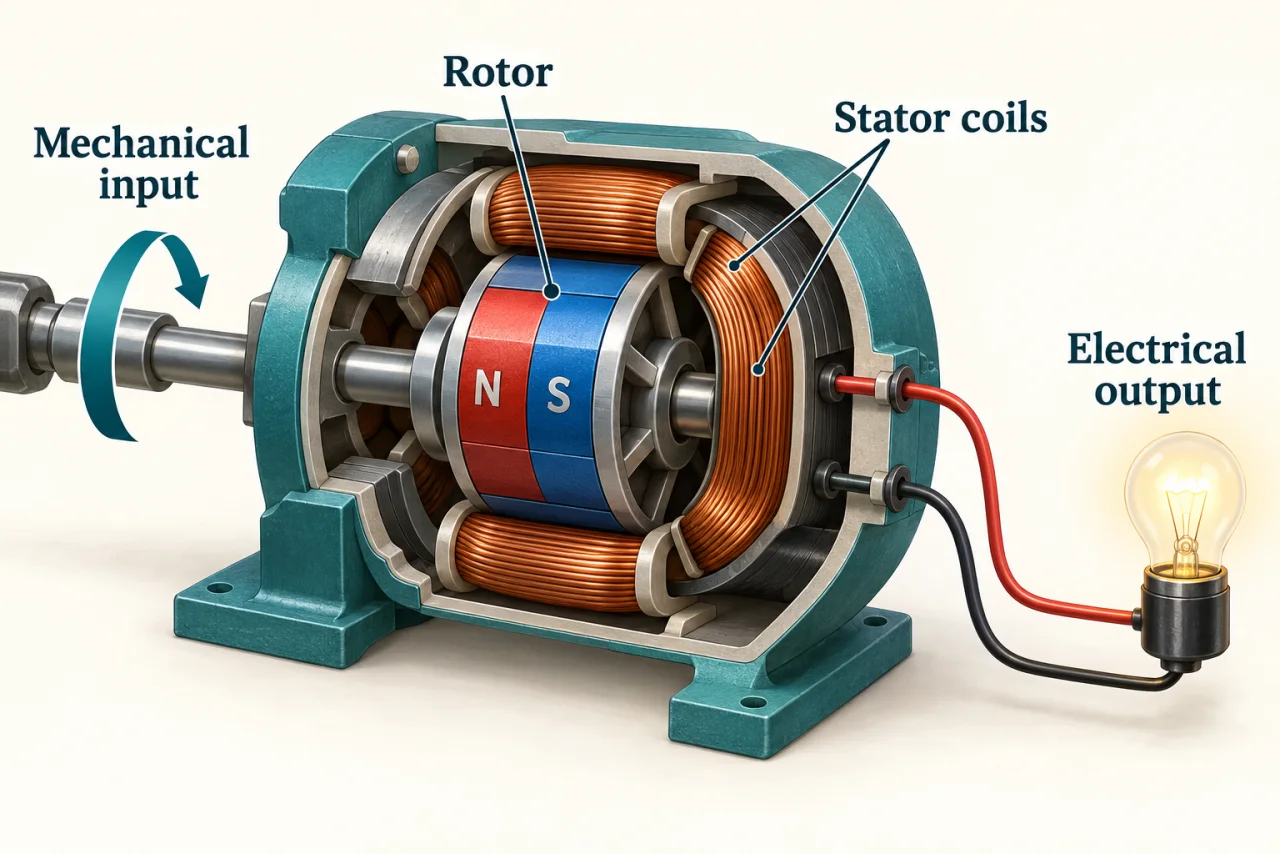
myAudience original rendered teaching illustration. Image: illustration, not a documentary photograph. · Operator-authored generated illustration; scientific model reviewed separately.
Where electricity begins
A generator changes the form in which energy is transferred. A shaft supplies mechanical work; an electrical circuit receives electrical energy. Changing magnetic flux through a circuit induces an electromotive force, or emf. If the circuit is complete, this can drive current. No fuel is created inside the copper wire.
In a simple rotating design, a magnetic rotor moves relative to stationary coils. Real machines use different arrangements, including electromagnets and permanent magnets. The cutaway is one conceptual design, not a universal construction plan. Trace the shaft and the circuit separately: the mechanical connection and the electrical leads do different jobs.
Connecting a load changes the forces acting on the generator. Supplying electrical power requires mechanical input, and resistance, friction and other losses prevent perfect conversion. A generator does not remove the need to ask where its input energy came from.
Consider an invented steady example: a shaft transfers 2, 000 joules each second and the useful electrical output is 1, 600 joules each second. Input power is 2, 000 watts; output is 1, 600 watts. The efficiency is 1, 600/2, 000 = 0.80, or 80%. The remaining 400 watts are transferred elsewhere. These are teaching values, not a product specification.
For a community choosing an electricity source, the generator is only one part of the decision. Ask about maintenance, energy supply, reliability and who can afford the service. Compare the whole system rather than judging only the shiny machine.
Discuss: a community can afford either a cheaper generator with unreliable fuel deliveries or a more expensive system with dependable supply. Which evidence would change your decision? Compare affordability, reliability and burdens on nearby residents; different defensible choices require explicit assumptions and affected people’s views.
Image: illustration, not a documentary photograph.
Worked example: A fictional generator receives 2,000 W of shaft power and delivers 1,600 W electrically. Calculate useful conversion efficiency and power transferred to other outputs.
Useful conversion efficiency = useful output ÷ input = 1,600 ÷ 2,000 = 0.80.
Convert the fraction to 80%.
Other outputs = 2,000 − 1,600 = 400 W; these include heating and mechanical dissipation.
Answer: 80% useful conversion efficiency; 400 W transferred to other outputs.
Check your understanding: A generator receives 3, 000 W at its shaft and supplies 2, 400 W electrically. What is its efficiency and power transferred to other outputs?
Answer: Efficiency = 2, 400/3, 000 = 0.8 = 80%. The difference is 600 W transferred into other outputs such as heating and friction-related dissipation; energy is conserved.
Why: Use the declared system boundary and conserve energy, mass or atoms. The worked example explains the calculation; these are invented teaching values.