More heat delivered than electricity used
By How things work · myAudience
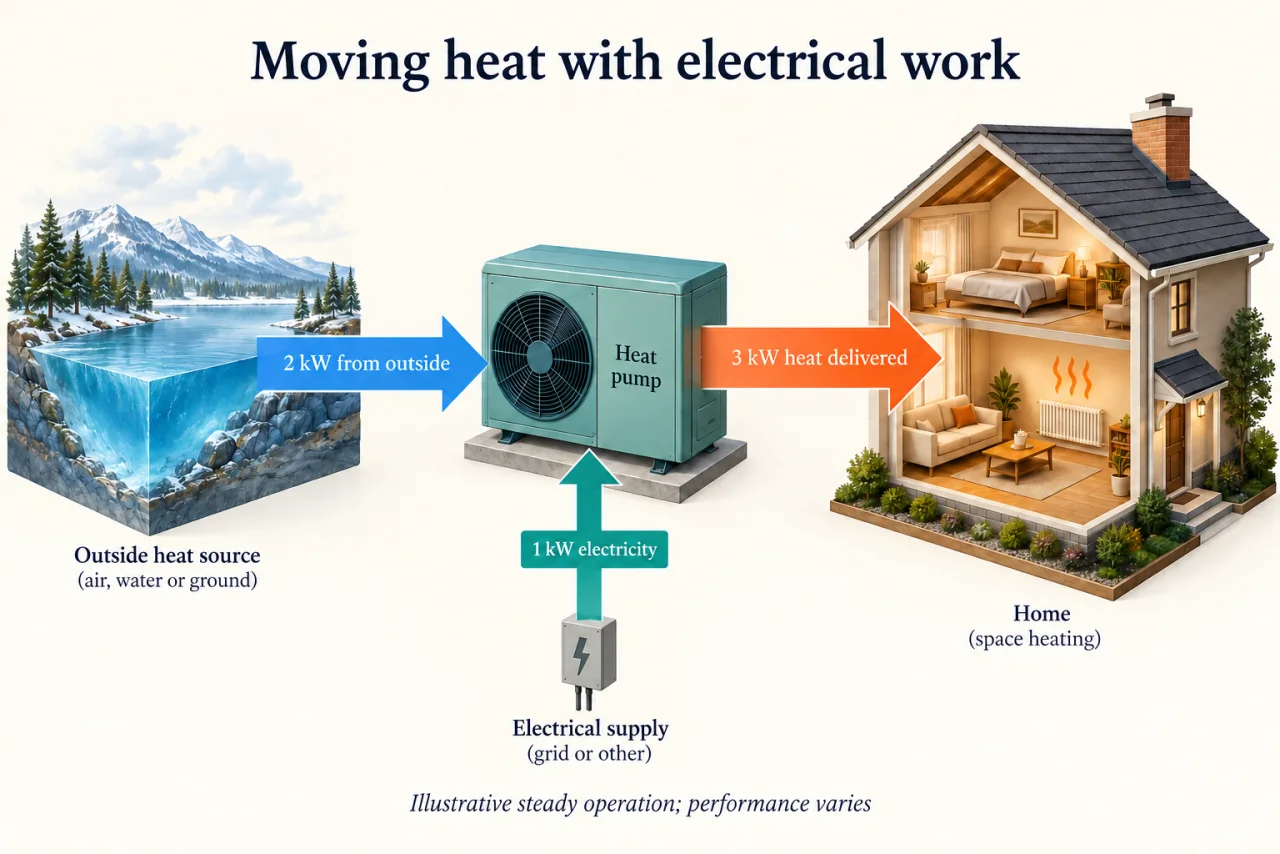
myAudience original rendered teaching illustration. Image: illustration, not a documentary photograph. · Operator-authored generated illustration; scientific model reviewed separately.
More heat delivered than electricity used
A heat pump moves thermal energy from a source to a useful destination. In heating mode, some delivered heat comes from outside the heated building and some from the electrical work needed to move it. The outside source can still provide energy when it feels cold to us.
In a vapour-compression system, refrigerant absorbs heat in an evaporator; compression raises its pressure and temperature; a condenser releases heat; expansion prepares the refrigerant for the low-pressure part of the cycle. These are connected stages, not four independent energy sources.
The heating coefficient of performance, or COP, is useful heat delivered divided by work input over the stated boundary and interval. COP is not the same quantity as a simple generator conversion efficiency. It can exceed 1 because the numerator includes heat transferred from the surroundings. Performance changes with conditions and system design.
The illustration uses an invented steady balance: 1 kW electricity plus 2 kW drawn from the outside gives 3 kW heat delivered. Heating COP is 3/1 = 3. Over two hours, those rates correspond to 2 kWh electricity and 6 kWh useful heat, with 4 kWh transferred from outside. Energy is accounted for rather than created.
A good heating decision considers the climate, building, electricity supply, repair services and household costs. A headline COP from one test condition does not guarantee the same seasonal result for every home. Cooling reverses the desired direction of heat transfer.
Discuss: should heating support prioritise the least efficient buildings or households least able to pay? Consider emissions, comfort, affordability and reliable maintenance. State an alternative that respects a different priority, and explain what evidence would make you reconsider.
Image: illustration, not a documentary photograph.
Worked example: A fictional steady heat pump uses 1 kW electricity and draws 2 kW heat from outside. Calculate delivered heat, heating COP and energy transferred over two hours.
Delivered heat rate = 1 + 2 = 3 kW, neglecting other outputs.
Heating COP = delivered heat rate ÷ work input rate = 3 ÷ 1 = 3.
Energy = power × time: electricity 2 kWh, outside heat 4 kWh, delivered heat 6 kWh.
Answer: 3 kW delivered, COP 3; 2 kWh electricity plus 4 kWh outside heat gives 6 kWh delivered heat.
Check your understanding: A model delivers 4.5 kW heat using 1.5 kW electrical input. Find heating COP and source heat rate, neglecting other outputs.
Answer: COP = 4.5/1.5 = 3. Source heat rate = 4.5−1.5 = 3 kW. This simplified balance excludes auxiliary and other losses; actual comparison requires a declared measurement boundary.
Why: Use the declared system boundary and conserve energy, mass or atoms. The worked example explains the calculation; these are invented teaching values.