Moving water takes a whole system
By How things work · myAudience
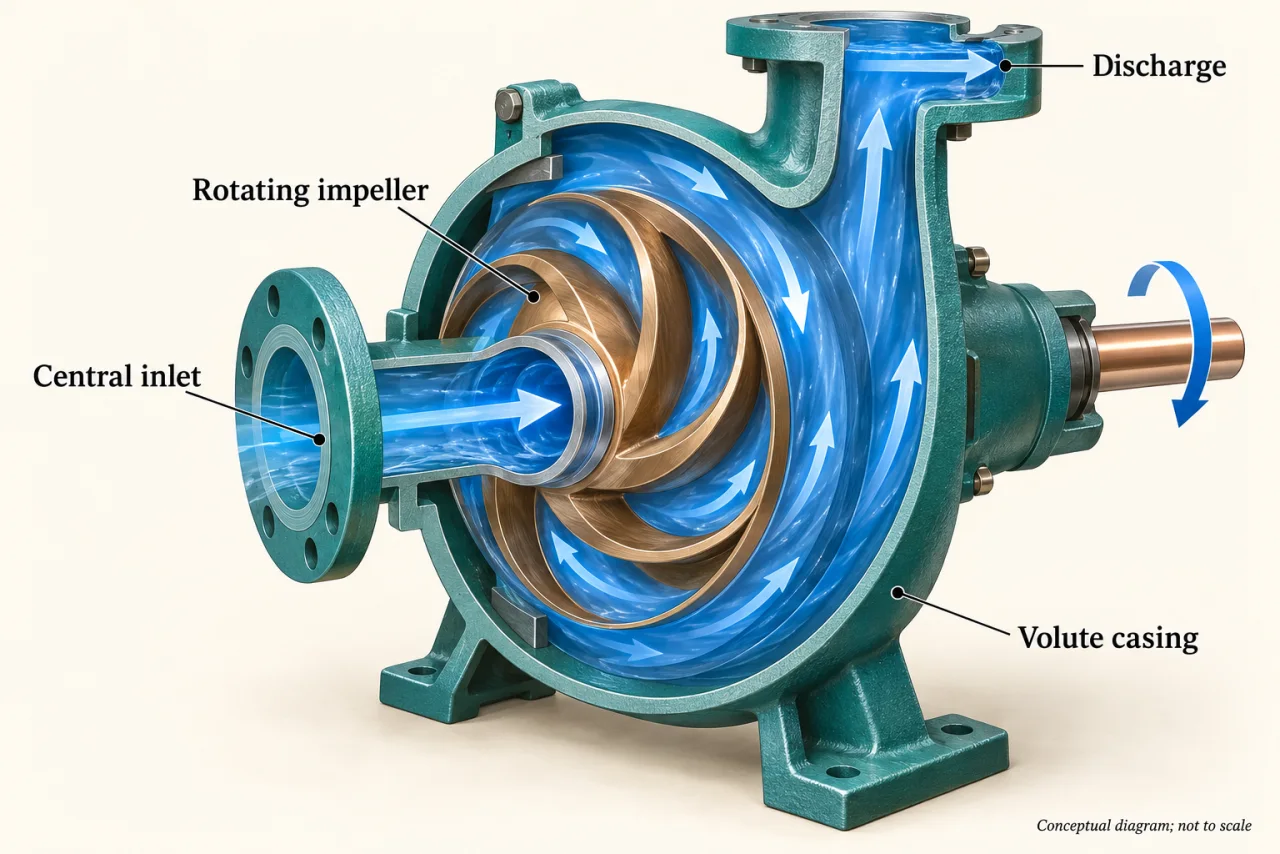
myAudience original rendered teaching illustration. Image: illustration, not a documentary photograph. · Operator-authored generated illustration; scientific model reviewed separately.
Moving water takes a whole system
A centrifugal pump transfers mechanical energy to a liquid. Liquid enters near the eye of the rotating impeller, gains energy as it moves through the blades, and reaches the surrounding casing. Geometry directs the flow and converts part of its velocity energy into pressure-related energy.
Pressure and flow must be considered together. The same pump can deliver different flow rates against different system demands. Pipes, height differences, valves and the required destination affect the operating point. A larger motor is not automatically a better water service.
For a steady incompressible liquid, useful hydraulic power can be written as density × gravity × total head increase × volume flow. In the simplified equal-elevation, equal-speed model used here, it becomes pressure increase × volume flow. A complete design must also account for elevation, velocity and losses. Electrical input must cover motor and pump inefficiencies.
Imagine a teaching system with pressure increase 50, 000 Pa and flow 0.002 cubic metres per second, with other hydraulic terms excluded by the model. Hydraulic power is 50, 000 × 0.002 = 100 W. If electrical input is 200 W, overall useful conversion efficiency is 50%.
Good engineering includes inspection, leak reduction and an affordable way to keep the system working. A water network that cannot be maintained may fail the people it was meant to serve. Discuss choices with users and qualified engineers rather than treating one calculation as a complete design.
Discuss: a village has funds for a larger pump or for repairing leaks and training local maintainers. What measurements and community priorities would justify either option? Weigh dependable access, ongoing costs and who bears failure; avoid assuming the more powerful machine is fairer.
Image: illustration, not a documentary photograph.
Worked example: A bounded pump model increases pressure by 50,000 Pa at 0.002 m³/s. Electrical input is 200 W; elevation and velocity changes are excluded. Find hydraulic power and efficiency.
Hydraulic power = pressure increase × volume flow = 50,000 × 0.002 = 100 W.
Pa × m³/s = (N/m²) × m³/s = N·m/s = W.
Overall efficiency = 100 ÷ 200 = 0.50 = 50%.
Answer: 100 W hydraulic power; 50% overall useful conversion efficiency.
Check your understanding: Under the same simplified model, pressure increase 80, 000 Pa and flow 0.003 m³/s give what hydraulic power? What is efficiency with 400 W electrical input?
Answer: 80, 000 × 0.003 = 240 W. Efficiency = 240/400 = 0.60 = 60%. Pa × m³/s=(N/m²)×m³/s = N·m/s = W. This is a bounded model, not a safe pump selection.
Why: Use the declared system boundary and conserve energy, mass or atoms. For pumps, pressure × flow applies here only because elevation and velocity changes are excluded.