From rock to metal: two different jobs
By How things work · myAudience
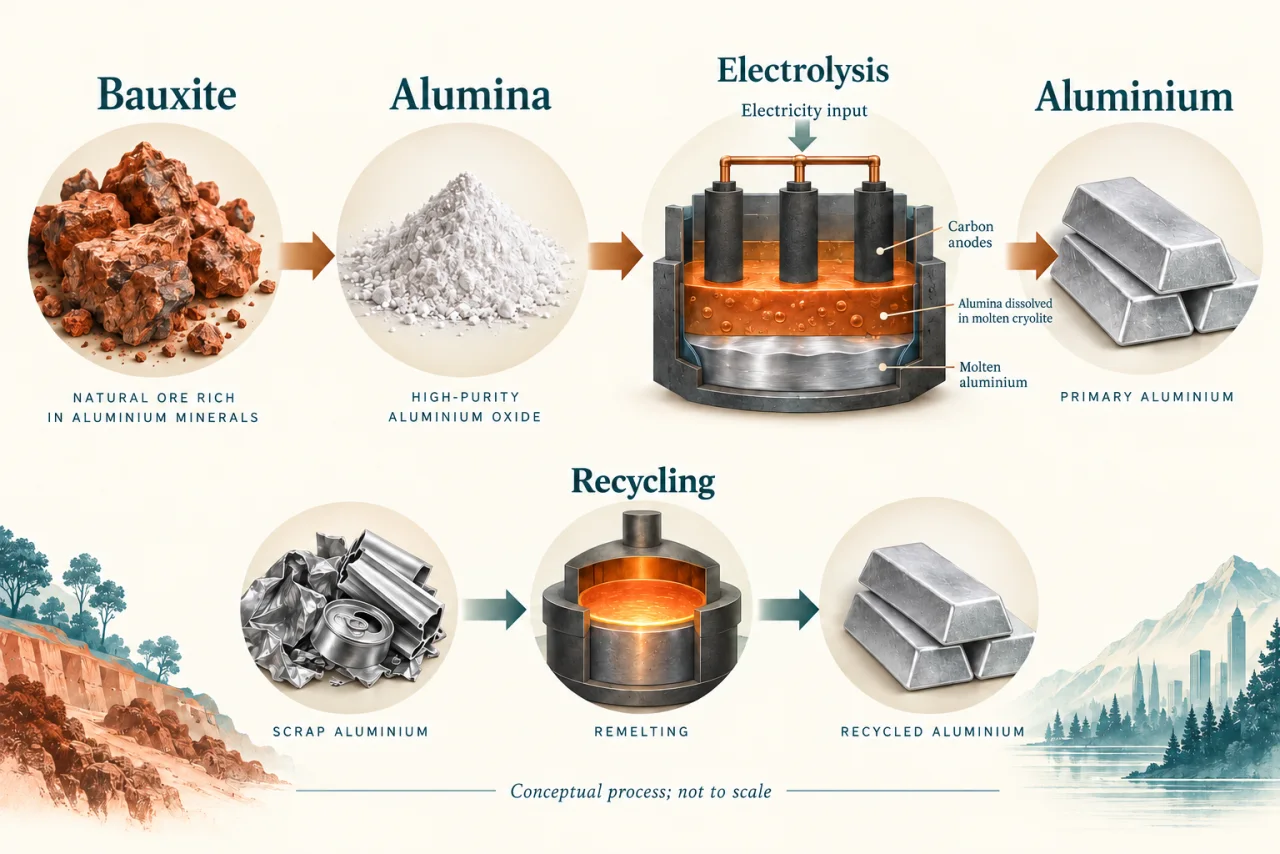
myAudience original rendered teaching illustration. Image: illustration, not a documentary photograph. · Operator-authored generated illustration; scientific model reviewed separately.
From rock to metal: two different jobs
Bauxite is a starting ore for primary aluminium production. Refining it through the Bayer process yields alumina, an aluminium oxide. Alumina is still a compound; it is not the metal in a window frame. The distinction between ore, purified compound and metal prevents a common misunderstanding.
Industrial Hall–Héroult production dissolves alumina in a molten cryolite-based bath and uses electricity to produce molten aluminium. Carbon anodes participate in the conventional process.
Recycling follows a different route: suitable aluminium scrap can be prepared and remelted rather than starting again from ore. Collection, contamination and alloy composition matter. A mixed scrap stream does not automatically provide any desired alloy or product quality.
For an original bookkeeping exercise, suppose a fictional collection contains 100 kg of usable aluminium and 10 kg of foreign material. If sorting removes all foreign material and processing loses 5 kg of aluminium, the recovered metal is 95 kg. Recovery relative to aluminium present is 95%; relative to total collected mass it is 95/110≈86.4%. These describe different denominators, not measured factory performance.
Evaluate extraction and recycling through complete boundaries: mining and refining residues, electricity source, transport, useful life and recovery. Avoid repeating a percentage saving without knowing what process and region it compares. Durable, repairable products and collection systems are social choices as well as technical ones.
Discuss: a recycling programme increases collection but shifts sorting burdens to poorly paid workers. Is higher recovery enough to call it successful? Compare worker safety, fair pay, accessible collection and resource use; explain both a proposed improvement and its possible costs.
Image: illustration, not a documentary photograph.
Worked example: A fictional collection contains 100 kg aluminium and 10 kg foreign material. Sorting removes foreign material; processing loses 5 kg aluminium. Compare two yield denominators.
Recovered aluminium = 100 − 5 = 95 kg.
Recovery relative to aluminium present = 95 ÷ 100 = 95%.
Yield relative to all collected material = 95 ÷ 110 ≈ 86.4%.
Answer: 95 kg recovered; 95% aluminium recovery and approximately 86.4% whole-batch yield.
Check your understanding: A hypothetical batch contains 80 kg aluminium plus 20 kg other material. All other material is removed; 4 kg aluminium is lost. What metal remains and what is aluminium recovery?
Answer: 76 kg aluminium remains. Recovery relative to initial aluminium is 76/80 = 95%. Yield relative to total collected material is 76/100 = 76%; these measures must not be confused.
Why: Use the declared system boundary and conserve energy, mass or atoms. The worked example explains the calculation; these are invented teaching values.