Why titanium metal needs careful processing
By How things work · myAudience
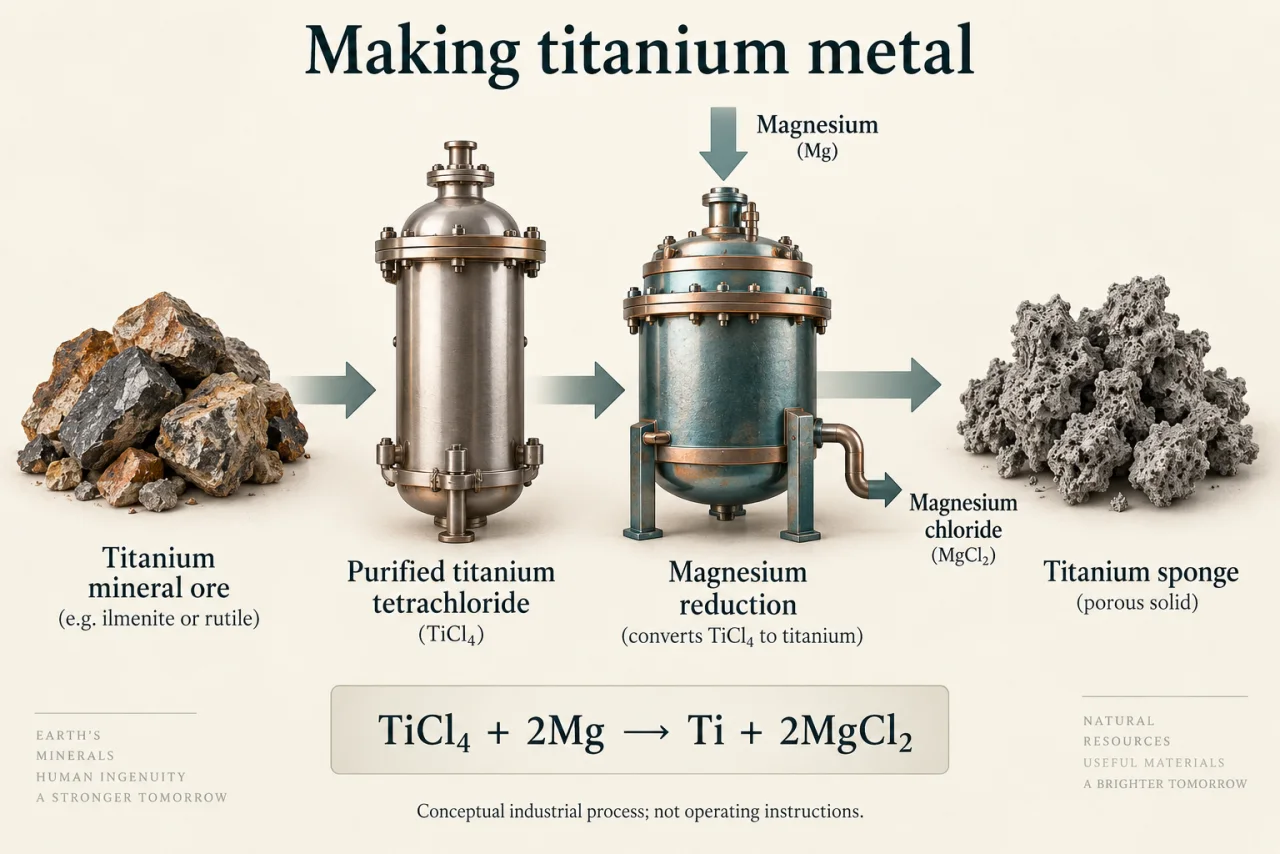
myAudience original rendered teaching illustration. Image: illustration, not a documentary photograph. · Operator-authored generated illustration; scientific model reviewed separately.
Why titanium metal needs careful processing
Titanium-bearing minerals contain titanium combined with other elements. Producing titanium metal is a different industrial objective from producing titanium dioxide pigment. A white pigment and a metal aircraft component must not be labelled as interchangeable products.
An established metal-production route is the Kroll process: purified titanium tetrachloride is reduced using magnesium to produce titanium, with magnesium chloride as a reaction product. The resulting porous material is called titanium sponge. Further processing is required to make suitable metal products.
The simplified balanced reaction is TiCl₄+2Mg → Ti+2MgCl₂. Count atoms: there is one titanium on each side, four chlorine atoms on each side, and two magnesium atoms on each side. Balancing states a conservation relation, not a set of safe processing conditions.
For an original symbolic exercise, three TiCl₄ formula units require six magnesium atoms in this ideal reaction ratio and produce three titanium atoms plus six MgCl₂ formula units. This is particle bookkeeping. It is not a measure of industrial recovery or purity.
Why choose titanium? An application may value a particular combination of mass, strength and corrosion behaviour, but selection must compare the alloy, service conditions, cost and processing burden. A material is not automatically the best choice because its name sounds advanced. Quality control and reliable repair matter to long-lived products.
Discuss: when should a designer choose a costly, durable titanium alloy rather than a cheaper alternative? Weigh material suitability, repair, service life and who can afford the product. An ethical answer explains trade-offs and evidence rather than declaring one material universally superior.
Image: illustration, not a documentary photograph.
Worked example: Use TiCl₄ + 2Mg → Ti + 2MgCl₂ to account for three titanium tetrachloride formula units.
The balanced equation requires two magnesium atoms for each TiCl₄ formula unit.
Three TiCl₄ formula units therefore require six magnesium atoms.
Products are three titanium atoms and six MgCl₂ formula units: Ti 3, Mg 6 and Cl 12 are conserved.
Answer: Six Mg atoms; three Ti atoms and six MgCl₂ formula units. This is symbolic atom accounting.
Check your understanding: In the balanced symbolic reaction, how many Mg atoms are required for five TiCl₄ formula units, and why is Ti+4MgCl₂ not a balanced product set?
Answer: Ten Mg atoms are required by the 2: 1 ratio. Ti+4MgCl₂ contains eight chlorine atoms, whereas one TiCl₄ contains four, so it cannot balance that reactant without changes elsewhere. The coefficients preserve atoms; no experimental quantities or operating procedure are provided.
Why: Use the declared system boundary and conserve energy, mass or atoms. The worked example explains the calculation; these are invented teaching values.