From an idea to a chip layout
By How things work · myAudience
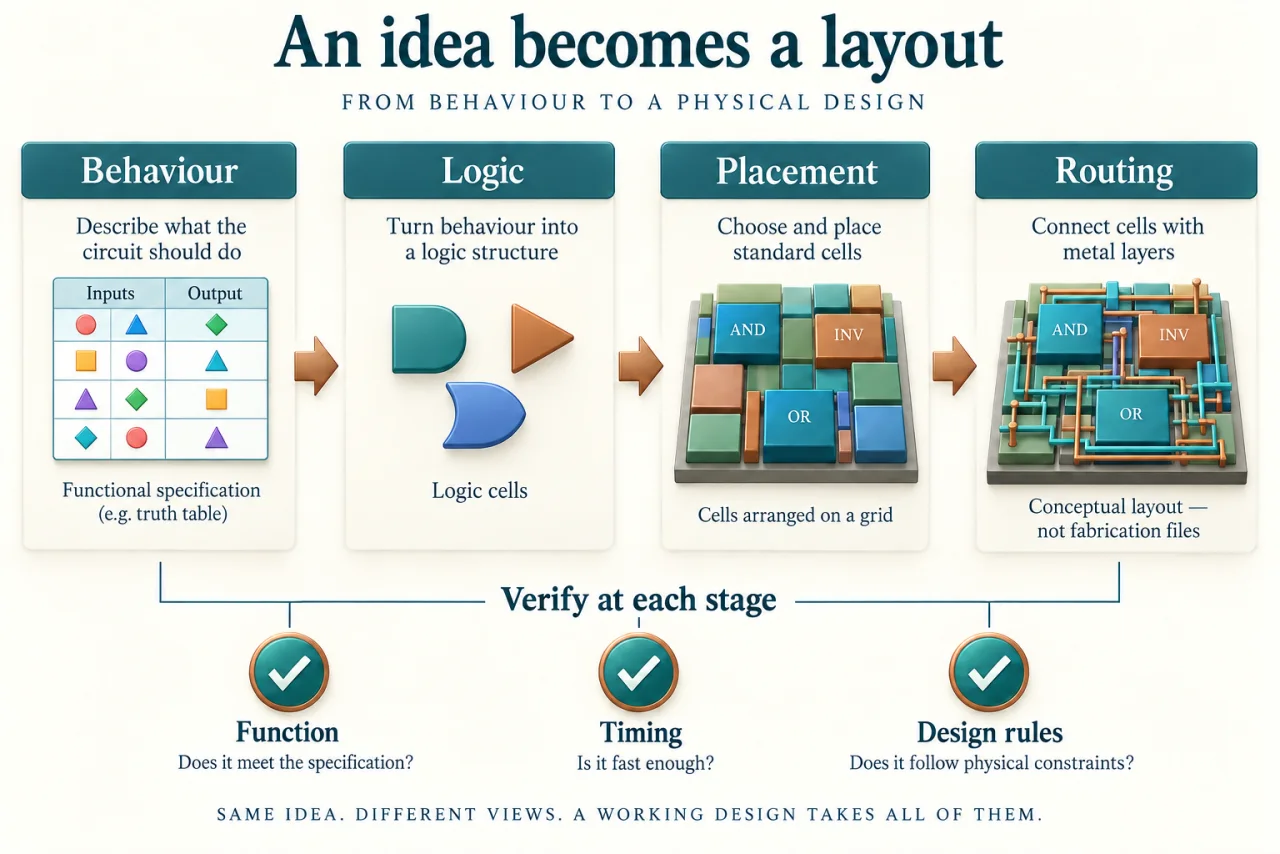
myAudience original rendered teaching illustration. Image: illustration, not a documentary photograph. · Operator-authored generated illustration; scientific concept model reviewed separately.
From an idea to a chip layout
Chip design begins with a need: what must a circuit do, how quickly, within what power and area limits? A behaviour description must handle inconvenient cases too. Stating “make it faster” is not enough to determine a circuit.
A designer can describe digital behaviour in a hardware description language. Synthesis maps that description into a network of permitted logic cells. Placement chooses locations, and routing supplies physical connections. OpenROAD’s documented flow separates synthesis, physical design and layout checks; these are related jobs, not synonyms.
Functional verification asks whether behaviour matches intent. Timing analysis asks whether signals arrive within constraints. Design-rule checking tests geometric manufacturing restrictions; layout-versus-schematic checks compare intended and extracted connectivity. Passing one category does not automatically pass the others.
Foundry process information, cell libraries and constraints shape what is possible. Wires have delay and consume space. A circuit can be logically correct yet fail timing or physical rules. Iteration is ordinary engineering, not proof that verification was unnecessary.
Established design tools generate real layout files, but the artwork here is a conceptual progression. It is not validated RTL, a netlist, a process-design kit or a tape-out. Experimental automatic design methods must be evaluated with the same functional and physical obligations.
Discuss: a cheaper design meets its stated speed but is difficult to repair or support. Which lifetime commitments should influence approval? Consider affordability, maintenance, honest claims and people who rely on the device.
Image: illustration, not a documentary photograph.
Worked example: A toy two-input AND function is proposed. Check all four binary input pairs.
For 00, output must be 0.
For 01 and 10, output must be 0.
For 11, output must be 1. These four cases check this truth table, not physical timing.
Answer: Expected outputs in order 00, 01, 10, 11: 0, 0, 0, 1.
Check your understanding: A layout passes geometric design-rule checking. Can you conclude that it implements the intended function and meets timing?
Answer: No. Functional, connectivity and timing checks remain separate obligations.
Why: A geometric rule check answers a different question from behavioural verification or delay analysis.