Why many computers need coordination
By How things work · myAudience
myAudience original rendered teaching illustration. Image: illustration, not a documentary photograph. · Operator-authored generated illustration; scientific concept model reviewed separately.
Why many computers need coordination
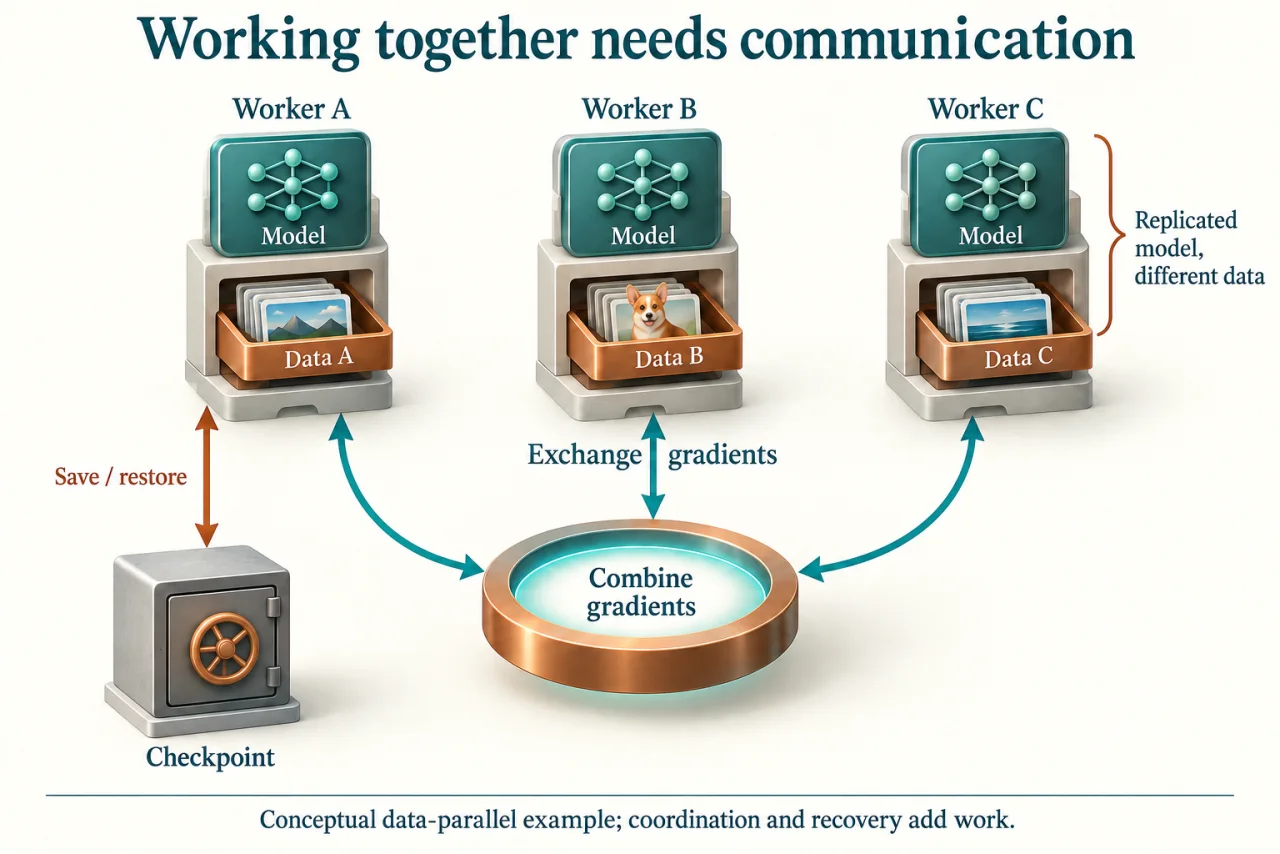
More computers create possibilities, not automatic speedup. In a simple data-parallel arrangement, workers hold replicas of a model and process different examples. Their computed gradients must be combined consistently before equivalent parameter updates keep the replicas aligned.
The illustration shows a conceptual exchange, not a required physical network topology. PyTorch’s distributed-data-parallel documentation describes gradient synchronisation and coordinated execution. A worker arriving late can make others wait; communication and uneven workloads reduce ideal gains.
Model parallelism instead splits a model across resources. It has different data-transfer and scheduling needs and can coexist with data parallelism. Describing both as “just divide the work” hides the important question of what must move and when.
A checkpoint records information needed to resume. Saved model weights alone may omit optimiser, random-number and progress state required for an equivalent continuation. Distributed recovery also needs agreement about which saved state is complete and accessible; a partially written file is not a reliable recovery point.
Distributed training is established, with implementation-specific scaling and recovery limits. New interconnects or algorithms require measured evidence. A fair comparison includes useful work, synchronisation, failures and energy rather than reporting processor counts alone.
Discuss: is a marginal improvement worth a much larger computing budget? Explain the task’s benefit, who gets access and what resource use is justified. Offer a defensible alternative involving a smaller model or more careful evaluation.
Image: illustration, not a documentary photograph.
Worked example: A fictional workload takes 40 s on one worker. Assume four workers divide computation perfectly, but add 6 s of communication. Estimate total time and speedup.
Ideal divided computation = 40 ÷ 4 = 10 s.
Add communication: 10 + 6 = 16 s.
Speedup = 40 ÷ 16 = 2.5, less than the ideal factor of four.
Answer: 16 seconds; 2.5× speedup under the invented model.
Check your understanding: Two equal-sized workers produce scalar gradients 2 and 4. If the agreed reduction is an equal-weight mean, what gradient should both use?
Answer: 3.
Why: (2 + 4) ÷ 2 = 3. The reduction rule and sample weighting must be explicit; a sum would be a different convention.