Power, heat and responsibility behind AI
By How things work · myAudience
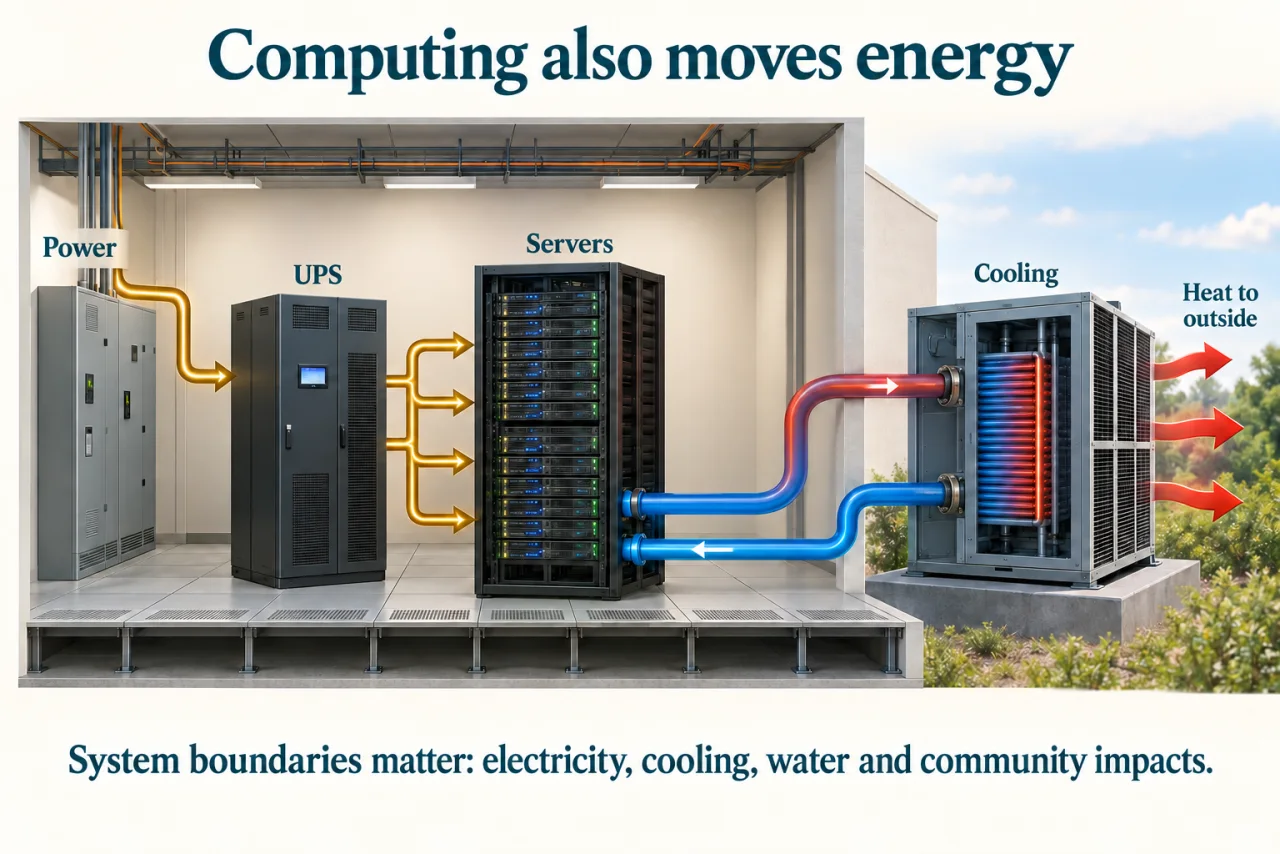
myAudience original rendered teaching illustration. Image: illustration, not a documentary photograph. · Operator-authored generated illustration; scientific concept model reviewed separately.
Power, heat and responsibility behind AI
An AI service runs inside a physical system: processors, memory, storage and networks depend on electrical distribution and heat removal. A useful boundary includes supporting equipment, not just the component doing arithmetic. Hardware reliability and responsible use are connected questions.
An uninterruptible power supply can support continuity during a supply interruption. It does not create free energy or guarantee unlimited runtime. Berkeley Lab’s design guide distinguishes electrical distribution and backup arrangements and notes their losses; requirements vary with the service being protected.
Air or liquid can transport heat away from components. A liquid loop must eventually reject that heat through another boundary. A closed loop does not make heat vanish, and cooling equipment itself uses power. Not every liquid-cooled design consumes water in the same way.
Compare energy, water, emissions and service quality separately. A favourable ratio can hide a large absolute total or shift impacts elsewhere. The guide describes established cooling approaches; particular deployments and experimental alternatives still require climate, materials and operating evidence.
Responsible infrastructure also asks who the service affects. NIST’s voluntary AI risk framework treats design, development, use and evaluation as opportunities to manage risk. Benefits, privacy, accessibility and failure consequences should influence what is built, rather than being added after capacity is purchased.
Discuss: a proposed data centre brings jobs and useful services but draws on a constrained local supply. What evidence and community participation should shape approval? Compare fair access, reliable electricity, water impacts and alternatives; reasonable people may weigh them differently.
Image: illustration, not a documentary photograph.
Worked example: An invented system uses 100 kW for IT and 20 kW for supporting electrical and cooling equipment. Calculate whole-boundary input and the facility-to-IT ratio.
Total input = 100 + 20 = 120 kW.
Facility-to-IT ratio = 120 ÷ 100 = 1.20.
Over 2 hours, whole-boundary energy = 120 × 2 = 240 kWh. This says nothing by itself about water use or carbon intensity.
Answer: 120 kW total, ratio 1.20 and 240 kWh over two hours; invented boundary-specific values.
Check your understanding: A fictional cooling redesign reduces supporting power from 20 kW to 10 kW while IT stays at 100 kW. What is total power, and does this prove zero environmental impact?
Answer: 110 kW; no. Electricity source, absolute use, materials and water remain relevant.
Why: 100 + 10 = 110 kW. One efficiency improvement does not answer every lifecycle or societal question.